
The 10-Second Rule for Better Maps
This post is the written version of the video tutorial on the Red Quills YouTube channel.
You’ve just finished a gorgeous fantasy map. You’ve spent hours on it - sketching coastlines, placing mountains, choosing the perfect parchment texture. Maybe it’s for your D&D campaign, maybe it’s part of a book you’re writing, or maybe it’s just for fun.
You drop it on the table for your players to admire… and the first thing they do?
They flip it sideways. Then upside down. Then someone squints and says, “Wait, where’s the capital city?”
And just like that, the magic slips.
Pause.
That’s where the 10-Second Rule comes in.
It’s a simple test, but it fixes a huge number of common map design problems. Whether you’re mapping a continent, a dungeon, or a single sleepy village, this one rule can seriously improve how people experience your world.
Today, I’ll show you what the rule is, why it matters, and how to make sure your maps pass the test. It might just change the way you design fantasy maps forever. You can also watch the full tutorial here, or read more at the Red Quills Journal.

The Rule Explained
So let’s break it down.
The 10-Second Rule is this:
A user should be able to locate any major point of interest - like a capital city, a dungeon, or a region name - within 10 seconds of looking at your map.
That’s it. Just ten seconds.
If they can’t find it in that time, your map isn’t failing aesthetically - it’s failing functionally.
And this rule isn’t just for world maps. It applies whether your map is:
- Hand-drawn or digital
- World-scale or zoomed in on a single town
- Designed for players, readers, or even game developers
Because clarity matters at every level. A beautiful map that no one can read? That’s art, maybe. But it’s not a usable map.
This rule is especially important in game maps - where players are under pressure, tracking goals, remembering clues, and moving fast. But it’s just as valuable for novel maps, because your readers aren’t memorizing your world - they’re referencing it while immersed in your story. Make that reference hard to use, and the story takes a hit.
So remember: the 10-Second Rule isn’t about being flashy. It’s about being readable. Usable. Instinctive.
In short: it’s not about being pretty - it’s about being useful.

Why It Matters
So why is this rule such a big deal? Why are ten seconds so important?
Because maps are tools. Even the most ornate, illustrated, gilded corner-of-the-scroll maps serve a purpose: they help people understand space. They help players make decisions. They help readers imagine scenes. And they help DMs create moments of tension, foreshadowing, or discovery.
But none of that works if people can’t find what they’re looking for.
If your rogue has to squint at your map for 30 seconds to find the vault marked on it, you’ve already lost the tension. The pacing stutters. The scene stalls. And your carefully-laid plans? They go out the window.
You might hear things like:
- “Wait, which direction is the temple again?”
- “Is this dot a village or a mountain?”
- “Where did you say the ferry docked?”
And the problem isn’t the players - it’s your map.
A confusing map can break immersion faster than a bad accent. It turns what should be an exciting moment - the party sees the Black Spire rising on the horizon - into an argument about labels and orientation.
It also costs you as a worldbuilder. If a key location is hard to find, you lose a chance to guide your players or readers. You can’t plant a seed, tease a twist, or create curiosity around a mysterious location - because they never even noticed it was there.
On the other hand, when your map is easy to read?
- People engage more.
- They navigate faster.
- They start asking better questions.
- And they make smarter, more intentional choices.
In other words: clarity fuels immersion.

Real Examples (Bad to Good)
Let’s look at how this plays out in practice.
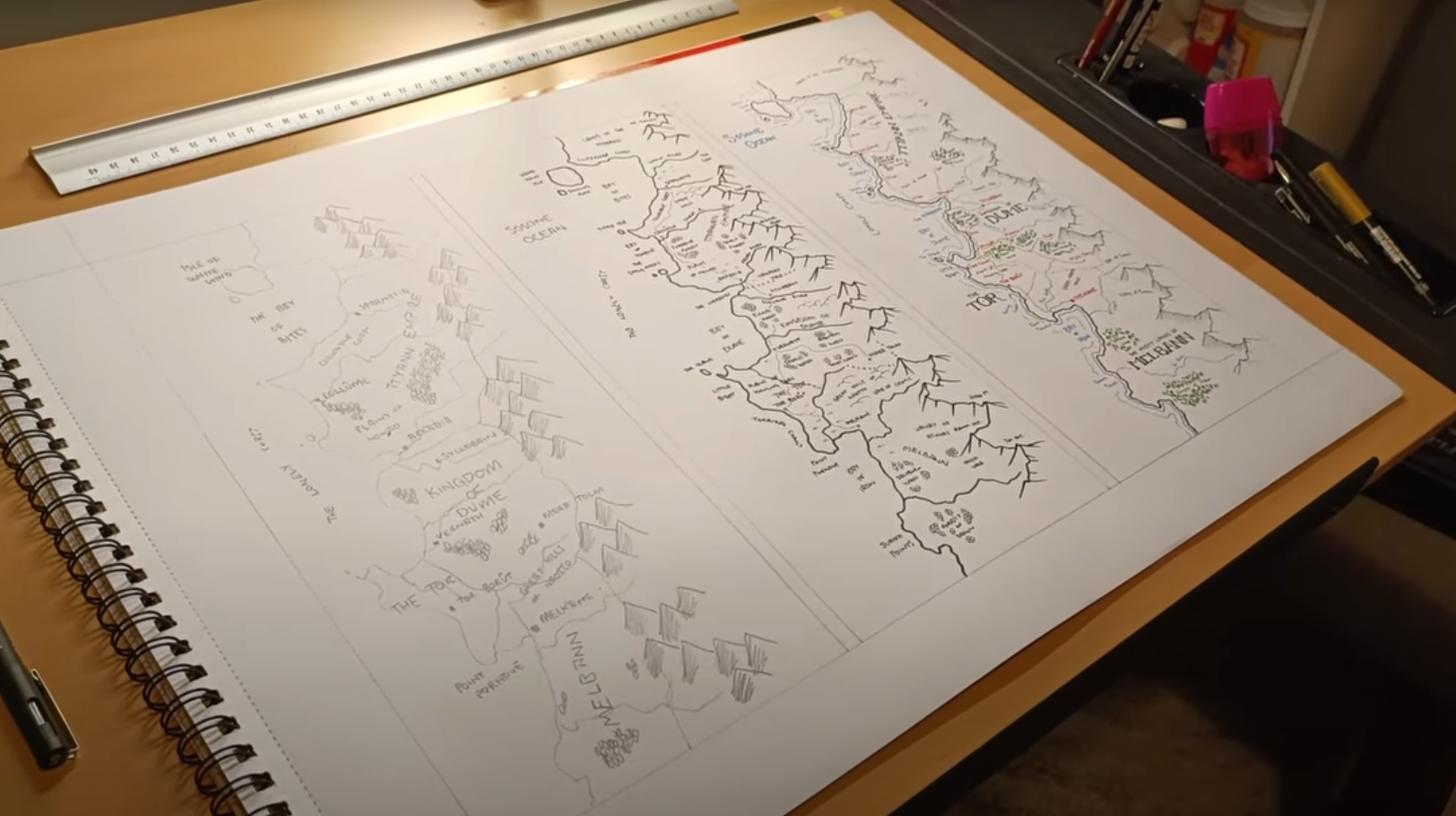
Imagine I’m making a fantasy region map. It’s meant for players in a campaign - but it could just as easily be the front of a novel or a world wiki.
Let’s go through three versions of the same basic map and see how they stack up.
Version One: The Messy Map
This one’s got nice linework, but the layout’s cluttered. There are forests and rivers everywhere, but no labels. Or maybe there are a few, but they’re tiny and hidden in curls of text. You can’t tell which town is the capital, and the compass rose is weirdly in the middle of the sea.
This map fails the 10-Second Rule. The eye has nowhere to land. It’s all noise.
Version Two: The Overloaded Map
Now we’ve added labels - but too many. Every village, road, and landmark is labeled, and they’re all the same size and style. There’s no visual hierarchy, so nothing stands out.
It’s better, but you still can’t find the important stuff quickly. Everything looks equally important - so nothing is.
Version Three: The Functional Map
Here, we’ve fixed the hierarchy. The capital has a larger label and a unique icon. Other major cities are labeled clearly but in smaller type. Roads create visual flow, and colors create contrast. There’s white space around key regions, and icons are used consistently.
Now, when someone looks at the map, their eye is drawn to the important things. You could find the capital in under five seconds without even trying.
Pro Tip:
It’s not just where things are - it’s how quickly your eye can find them. Design is about guiding attention.
Use:
- Color: Brighter or bolder hues for emphasis
- Spacing: Don’t cram everything in one area
- Iconography: Unique symbols for different places - just be consistent
Maps aren’t just pictures. They’re visual language.

How to Fix It: Design Principles
Okay, so how do you actually make a map pass the 10-Second Rule?
Here are the core design principles I use - and recommend for anyone trying to improve clarity in their fantasy maps.
Label Hierarchy
Not every label is equal. Major locations - like capital cities, central regions, or world wonders - should be larger, bolder, or more decorative than lesser ones.
Use size, font weight, or even style to show importance at a glance. If your players need to read every label to find the big ones, you’ve already lost them.
Contrast
This is huge. If your text is black and your forest is dark green… guess what? Your text disappears.
Make sure there’s enough visual contrast between labels and background elements. Light forests, lighter mountains, subtle shading - anything that keeps the words readable.
If you’re unsure, print your map in black and white and see what gets lost. If it’s illegible in greyscale, it probably needs contrast help.
Whitespace
Let key areas breathe. Don’t put labels directly on top of lines. Leave some room around important locations so they stand out.
A busy map with no negative space looks overwhelming and discourages exploration. Clean, simple layouts invite curiosity.
Visual Anchors
These are big, recognizable features - like coastlines, rivers, mountain ranges, or huge landmarks - that help people get their bearings fast.
Anchors are how we orient ourselves. “Oh, the capital is just north of that mountain range.” That kind of recognition is what makes maps feel intuitive.
Consistent Iconography
If you use a little tower icon for towns, use it every time you mark a town. If temples get a star, don’t swap it halfway through for a triangle.
Consistency trains your users to read your map correctly.
It also saves you time in the long run - you don’t have to keep explaining things.
Pathfinding
People move across your map - whether in a story or a game - so give them paths.
Show roads, trails, rivers, or even suggested routes. These help readers and players imagine how people travel in your world and how long it might take.
They also naturally guide the eye across the page.
Bonus Aside:
If the party can’t find the evil tower… they won’t defeat the evil wizard. And that’s your fault. Don’t be the reason the world stays evil.
Bonus Tips + Map Styles
Let’s talk about a few extra tips - and how different map styles handle the 10-Second Rule.
Pictorial maps, where landmarks are illustrated directly on the map, often pass this rule naturally. Why? Because big landmarks are big visuals. A giant castle icon? That’s hard to miss.
Isometric maps also do well - because they often separate terrain and labels more clearly, and they naturally create depth and direction.
But here’s the catch:
Over-designed parchment maps - with super textured backgrounds, aged scroll effects, and handwritten fonts - can fail the rule easily. Especially if clarity gets sacrificed for style.
These maps look gorgeous, but if the text blends into the background or the icons are too ornate to read… your players are stuck again.
And here’s something mapmakers sometimes need to hear:
Don’t be afraid to move things for clarity.
If the city would realistically be at the delta of two rivers but that area is cramped and crowded on your map? Move it a little.
Because clarity isn’t the enemy of immersion - it’s how immersion happens. A player who instantly finds a place is a player who’s already inside your world.

Challenge + Wrap-Up
So let’s recap.
The 10-Second Rule is a tool - not a law. But it’s one that helps every kind of fantasy mapmaker, from beginner to pro.
It’s not about rigid standards. It’s about making sure your work does its job - that people can explore your world without getting lost before they even set foot in it.
Challenge for you:
Go pull up your favorite map - whether it’s one you’ve drawn, one from a module, or one from your favorite fantasy series.
Set a timer. Ten seconds.
Can you find the capital city?
If not… maybe it’s time for a redesign. Or at least a tweak. It could be as simple as a bold label or an icon that stands out.
And I’d love to hear from you:
What’s the hardest thing to find on your maps?
Is it a landmark, a dungeon, a road? Let me know in the comments.
Next time, we’re talking about Tolkien, and his influence and lessons in fantasy mapmaking.
Thanks for watching - and happy mapmaking.