
Adding Adventure Primers to your Fantasy World
This post is taken from the episode Make Your Fantasy World Come Alive with These Simple Tricks on the Red Quills YouTube channel.
You’ve poured dozens, maybe hundreds of hours into it. You’ve shaped every coastline, raised every mountain, and drawn every river. Your fantasy map is a masterpiece. It's detailed, it's gorgeous, it's huge. And… it's completely dead. It’s a pretty picture, a beautiful backdrop, but it doesn’t do anything. You’ve made a museum piece, but what you really wanted was a playground.
You know the feeling, right? You roll the map out for your players, or maybe you just stare at it, hoping for a spark of inspiration, and you get… beautiful silence. The map shows you where things are, but it doesn't tell you what’s happening there. It's the classic worldbuilder's trap: creating a world as wide as an ocean but as deep as a puddle. The geography is all there, but the life - the stories, the conflicts, the actual adventures - is missing.
And that’s a huge problem. For Game Masters, it means every single session starts with a mountain of prep, just trying to spin quests out of thin air because the map itself offers nothing. It’s a fast track to burnout. For writers, it creates a static set that characters just move through, not a dynamic world that pushes back and engages with them.
You can watch this full video on the channel: The Red Quills YouTube
Or read more on the blog here: The Red Quills Journal
For your players and readers, the map is just something to look at, not to explore. There’s no pull, no reason to ask, "what's over that next hill?" because the answer is probably… just more beautifully rendered, empty hills. All that incredible potential, everything you poured your passion into, is locked away.
But what if there was a simple, powerful way to change all that? A method to systematically inject life, mystery, and instant adventure into every corner of your atlas. A technique to turn any landmark, from the tiniest village to the most imposing fortress, into an immediate, actionable quest. I call them Adventure Primers. And by the end of this, you’ll know exactly how to use them to transform your static atlas into a living, breathing world that’s begging to be explored.

Why A Good Map Isn't Enough
Let’s really dig into this for a second, because you can't fix a problem until you really understand it. The core issue is that a map is just geographic data. It’s an arrangement of symbols and lines, not a story. We, as creators, fall into this trap of believing that if we just make the map detailed enough, the stories will magically pop out. We think that if we name every river and forest, the adventures will just write themselves.
But they don’t. What happens instead is this kind of creative paralysis. You look at the "Duchy of Virhurst" and think, “Okay… so what happens here?” You see the city of Shallowport, and you know it’s a port on the coast. But what’s the story? Is a corrupt harbormaster skimming money off every ship? Is a sea monster attacking the fishing fleet? Could a smuggler's guild be using ancient sea caves under the cliffs?
The map doesn't tell you.
So you have to invent it all from scratch, every single time. This is exactly why so many campaigns and stories start in a tavern. The tavern is a safe, enclosed space where the GM or writer can control everything and just hand over a quest hook. It’s a retreat from the overwhelming emptiness of the world map. Players get funneled from one plot point to the next, and the world starts to feel less like an open sandbox and more like a series of disconnected rooms. The journey between those points becomes dead air because nothing is happening in between.
This creates a subtle but really damaging disconnect. Players look at the map and see a dozen cool-sounding places - The Sunderking’s Barrow, the ruin of Tol Fallent, the Wither Watch - but they have no reason to go to any of them. There's no hook. Their experience of the world becomes passive. They just wait to be told where the next "quest hub" is. They stop seeing the map as a field of opportunities and start seeing it as a glorified loading screen.
And for you, the creator, this is exhausting. It feels like you’re on a content treadmill, constantly having to churn out new plots just to keep things moving. The world you built to inspire you has become a burden you have to constantly prop up. The joy of creating gets buried under the pressure of production.
We need to change the map from a passive document into an active participant in our storytelling. We need to embed the "so what?" into the geography itself. And that is exactly what an Adventure Primer is for.

Introducing the Adventure Primer
So, what is an Adventure Primer? Put simply, it’s a short, concise, and super-structured block of info that you tie directly to a specific spot on your map. Think of it like a micro-adventure module or a one-page dungeon in prose form. Its goal isn't to write out an entire quest, but to give you the key ingredients - the seeds of an adventure - that you can grow in the moment.
The magic of the primer is its brevity. This isn't about writing a novel for every dot on the map. It's the opposite: you want to boil down a location's potential for conflict into a format you can read and absorb in under a minute. It’s the cure for creative paralysis because it lowers the bar for what a "finished" idea looks like. You're not building a whole house; you're just making one really good brick. And once you have a pile of good bricks, building the house gets a whole lot easier.
How to Use Them
You keep these primers with your atlas. Maybe that’s a physical binder with your printed map, or even better, a digital tool like a personal wiki or a worldbuilding app like World Anvil or Legendkeeper. There, you can link your primers directly to pins on an interactive map. Imagine clicking on a mountain range and getting a little pop-up with a perfectly encapsulated adventure seed, ready to go. That's the power we're aiming for.
This system completely changes your relationship with your world. Your atlas goes from being a static image to a database of adventure. A player points to some ruins on the edge of a swamp? You click the pin, and you’re ready. They decide to take a random detour through a forest you haven't thought about in months? You find the primer for it, and suddenly that forest is buzzing with danger and opportunity.
It helps you improvise. It slashes your prep time. And most importantly, it makes your world feel deep, cohesive, and alive. Every single location, no matter how small, has a story. The world is no longer a silent backdrop; it’s a chorus of voices, and every one is singing a song of potential adventure.

The Philosophy of the Primer
Before we get into the nitty-gritty of writing a primer, we need to talk about the core ideas that make them work so well. This is more than just filling out a template; it's about adopting a mindset that puts usefulness and inspiration above exhaustive detail.
Brevity over Bloat
The first and most important principle is Brevity over Bloat. The number one enemy of a useful adventure primer is too much detail. We are not writing a sourcebook. We are not writing a novel. A primer is a spark, not a bonfire. A classic worldbuilding mistake is to front-load every location with pages of history, convoluted family trees, and detailed descriptions of architecture. That stuff can be interesting, but it's often useless when you're actually playing or writing. It's lore for the sake of lore.
A primer, on the other hand, is ruthlessly practical. Every single thing in it has to create immediate, playable conflict or intrigue. If a bit of history doesn't create a hook, a threat, or a reward, it gets cut. This idea is heavily inspired by the One-Page Dungeon concept, where the tight space forces you to focus only on what's essential and actionable. We want that same efficiency. A good primer should be something you can digest in 30-60 seconds.
Inspiration, Not Prescription
The second principle is Inspiration, Not Prescription. A primer gives you prompts, not a script. It should present a situation, not a linear plot. For example, instead of writing, "The players must kill the goblin chief to get the stolen amulet," a primer would say something like: "The goblin chief has a powerful amulet he doesn't understand. A local merchant wants it back for a reward, but a desperate shaman in the tribe thinks the amulet is the only way to save her people from a magical plague."
See the difference? The first one is a railroad. The second is a situation bursting with potential choices. The players could fight the chief, steal the amulet, try to negotiate, side with the shaman, or even look for a cure to the plague themselves. The primer gives you the actors (chief, merchant, shaman), the object (the amulet), and the conflicting goals. It doesn't tell you what has to happen. This gives you total flexibility to react to what your players or characters do, which makes the story feel way more collaborative and emergent.
Modularity and Connection
The third principle is Modularity and Connection. Each primer should work as a self-contained, standalone encounter. You should be able to drop it into any game or story for a quick adventure. But the real magic happens with the final piece of every primer: the Lore Tie-in. This is where you weave your world together.
Maybe that weird amulet from the goblin cave has the symbol of a long-dead empire whose ruins are on the other side of the continent. Maybe the merchant who wants it is secretly working for a political faction you've already established somewhere else. These little connections are what turn your world from a bunch of random dungeons into a complex, interconnected setting. A player might finish the adventure in the goblin cave, but now they have a new lead, a new mystery pulling them toward another location on your map - a location that has its own adventure primer waiting for them. This is how you build organic, player-driven campaigns that can span your entire world. You’re not just creating points of interest; you’re building a web of stories.
By sticking to these three principles - Brevity, Inspiration, and Modularity - you'll make sure every primer you write is a powerful, useful tool that respects your time and sparks your creativity.

The Anatomy of an Adventure Primer
Alright, let's get practical. We’ve covered the "why," so now let's get to the "what." A solid Adventure Primer has just a few specific, high-impact parts. I’ve boiled it down to a simple seven-part template that gives you everything you need and nothing you don't. When you write a primer for a location, this is what you'll fill out.
1. Title & Location:
This one's easy. Give your spot a name and note where it is on your map, maybe by region or grid coordinates. For example: "The Sunderking’s Barrow”, in Virhurst Forest, some twelve miles northeast of Shallowport.
2. The Hook:
This is probably the most important part. The hook is one compelling sentence that grabs attention and lays out the core problem. It's the headline for your adventure. It’s not a call to action yet, just the raw situation. Think of it like a news flash from that location. For instance:
- “A prophet in Cliffton is gathering a following claiming that the Old Gods are returning, and a time of blood and iron is night.”
- "The mines near Picar went silent as rumours abound of an ogre bellowing in the night."
- "A ghostly toll-keeper has appeared on the Old King's Bridge near Fort Fenlock, and it demands a memory as payment to cross."
This sentence should immediately make you ask questions and sense conflict. Who's the toll-keeper? Where’s the ogre’s lair? Is this prophet for real?
3. Significant NPCs:
List two or three key people involved in this mess. Don't write a biography. Just give their name and a single line describing their role and what they want.
- Ser Kaelan: A disgraced knight of the Escalion Order, longing for the chance to prove himself after he fled from a rampaging dragon.
- Elara: A desperate mother whose child was taken by an ogre; she'll offer her life's savings to get him back.
- Old Grizelda the Hag: A swamp witch who knows the crypt’s secrets but demands a grim price for them.
These NPCs provide the roleplaying moments and the quest hooks. Their conflicting goals are the engine of the adventure.
4. Enemies & Threats:
List the main bad guys or dangers of the place. Again, be brief. Focus on what makes them interesting.
- The Roc of the Wither: A gargantuan, ferocious eagle, long thought to be merely myth and the symbol of the Old Gods.
- The Flintgullet Maw: Tzulk, the cunning and ravenous ogre that has made its home in the Flintgullet near Picar.
- Lord Rynvald Grymm: A lord of old Tarbannig, risen from the dead due to the throne of Cliffton sitting empty.
5. Encounter Guide / Scaling Tips:
This is a huge help for TTRPG Game Masters. It's a quick note on how to tweak the difficulty. This keeps the primer useful whether your party is level 1 or level 10.
- Low Level: There are only a few ghouls, and the Wight is damaged and slow.
- High Level: The ghouls are led by a clever Ghast. The Wight is at full power, and the mist does psychic damage.
- For Writers: You can use this section for "Plot Complications." For example: "A rival group of tomb-robbers shows up at the same time," or "The ritual to calm the spirits has to be done before the next full moon."
6. Rewards:
What do the characters get for winning? Don't just list gold. Make the rewards interesting and able to generate new stories.
- The Warden's Aegis: A shield that can deflect one magical curse per day.
- A Map to a Hidden Library: Reveals the location of another adventure site.
- The Hag's Favor: Grizelda now owes the party one big magical favor.
7. Lore Tie-in:
This is the last, crucial piece that links this little adventure to your bigger world. It's a single sentence that hints at a larger story.
- "The shield has the crest of the lost Tarbannig Dynasty, an artefact nobody in the kingdom has seen for 500 years."
- "The ghouls were made by a necromantic ritual from the Grimoire of Axagul - a book that's supposed to be locked up in the capital."
- "The rescued child now mutters fragments of a terrifying prophecy about a god sleeping under the mountains."
And that's it. Seven simple, focused parts. When you put them together, you get a dense, powerful packet of information that can launch a whole session of play or a new chapter in your book, all from one little spot on your map.

A Practical Walkthrough - Priming Your Atlas
Theory is great, but let's actually see this in action. I'm going to grab a hypothetical spot from a fantasy map and build an Adventure Primer for it, step-by-step, using our template.
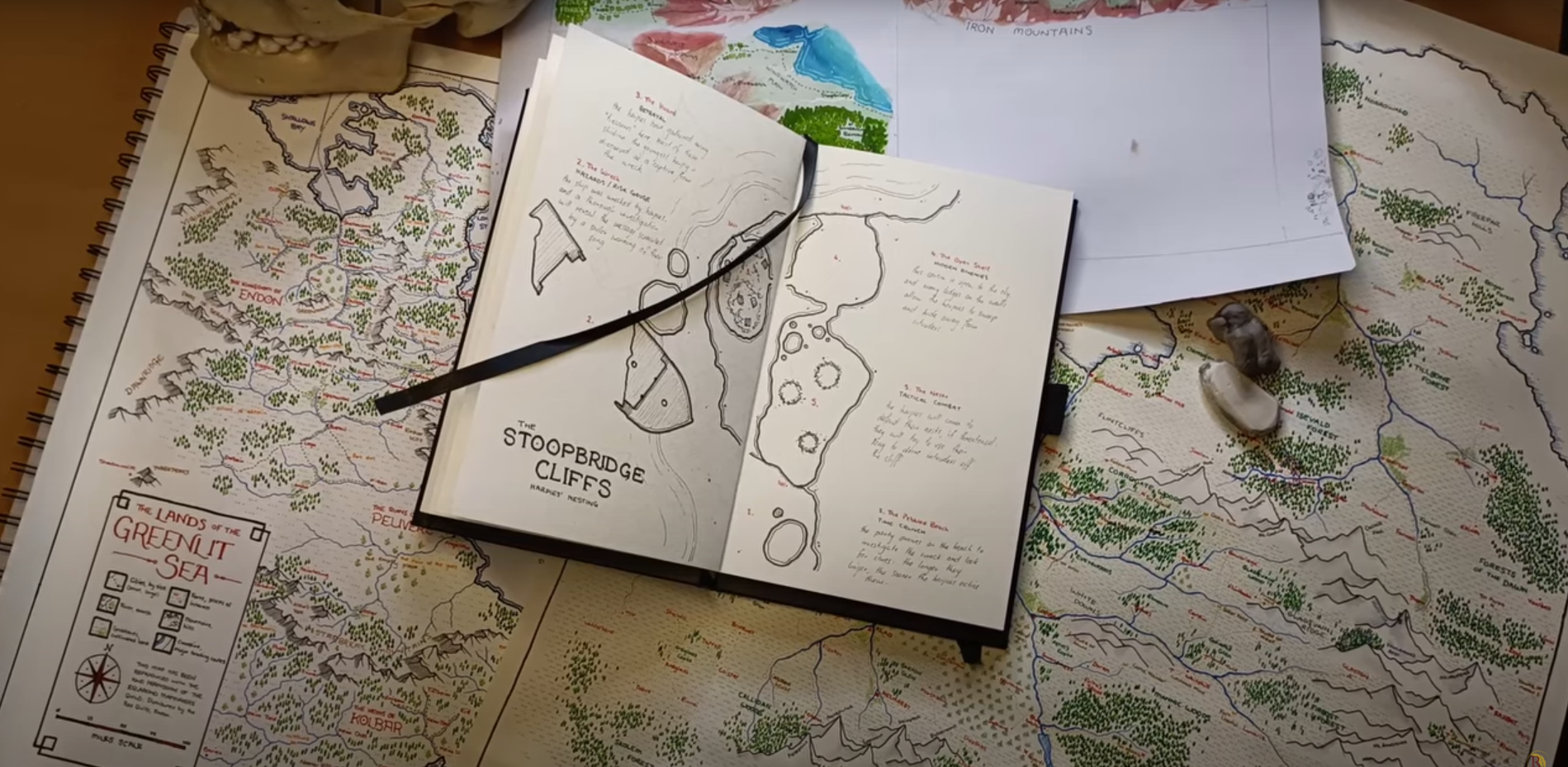
Okay, let's say on my map of the Kingdom of Endon, there's a place along the coast called the "Stoopbridge Cliffs." Right now, it's just a name. It sounds cool, but it's lifeless. Let's fix that.
Step 1: Choose a Location and Create a Title
Simple enough. The place is the Stoopbridge Cliffs. Let's make the title more specific to our adventure. How about: "The Harpy's Nest of Stoopbridge."
- Title & Location: The Harpy's Nest of Stoopbridge. (Stoopbridge Cliffs, Fenlock Coast)
Step 2: Brainstorm a Hook
What’s the problem here? The name gives us a hint: harpies. But "there are harpies here" isn't a hook. We need a situation. What are the harpies doing? Maybe they're not just mindless monsters. Let's try this: "The harpies of Stoopbridge have started singing a new, magically alluring song that wrecks ships, but they always ignore ships flying the flag of the reclusive Duke of Virhurst." Now that's a hook. It gives us the threat (deadly magic song), a mystery (why now?), and a social complication (the connection to Lord Virhurst). It immediately makes you ask: what’s up with this lord?
- The Hook: The harpies of Stoopbridge have started singing a new, magically alluring song that lures sailors to their doom, but they ignore ships flying the colors of the reclusive Lord Virhurst.
Step 3: Define the NPCs
We need a few characters with different things at stake.
Captain Anya: A pragmatic merchant captain who lost a ship and crew to the song. She's offering a simple reward to end the threat. She’s the heroic/business angle.
Silas, the Lighthouse Keeper: An old man who’s lived near the cliffs for decades. He says the harpies were peaceful until a "beautiful, dark-haired sorceress" visited Lord Virhurst last month. He's our source for local rumors.
Matriarch Screech-Wing: The harpy leader. She isn't actually evil; she's been magically enthralled by a cursed flute given to her by Lord Virhurst’s new "advisor." She could be a tragic figure, not just a monster to kill.
Significant NPCs:
- Captain Anya: A merchant captain offering a bounty to make the shipping lanes safe.
- Silas, the Lighthouse Keeper: Knows the harpies weren't always hostile; blames Lord Fenlock's new advisor.
- Matriarch Screech-Wing: The harpy leader, magically forced to sing by a cursed artifact.
Step 4: Detail the Threats
The harpies are the main threat, but let's add some flavor.
The Siren's Song: This isn't a normal harpy attack. It requires a tough save to resist a magical pull that forces sailors to steer onto the rocks or jump overboard.
Cliffside Nests: The terrain itself is a danger. Getting to the nests means a treacherous climb, with high winds and harpies diving at you.
Virhurst’s Patrols: Small, fast ships loyal to Lord Virhurst sail these waters. They'll "warn away" anyone getting too close to the cliffs, and they're not afraid to use force. This adds a human threat.
Enemies & Threats:
- The Siren's Song: A powerful magical compulsion affecting anyone who hears it.
- Treacherous Cliffs: The environment is a major hazard that requires skilled climbing.
- Virhurst’s Patrols: Human guards who will attack to protect their lord's secret.
Step 5: Add Scaling Tips
How do we make this work for different power levels?
- Low Level: The song is the main danger, but the harpies themselves are standard enemies. Lord Virhurst’s patrols are small and can be avoided or scared off.
- High Level: The Matriarch is a powerful spellcaster herself. The song can charm multiple people at once. Lord Virhurst might be a warlock, and his advisor is secretly a demon.
- Plot Complication: A rival crew of salvagers shows up, hoping to loot the shipwrecks while the party handles the harpies, leading to a three-way fight.
- Encounter Guide / Scaling Tips: For high-level parties, Lord Virhurst’s advisor is a powerful fiend who joins the final battle. For low-level parties, Silas knows a simple ritual to destroy the cursed flute.
Step 6: Determine the Rewards
Let's offer a mix of loot and story fuel.
- The Cursed Flute: Once you break the curse, it becomes a powerful magical instrument that can charm beasts.
- Lord Virhurst’s Gratitude (or Wrath): Depending on how the party deals with things, they could get a powerful (if shady) noble ally or make a very dangerous enemy.
- A Map of Sunken Treasure: Found in the harpy nest, taken from a shipwreck, leading to a new adventure.
- Rewards: The cursed flute (once cleansed), a map to a major shipwreck, and the political favor or enmity of Lord Virhurst.
Step 7: Create the Lore Tie-in
Finally, let's connect this to the bigger picture.
"The cursed flute is carved with runes sacred to Axagul, a dragon demigod - a deity whose cult is secretly growing in the capital city."
Lore Tie-in: The flute is marked with the runes of a clandestine cult growing in the capital, suggesting Lord Virhurst’s corruption is part of a wider conspiracy.
And there you have it. In just a few minutes, we've turned "Stoopbridge Cliffs" from an empty label into a dynamic adventure site with political intrigue, moral gray areas, and clear hooks for future stories. It took almost no effort, but the result is a powerful, ready-to-go piece of your world. Now, just imagine doing this for ten or twenty key locations on your map. Your atlas would instantly become a dense web of adventure, ready for you to explore.

Integration, Tools, and Building the Web
Making a library of Adventure Primers is the first part. The next is fitting them smoothly into your creative process so they feel like a natural part of your atlas. How you do this is up to you, whether you’re an old-school analog type or a digital wizard.
For the analog worldbuilder, the classic three-ring binder is your best friend. You can print your map in sections, and on the opposite page - or on tabbed pages for each region - you can write out your primers on index cards or separate sheets. Using color-coded tabs for different kinds of places (blue for cities, green for forests, gray for ruins) can be really satisfying. Just flipping through your binder can spark new ideas as you see primers next to each other.
But... digitally?
But this system really shines in the digital world. Using a worldbuilding platform is a total game-changer. Tools like World Anvil, Campfire, and Legendkeeper are built for exactly this kind of layered information. You can upload your map and then drop interactive pins on each location. Click the pin for the "Redfang Warrens," and a pop-up instantly shows your Adventure Primer. This is the ultimate "interactive atlas." It's fast, organized, searchable, and you can even put links inside your primers. The "Lore Tie-in" for one primer can be a direct hyperlink to another primer it references, creating a true, clickable web of stories.
Even simple tools can work wonders. A personal wiki, using free software like TiddlyWiki, or even just a well-organized folder of documents in Google Docs or Obsidian, can be super effective. The key is being able to link things together. You want to be able to jump from the "Barrow on Virhurst Downs" entry to the "Signet of Virhurst" item with a single click.
Once your primers are set up, you can start building the web.
Lay out your map and start making connections on purpose. Take two primers from opposite ends of your kingdom and figure out how to link them. Maybe the goblin chieftain in the west is raiding caravans for an artifact he needs to pay tribute to a dragon in the eastern mountains. Boom. Those two separate adventure sites are now part of one big story.
This is also where you can weave in your characters' backstories. If a player has a story about a lost family heirloom, create a new primer or tweak an old one to include that heirloom as a reward. This makes the world feel incredibly personal and responsive, which gets players way more invested. They aren't just exploring a world; they're exploring their world.
Just remember, you don't need a primer for every single square inch of your map. That would be insane. Start with the big, obvious places - the major cities, the scary-looking mountains, the named ruins. Then add more as you need them or when you feel inspired. The whole system is modular and can grow with you. You can have a world with ten primers or a thousand. It’s a living document that evolves right alongside your story.

That gap between a beautiful map and a living world can feel like a canyon.
We spend so much time making our geography look good that we forget to plant the seeds of story inside it. But as we've seen, it doesn’t take a mountain of work to fix that. All it takes is a small, consistent effort - a choice to turn your static landmarks into launchpads for adventure.
The Adventure Primer isn't a magic wand, but it's a powerful tool, and more than that, a powerful way of thinking. It teaches you to think in terms of hooks, conflicts, and connections. It forces you to focus on what’s playable, what’s interesting, and what will push your story forward. And it turns worldbuilding from a passive, academic chore into an active, creative process of designing adventures.
So here’s my challenge to you.
Take out one of your maps. It doesn't matter if it's a huge continental atlas or a quick sketch of a single county. Pick one location on it. Just one. And in the comments below, write a short Adventure Primer for it using the seven-part template: Title & Location, Hook, NPCs, Threats, Scaling/Complications, Rewards, and a Lore Tie-in.
I want to see what you create. I want to see the "Sunken Library of the Star-Mages" and the "Goblin Market of the Grime-Stained Alley." By sharing our primers, we can build a huge, collaborative library of adventure ideas. Read what other people write, get inspired, and see how this simple framework can spin up an incredible variety of stories.
Stop letting your atlas be a silent partner. Give it a voice. Give it a thousand voices. Turn every mountain, every forest, and every forgotten ruin into a promise of adventure. Transform your map from a pretty picture into an interactive playground, and you will unlock a world of stories you haven't even begun to imagine. Thanks for reading.