
Maps, Traps, and Mishaps! How to Make a Dungeon Crawl
This post is based on the Red Quills YouTube Channel video, Maps, Traps, and Mishaps! by Ryan of the Red Quills.
The stone mouth yawns open before you, its fangs long since worn blunt by wind and time. Vines like veins snake across the crumbling façade, woven into the cracked stone of an enormous dragon’s skull - its empty eyes hollow and watchful even in death. The steps leading into the temple are broken, half-buried by centuries of moss and dust, but the carvings remain legible to those who know the draconic tongue.
Here lies Aiqulandur, the script reads, The Voice Before Fire, the Dreamer of Bones, the Last of the Serpent Mothers.
The moment you cross the threshold into the skull’s open mouth, you are inside the Temple of Aiqulandur. The air shifts - cooler, drier, as if the breath of the place has been held for a thousand years. The entry hall is cavernous and curved, like the interior of a ribcage, or the first chamber of some long-dead beast. A shattered statue lies fallen at the foot of the dais: a dragon in flight, broken in three.
But the temple is not empty.
Hello, friends.
Welcome back to The Red Quills.
I'm Ryan, your mapmaking companion, and today we’re doing something special - both for the channel and for me personally.
Because today’s video isn’t just about how to build a dungeon. It’s a celebration.
As of this month, we’ve passed 10,000 subscribers, and it’s been eighteen months since I first launched the Red Quills into the wilds of YouTube. That’s a year and a half of fantasy maps, overland journeys, sketchbooks filled with mountain ranges, contour lines, rivers, realms, cities, and caverns - and yes, a few mishaps along the way. So thank you. Every single one of you who’s liked, commented, downloaded a map, joined the Patreon, or just let one of my videos play while you’re drawing your own worlds: you’ve made this journey real.
Read and Watch More!
You can watch the full tutorial on the Red Quills YouTube Channel, and even download both versions of this map for free on our Patreon.
Or read more in the Journal.
Celebrating Mapping!
To mark the occasion, I thought I’d take you behind the scenes on something I’ve been working on for a while. A dungeon. But not just any dungeon - this one’s a megadungeon, a temple, and a narrative experiment all in one. I call it The Temple of Aiqulandur, and it’s part of a campaign setting I’ve been building quietly in the background.
It’s designed to be huge, mysterious, and playable across multiple sessions, with factions, secrets, puzzles, traps, and a few very strange inhabitants. It’s also a testbed: I’m using it to explore new ideas in dungeon layout, encounter pacing, and using maps as a storytelling tool - something I think we, as fantasy worldbuilders, don’t do nearly enough.
In this tutorial, I’ll walk you through how I’m designing it - from blank page to full encounter-ready dungeon. I’ll share the tools I’m using, the design principles I’ve been building on from my older dungeon episodes, and some of the creatures and encounters that live within these halls.
So: let’s crack open the map case, sharpen a few pencils, and descend into the halls of Aiqulandur together. The kobolds are waiting, and the dragon’s bones still remember fire.

The Concept and the Canvas
So, let’s talk about how this dungeon begins - not on the page, not with encounters or stat blocks, but in the imagination.
Every map I make starts with a moment of atmosphere. A spark. Something vivid and strange that I can feel before I understand. For the Temple of Aiqulandur, that moment was a single sentence that popped into my head while I was washing dishes:
“The entrance is the skull of a dragon, cracked open like a cathedral.”
From there, the temple unfolded like a dream: a long-forgotten pilgrimage site turned battleground. A war not between good and evil, but between the misrememberers - kobolds who treat Aiqulandur as a living god, and lizardfolk who believe they are her true descendants. Both factions cling to the same ruins, reinterpreting and reshaping its meaning as they fight to survive in the dark. That contrast - that layering of faith, memory, and violence - was where the dungeon started to come alive.
But a feeling is just a spark. You still need to build the fire.
And that’s where the map comes in.

The Blank Page
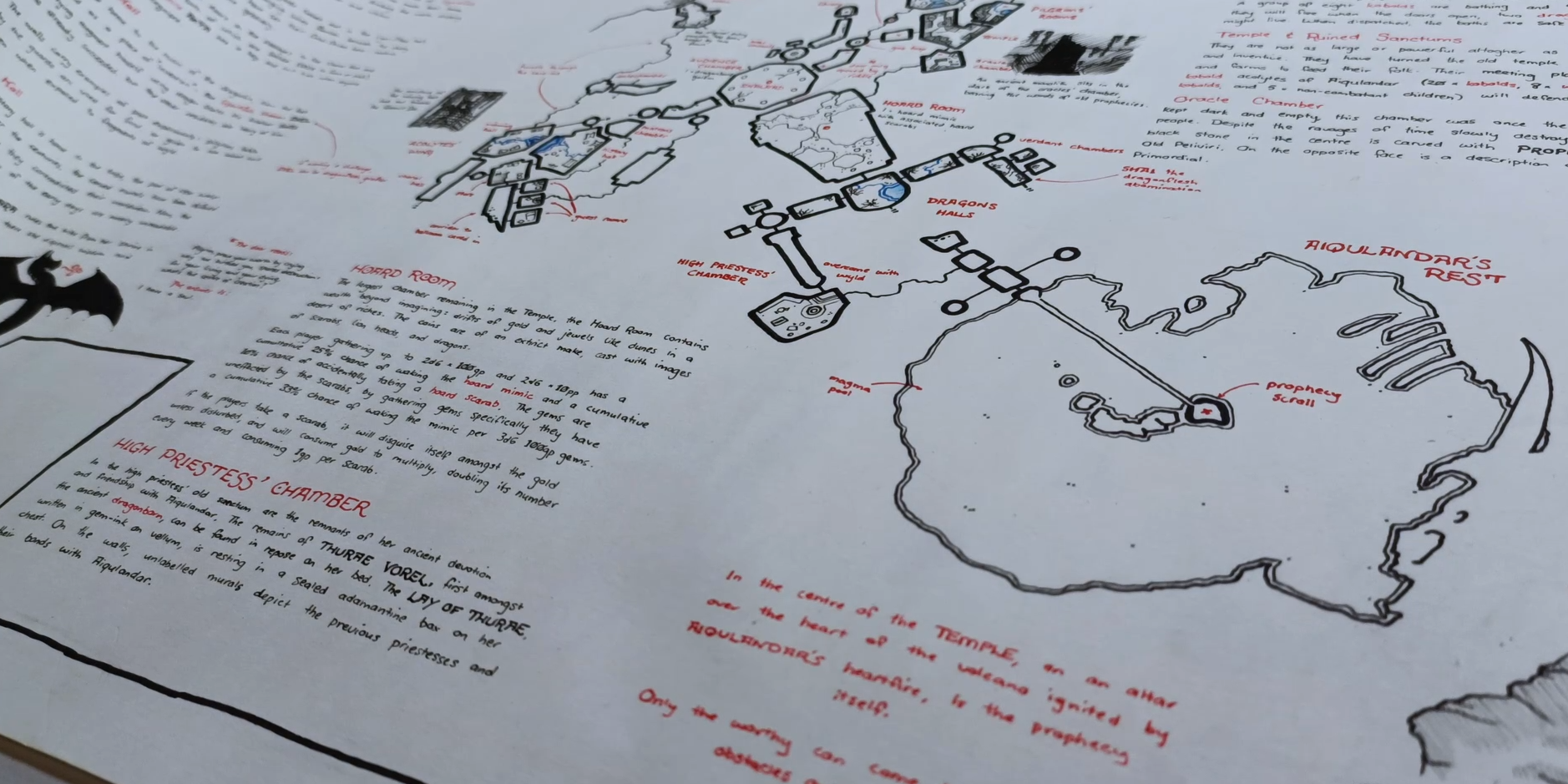
For this project, I’m working on a large sheet of A2 watercolour paper, roughly 16 by 23 inches. This gives me enough real estate to spread out the dungeon, make notes, and leave room for margin doodles, rough NPC sketches, and encounter flow diagrams - all on the same sheet.
If you’ve watched my previous dungeon design episodes, you’ll know I like to sketch in layers - literally and figuratively. I start with light pencil lines, often no more than abstract blobs: zones, shapes, flow patterns. These are just placeholders for mood and function. A long oval might be a shrine. A jagged sprawl could be collapsed tunnels. Nothing’s named yet. I’m not worried about what fits in a five-foot square. I’m building energy.
On one edge of the paper, I make a column of narrative questions:
- What’s the story of this place?
- Who built it, and who uses it now?
- What secrets does it want to keep?
- How do players know they’re deepening their journey?
- What changes when someone dies here?
These guide the process. I don’t need to answer them all at once - but they shape how the layout evolves. They remind me that a dungeon is not just a space; it’s a story machine.
Visual Thinking
My sketching is messy at first. Sometimes I use colored pencils to loosely block in factions (blue for kobolds, red for lizardfolk, green for wild or “unclaimed” spaces). I start adding arrows between rooms and ideas: a patrol route, a blocked shortcut, a “loop” that encourages tactical movement. I’m thinking in verbs before nouns: sneak, fight, escape, hide, reveal.
And alongside that, I’m brainstorming NPCs and encounter hooks in the margins.
At this point, I’m not trying to “balance” anything. I’m building a toolbox. Later, I’ll test what fits where.
Using the Books
While I love inventing creatures and hazards, I also think one of the best tools a dungeon designer can use is the Player’s Handbook, the Dungeon Master’s Guide, and especially Xanathar’s Guide to Everything. Why reinvent the wheel when you have so many wonderful traps, encounter tables, magic item quirks, and monster templates ready to go?
I keep these books nearby - not to slavishly follow them, but to spark new ideas. If I see a poison gas trap in Xanathar’s, I might ask: How would kobolds use this creatively? Would they trap only half the room, forcing players to figure out where the gas comes from by watching a candle flicker? Or if I read about a gelatinous cube, I might imagine it used as a sacrificial offering in a half-collapsed cistern.
The books give you a structure. The dungeon gives it flavor. And the map helps you make it all visible.
The Map as a Living Document
One thing I want to emphasize is that your dungeon map should not be final too early. That blank page is a thinking tool, not just a finished product. I’ll redraw the Temple of Aiqulandur map at least twice during this project - once for layout, once for flow, and finally for presentation.
In the version you’ll see me working on during this video, I’ve started by loosely grouping the temple into zones. Each zone will have its own design language, music cues if I run it in person, and encounter dynamics. But I’m not drawing all of that at once. I’m letting the ideas breathe, testing how they connect, and always asking: If I were a player, would I remember this room a week later?

The Why of It
Before we dive into the step-by-step dungeon building in the next section, I want to pause on this idea:
You don’t make a dungeon to have a dungeon. You make it because it says something.
The Temple of Aiqulandur says something about my world: that dragons are gods, that memory can be contested, and that even monsters can have faith.
It says something about my players: that they will face both physical and emotional tests. That they’ll need to choose whom to trust. That the loot isn’t always the reward.
And it says something about me, as a mapmaker: that I believe even the darkest halls can tell stories, if you give them a chance.
So with that, let’s dig into the real meat of this episode. In the next section, I’ll take you through my process for creating dungeon areas, assigning dramatic functions, setting traps and puzzles, and building encounters - from start to terrifying finish.
Ready? Let’s descend.

Room Types, Traps, Encounters, and Bosses
Alright. We’ve got our core idea. We’ve got our zones sketched in. The bones of the dungeon are in place - now let’s add flesh.
This is the part where a dungeon stops being a map and starts becoming a story engine.
When I build a dungeon, I don’t start with a numbered list of rooms. I start by asking: What does each area do for the players? Because not every room should be a fight. Not every hallway should be a trap. A good dungeon design offers contrast - moments of tension and relief, noise and silence, clues and confusions.
So here’s how I break it down.
I. Room Types: The Drama Curve of a Dungeon
Let’s start with room functions. These are what I call dramatic room types. Each serves a narrative or gameplay purpose. You don’t need every type in every dungeon - but I like to have at least four or five across different zones.
1. Entrance Room – Tone-Setting
This is where it all begins. The room that teaches players what kind of place they’re in.
In the Temple of Aiqulandur, the entrance is a cracked dragon skull - its bones turned into columns, its teeth like gate-spikes. Moss grows in the sockets. Kobold graffiti marks the snout. There’s no combat here - just atmosphere. But it’s a warning. A whisper: This place is old, and it has been claimed by many hands.
Design Tip: Give your entrance a moment of awe, a moment of choice, and a trace of mystery. Let players feel like they’re walking into a story already in motion.
2. Puzzle Room – Mental Play
Not every challenge needs hit points. I like to include 1–2 rooms per zone that are about clever thinking, not combat.
In one shrine chamber of the Temple, I’ve placed a reflecting pool beneath an old stone statue. The pool has no bottom. Players can toss in an object - and watch it age 1,000 years in an instant. Food rots. Weapons rust. Scrolls crumble. But the water also shows visions of the past.
This ties into the dungeon’s theme of memory - and offers clues if players engage.
Design Tip: A puzzle is not a riddle. Let the environment itself be the puzzle. Use lighting, echoes, broken murals, or water levels as tools.
3. Tension Room – Environmental Threat
These are quiet rooms that still scare people.
Maybe it’s a hallway lined with dragon bones, and one of them is breathing. Maybe it’s a flooded cistern where something swims just out of sight. Or a place where kobolds have trapped the air itself, using poison gas that leaks only when players light a torch.
You don’t need dice rolls for tension - just uncertainty and stakes.
Design Tip: Give at least one room in your dungeon the power to make players say: “We’re not ready for this.”
4. Combat Room – Classic Fights with a Twist
Yes, you need fights. But not just fights.
Here’s a rule I follow:
Every encounter should offer at least one tactical choice that’s not obvious.
That could be terrain: a narrow bridge, a crumbling staircase, a lizardfolk priest fighting waist-deep in water.
It could be narrative: a wounded kobold dragging a relic that two factions want - will the players kill them, help them, or bargain?
And it could be timing: two enemy groups about to clash, and the players arrive first.
Design Tip: Give every fight an extra layer. Make the map matter.
5. Safe Room – Breathing Space
These are sacred. Especially in megadungeons.
In the Temple of Aiqulandur, there’s a collapsed library chamber where no light enters - but sound travels strangely. The kobolds think it’s cursed and won’t go near it. But there’s a dry corner, clean water, and a locked stone cabinet of forgotten scrolls.
A perfect place to short rest, plan, or argue.
Design Tip: One good safe room can become a party’s home base. Make it memorable.
6. Lore Room – The Past Speaks
Players love lore if they uncover it themselves.
This could be a forgotten altar, a wall fresco slowly coming to life, or an automaton that speaks only in prophecy. Don’t dump exposition - let them dig for it.
In the Temple, there’s a ruined crypt where names are scratched off stone plaques. But under the right light, the original names glow - revealing that kobolds and lizardfolk used to share this temple before a great betrayal.
Let players reconstruct the past, one clue at a time.
II. Traps That Tell Stories
Let’s talk traps - not as punishments, but as expressions of faction logic.
A good trap tells you who built it, what they fear, and what resources they have. A kobold trap will not look like a dwarven one. A trap meant to keep out adventurers will feel different than one built in panic.
Kobold Traps (Clever + Annoying)
- Swinging log with holy relics strapped on - triggers a religious panic for rival lizardfolk.
- Pressure plate that breaks a lantern behind the party, plunging them into darkness - kobolds attack with infravision.
Lizardfolk Traps (Spiritual + Deadly)
- Pit trap disguised as a baptismal pool, with stakes below.
- Hall of dripping water where one droplet is acid, and the players have to figure out which by listening.
Design Tip: Traps are mini-narratives. Give them context, flavor, and fallout.
III. Faction Encounters and Dynamic Spaces
The best dungeons feel alive. That means not every encounter is static.
I treat factions like cults in a sandbox. They’re groups with desires, tools, grudges, and weaknesses. If you enter their space, they will react. And sometimes, they’ll reach out first.
Dynamic Encounter Examples:
- A kobold priest offers to “bless” a player with dragon’s breath (fire damage for 3 turns) - but it requires a scarification ritual.
- A lizardfolk scout betrays their leader mid-combat if the party offers a family relic found earlier.
- Factions move after alarms are triggered. Reinforcements change. A shrine becomes a war camp. The safe room becomes not so safe.
Design Tip: Change the state of the dungeon after key moments. Make player actions echo.
IV. Boss Fights: Making Them Matter
Your final room - the “boss chamber” - should be more than just a sack of hit points. It should be the culmination of your themes.
Not every ending needs a fight. But if you do include one, make it:
- Tactically rich (terrain matters),
- Narratively weighted (choices have consequences),
- Mechanically unique (not just "another dragon").
Design Tip: A great boss fight answers the dungeon’s question. What was this place really about?
Wrapping Up the Core Build
By the end of this process, I don’t just have a list of rooms - I have a living dungeon, full of choices, echoes, and stakes.
Here’s my short checklist when I finalize the first draft:
- At least one room of each dramatic type
- Multiple routes and loops
- At least two factions with distinct personalities and tools
- Meaningful traps and puzzles
- A boss encounter that reflects the dungeon’s central theme
- A few spaces that are just weird - because weirdness is memorable
When we come back in Section 4, I’ll show you how I turn this paper design into something I can actually use at the table. We’ll talk about labeling, encounter keys, visual flow, GM notes, and how I prep a dungeon for play without over-prepping.
Because a good map is a gift. But a great dungeon is something players help discover.
Let’s talk about how to make that possible.

How to Run a Homebrew Dungeon
So you’ve got a beautiful dungeon map. You’ve filled it with weird rooms, moving parts, and factions ready to backstab each other. Now comes the real test: how do you run this thing at the table?
Because a dungeon that looks great on paper might still fall flat in play if it’s too rigid, too hard to track, or too dense to improvise around.
So here’s how I translate a hand-drawn, zone-based dungeon like the Temple of Aiqulandur into something I can run without flipping through 30 pages of notes.
Step 1: Create a One-Page Zone Index
Forget room-by-room lists for now. The first thing I make is a one-page dungeon overview, broken down by zone. Each zone gets a bullet list with:
- Key features (terrain, lighting, feel)
- Notable encounters or events
- Roaming NPCs or monsters
- Secrets or faction influences
For example:
ZONE 2 – THE FLOODED CRYPTS
- Chest-high water, echoes, constant dripping
- Undead lizardfolk patrols (restless souls, misled by faction lies)
- A drowned bell that tolls when disturbed (wakes up the deeper crypt)
- Hidden passage under altar leads to Zone 4
- Safe rest point in a sealed tomb (requires solving runic lock)
If a zone’s summary can’t fit in 5–7 bullet points, it’s too complicated for me to run comfortably. This sheet is my quick-glance reference in-game.
🛠️ Design Tip: Give each zone one distinct sound, smell, and symbol. These sensory cues help players remember where they are - and help you describe things faster.
Step 2: Key Rooms, Not All Rooms
I don’t write notes for every room - just the ones that matter.
In the Temple map, I’ll pick maybe 6–8 key rooms total - boss fights, puzzles, faction negotiation spaces, environmental set-pieces - and give them a short stat block like this:
ROOM 3.1 – THE BONE SHRINE
- Visual: 12-foot dragon skull, incense smoke spirals from nostrils
- Puzzle: Incense colors = different effects (red = rage, blue = fear, gold = reveal secret door)
- Hidden: Pressure plate under left eye opens reliquary with cursed amulet
- Tactics: Kobold priest can trigger gas trap if threatened
I don’t need 500 words of prose here. I need just enough to jog my memory and offer player-facing material. The rest? I make up on the spot, based on the factions, goals, and tone already in place.
Step 3: Prep Modular Encounter Tools
Running a dynamic dungeon means accepting the fact that players will do unexpected things. They’ll camp where you didn’t expect, kill a faction leader early, or try to collapse a whole wing of the map.
So I prep modular encounter kits, not scripted scenes.
Here’s what that looks like:
- Reaction Tables: How do different groups respond to the party?
- Lizardfolk: 1–2 = attack on sight, 3–4 = demand a holy relic, 5–6 = offer alliance against the kobolds
- Kobolds: 1–2 = run and report, 3–4 = prank the party, 5–6 = try to recruit them
- Lizardfolk: 1–2 = attack on sight, 3–4 = demand a holy relic, 5–6 = offer alliance against the kobolds
- Faction Timelines: What happens in the dungeon while players explore?
- If players ignore the altar for 2+ hours, the lizardfolk perform a ritual and wake something up.
- If the kobold war drums sound for 3+ rounds, reinforcements arrive from Zone 5.
- If players ignore the altar for 2+ hours, the lizardfolk perform a ritual and wake something up.
- Random Room States:
- This room is [empty / flooded / guarded / desecrated / newly trapped].
- Let one roll change the story.
- This room is [empty / flooded / guarded / desecrated / newly trapped].
This helps me improvise changes and consequences without scrambling for notes or stalling the game.
Design Tip: Write tools that serve you in play - not prose you’ll forget to use.
Step 4: Use the Map Actively
Your map isn’t just a picture - it’s a play surface. So use it.
- Mark routes as they get blocked or explored.
- Use transparent overlays for faction control - color-coded zones can shift as alliances change.
- Let players annotate the map as they explore - what they think is true may not be.
If you’re running online, tools like Owlbear Rodeo or Foundry let you use fog-of-war, layer reveals, or tokens that represent shifting allegiances. In-person? Print the map large and use post-its, dry erase, or string paths to show movement.
Maps should never feel static. They’re storyboards in motion.
Step 5: Trust Your Table
Finally, once I’m running the dungeon, I stop thinking of it as “my creation.” It becomes a shared space. Players will surprise you. Let them.
Maybe they decide to ally with both factions and form a peace summit. Possibly they burn the temple down. Perhaps they excavate the deeper crypts and release something no one saw coming.
Good dungeon prep gives you a scaffold, not a straitjacket. If you’ve got strong zones, clear factions, dynamic tools, and a few memorable set pieces, you can wing the rest - and it’ll feel better than something rigid.
Running Tip: When in doubt, let the dungeon respond like a person. What would it want? What would it fear?
Your Turn to Build a Living Dungeon
If you’ve stuck with me this far, congratulations: you now have everything you need to design, map, and run a homebrew dungeon that doesn’t just sit on the page - it breathes, it mutates, it remembers what the players did five sessions ago.
Now it’s your turn.
Here’s the creative challenge I’m setting for you this week:
Prompt: Build a Zone-Based Dungeon with Two Conflicting Factions
Start simple. Choose a location, something evocative:
- An abandoned watermill built into a cliffside
- A forest shrine half-swallowed by fungal growth
- A buried moon temple beneath a collapsed city
Now ask yourself five questions:
- Who’s here now, and why haven’t they left?
Give me two groups - maybe they’re enemies, maybe they’re in a cold war, maybe they don’t know about each other… yet. - How do they control or influence different parts of the map?
Let their presence define the zones - colors, sounds, defenses, clues. - What’s changing right now?
A ritual is almost complete. The power balance is shifting. An old curse is weakening. Something is happening today. - What can the players do to tip the balance?
Build in pressure points. Let them ally, sabotage, negotiate, desecrate, liberate. - What truth about this dungeon do none of the factions know yet?
Leave space for secrets. Dungeons need mystery, or they become a checklist.
Don’t worry about drawing it perfectly or having all the answers. Just start. Build three to five zones, place some pressure points between them, and sketch the shape of the factions. That’s enough.
Pro Tip: If it feels alive when you’re writing it, it’ll feel alive at the table.
Share Your Work
Once you’ve got a sketch or a short write-up, I’d love to see it. Share it with me in the comments on YouTube or tag me on social media - I check them all. Or, if you're a supporter on Patreon, drop it in the community Discord so we can swap feedback and build weird little temples together.
What We Just Learned
Let’s recap the five big tools we used in this dungeon build:
- Start with story-first zones – Not just rooms, but areas with identities and conflict
- Design your map like a flowchart – Think traversal, relationships, and choke points
- Let your factions define the drama – More interesting than monsters on repeat
- Prep to improvise – Indexes, tables, and modular encounters beat encyclopedic notes
- Build for player freedom, not plot beats – And be ready for your dungeon to change
If you build your maps like this, you’ll find that your dungeons get better with age. They’ll surprise you. They’ll tell you things you didn’t know you were writing. And when your players come back weeks or months later to revisit the temple they once nearly destroyed, you’ll be able to show them how it’s changed.
That’s the goal.
That’s the Red Quills way.
So pick up your pen. Let’s make something that matters.