
Maps inspired by the Edo Period
This tutorial is based on the video How to Map like the Edo Period on the Red Quills YouTube channel, by Ryan of the Red Quills.
A veil of steam curls from a vendor’s brazier. Charcoal-roasted fish glisten under paper lanterns as a child darts past, chasing the tail of a fox mask worn just moments ago. The sun hangs low over tiled rooftops, casting golden light across a warren of alleys, market stalls, shrines, and tea houses. A thousand lives, a hundred stories, and one map that ties them all together - a painted scroll hanging in the magistrate’s hall, its borders etched with dragons, rice paddies, and the names of forgotten gods. It is not to scale, but it is true. It does not show the world as it is, but as it is understood.
Hello, adventurers, and welcome back to the Red Quills!
Today, we’re turning our ink and brush toward a part of the world where city maps weren’t just records of streets and buildings - they were acts of cultural storytelling. This episode is all about making your own fantasy map inspired by the urban cartography of Edo-period Japan, a place and time where geography was shaped by ritual, artistry, and the pulse of everyday life.
By the end of this tutorial, you’ll have a full city layout inspired by one of the richest artistic traditions in the world - and a toolbox of visual techniques that’ll help your fantasy cities feel alive, historical, and worth exploring.
Watch and Read More!
You can find the full video tutorial for this map on the Red Quills YouTube Channel, and download this map on our Patreon for free!
If you want to read more tutorials like this, check out the Journal.
And, of course, you’ll be drawing right alongside me. Let’s see what secrets the streets of Edo have to offer.

Visual History Overview
To understand how to build a fantasy city map in the style of Edo-period Japan, we need to first understand how the Japanese themselves imagined their cities - and more importantly, how they expressed those cities on paper.
Unlike many Western maps of the time, which pursued mathematical precision and coastal accuracy, maps in Edo-period Japan were a tapestry of practical needs, religious belief, political messaging, and artistic flair. They weren’t just diagrams of space - they were cultural documents, telling us what people thought was important, sacred, or powerful. And nowhere is this more evident than in their depictions of cities.
The Edo period, which ran from 1603 to 1868, was a time of peace, strict social order, and astonishing artistic productivity. Under the Tokugawa shogunate, Japan was largely closed to the outside world, which allowed internal culture to flourish in incredibly distinctive ways. The population of cities like Edo (modern-day Tokyo), Osaka, and Kyoto ballooned, giving rise to an urban culture that needed its own systems - both physical and visual - for navigation, control, and celebration.
Let’s take a look at some key historical examples. These are going to be our artistic and conceptual foundation:
1. “Map of Kyoto” by Ishikawa Ryūsen (circa 1680–1710)
Ishikawa Ryūsen was a ukiyo-e artist who also created some of the most visually arresting maps of his time. His "Map of Kyoto" is not what we’d call accurate by modern standards - it bends geography to suit composition and aesthetic priorities - but it feels true in a different way. Buildings are depicted almost like architectural drawings, with tilted-roof views that resemble dolls’ houses. Temples and shrines are prominently shown, far larger than other buildings, because they mattered more. Rivers are bold, winding ribbons of blue, and roads flow like veins through the city’s neighborhoods.
What’s important here is the emphasis on human experience. Ryūsen’s Kyoto is not the city as seen from the sky - it’s the city as experienced by its inhabitants. It’s a practical map, but also a moral one, showing which places have social, spiritual, or political weight. If you want to build a fantasy city that feels lived-in and lore-rich, this is a brilliant model.
2. “Illustrated Map of Famous Places in Edo” by Utagawa Hiroshige (circa 1855)
Hiroshige is most famous for his landscape prints - like his Thirty-Six Views of Mount Fuji - but he also produced illustrated guide maps of Edo that blur the line between map and art. One standout piece is his "Illustrated Map of Famous Places in Edo," which combines cartography, storytelling, and tourism into a single visual document. The map doesn’t just show streets; it celebrates places - markets, shrines, gardens, bridges - each rendered with individual personality and often accompanied by a short caption or poem.
This is key for your fantasy maps. Ask yourself: what places in your city are worth turning into landmarks? Not just for navigation, but for memory and story? Add text, captions, or narrative elements directly onto the map - use them the way Hiroshige used poetry: to enchant the reader.
3. “Edo Meisho Zue” – the “Illustrated Guide to Famous Sites of Edo” (published 1834–1836, various authors)
The Edo Meisho Zue is a multivolume travel guide that functions both as a tourist’s handbook and as a cultural document. Its illustrations are bird’s-eye views of famous districts in Edo, showing the seasonal festivals, famous restaurants, riverside activities, and sacred sites that made each area distinctive. Streets are shown almost vertically, and there’s little concern for strict top-down accuracy. The goal is clarity, yes - but also charm.
These guides were incredibly popular in the Edo period, and they inspired generations of artists and wanderers. In your fantasy map, you can use this technique to present your city as though it’s being introduced to a new traveler or visitor. Think of your map as a “guided tour” of the city, emphasizing the color and rhythm of daily life.
4. “Nihonbashi and Edobashi Bridges” from the “One Hundred Famous Views of Edo” by Hiroshige (1856)
Let’s look briefly at this specific view because it gives us insight into perspective. The scene shows merchants, samurai, and porters crossing the Nihonbashi bridge, which was literally the center of Edo - every road in the country was measured from that point. The city radiates out from this symbolic center.
This is a brilliant detail to adopt for your fantasy map. What is the symbolic center of your city? Is it a sacred tower? A river crossing? A market square where proclamations are made? If you structure your city around a powerful central concept, your map gains an immediate sense of hierarchy and meaning.
Pulling Together the Lessons
So what do these examples teach us as fantasy mapmakers?
- Don’t confuse accuracy with meaning - Edo-period maps were designed to be useful, beautiful, and informative, not mathematically perfect. Prioritize what matters to your world, not our world.
- Use perspective to serve the narrative - Buildings can be shown in elevation or axonometric view. Rivers can flow dramatically. Landmarks should be readable and even exaggerated if needed.
- Decorate the borders with cultural motifs - Not just for flair, but for storytelling. Include animals, plants, patterns, or calligraphy that evoke your fantasy culture’s values.
- Include human activity and presence - A map feels alive when it includes festivals, travelers, ships, or little story vignettes tucked into corners.
- Think about the map’s maker within your world - Was it drawn by a city planner? A shrine artist? A merchant guild? Their bias will shape the style and what gets emphasized.
As we move into the live build, I’ll be putting these ideas into action: using symbolic layout, elevated views, and decorative marginalia to bring a fictional capital city to life - one shaped not just by streets and squares, but by memory, myth, and meaning.

The Process
All right, adventurers - it's time to turn ink and paper into imagination. In this section, we’re going to build a fantasy city map inspired by the urban cartography of Edo-period Japan. I’ll be guiding you through the whole process, live on paper or tablet, combining practical layout with symbolic elements, cultural storytelling, and - of course - a lot of flair in the borders.
I’m going to structure this like a city that might belong in your campaign - a capital perhaps, or a cultural hub. Something with history, religious resonance, and a little mystery. Our guiding inspiration? That blend of elevation drawing, birds-eye narrative perspective, and human-centered layout you’ve seen in maps by Ishikawa Ryūsen and Utagawa Hiroshige. Let’s get started.
Step One: The Symbolic Center
We begin not with the walls, or the roads, or even the land - but with the center. Remember the Nihonbashi Bridge in Edo? That single point from which all roads in Japan were measured? We’re going to do something similar.
In our case, I’m drawing a towering stone shrine - crowned with a sun disc, wreathed in banners. This shrine is both literal and symbolic: it marks the city’s spiritual heart and is used for celestial alignment during festivals. Everything radiates from here. Around the base of the shrine I sketch a fan-shaped plaza, like sunbeams extending outward.
Design tip: If you’re building a city from scratch, always begin with the “why” - why was this location chosen? What gives it power, prestige, or practicality? Then let that guide the layout.
From here, I sketch a wide ring road, looping around the plaza. This will serve as a kind of orbit for civic life - like a moat of culture. Main roads will radiate from this circle like spokes on a wheel. I’m using a slightly tilted angle on the roads and buildings, keeping that isometric or bird’s-eye Ryūsen-style elevation in mind.
Step Two: Mapping with Elevation
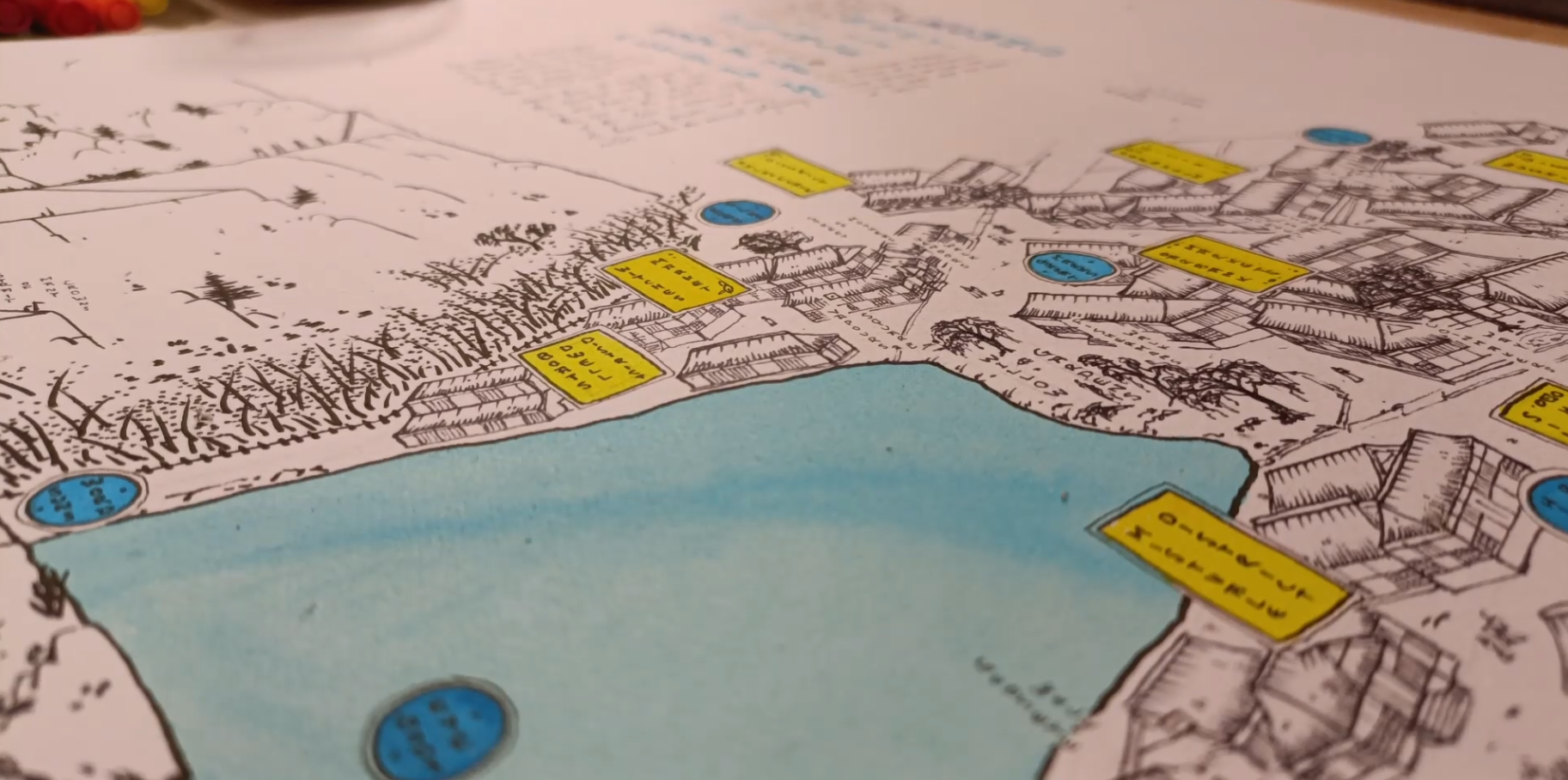
Rather than a purely top-down view, I want to give a sense of architecture. I’m going to render major buildings - temples, courts, theaters - with tilted, three-quarter elevations. Imagine the city’s viewer not floating above it, but looking down at an angle, like they’re observing from a nearby hilltop.
Each building is not just a shape, but a character. For example:
- The House of Silk Banners, in the merchant quarter, has rippling cloth drawn hanging from its roof eaves.
- The Gilded Archive, where magical and legal documents are stored, is an octagonal tower with fan-like windows.
- The Courtyard of Blossoms, a noble family’s estate, is drawn with winding walls and a miniature inner garden, shown from a raised angle.
The roads flow like rivers between these buildings. They’re not perfectly gridlike - the Japanese aesthetic often embraced asymmetry and natural flow. I let streets bend and split, especially where they follow older terrain: ancient streambeds, sunken paths, or collapsed shrines.
Step Three: Thematic Districts and Public Life
Now we start dividing the city into districts - each with its own visual signature and purpose. This is where Edo-period maps shine: they show not just where things are, but what it feels like to be there.
I block out six key districts around the ring road:
- The Pilgrim’s Walk – A winding road that connects seven sacred sites. These are drawn large, with red torii-style arches and incense smoke curling upward. They visually dominate their area, reflecting spiritual importance.
- The Lantern Market – A crowded network of covered stalls and tea-houses, drawn with repeating roof motifs and hanging signs. I tuck in tiny human figures here: someone stirring soup, someone fanning a charcoal grill. It’s alive.
- The Hall of Peers – A rigid, formal area with symmetrical roads and angular buildings. This is where scholars and officials live. I use straight lines and squared-off geometry to contrast the organic chaos of the market.
- The Bath District – Curving alleys, steam rising from rooftops, little drawn symbols for hot water and cranes. I add a small poem in the corner, written in faux-calligraphy, describing the feeling of winter steam on bare skin.
- The Inner Ward – For the wealthy. These buildings are larger, with courtyards shown like folded paper. I add decorative symbols for family crests - perhaps based on phoenixes, lilies, or floating islands.
- The River Gate – The port. Boats are drawn side-on, loading and unloading goods. The river itself is stylized, with waves resembling ukiyo-e prints. I make sure to include a fishmonger’s stall and a floating shrine on a barge.
These districts are labeled with iconography rather than just text - little pictures of lanterns, cranes, inkstones, and shrines. This encourages the viewer to read the map visually, like a story or game board.
Step Four: Decorative Borders
Now we turn our attention to the borders - one of the most striking features of many Japanese maps. I want to give the map not just edges, but context. Here’s what I add:
- North border: A row of stylized mountains, drawn in sweeping brushstrokes, with clouds drifting over the peaks. These are the sacred mountains beyond which lie forbidden lands.
- South border: A wave pattern inspired by The Great Wave off Kanagawa, stylized and repeating, enclosing sea monsters and trading ships heading into fog.
- East border: A parade of mythical animals - foxes with nine tails, cloud dragons, and owl-headed spirits - each marching between columns of bamboo.
- West border: An illustrated calendar of festivals. Twelve boxes, each representing a month and its associated celebration, with a figure shown preparing a ritual, dancing, or feasting.
Between each border section, I add inscriptions in fictional script, meant to look like brush-painted kanji. You might choose to develop your own logogram-based script, or simply use shapes and swirls that suggest meaning.
Design tip: The border is a fantastic place to include world lore, cosmology, or seasonal rhythms - without cluttering the core map.
Step Five: Final Pass with Texture and Inkwork
Now it’s time to unify everything. I ink the roads with flowing, slightly uneven lines - like old brushstrokes. Then I keep the textures varied: woodgrain patterns on certain rooftops, tilework on others. I use crosshatching sparingly, relying more on stippling and soft washes to define shadow and elevation.
In a few corners, I include small vignettes: a duel taking place on a bridge, children flying paper dragons, an old storyteller beneath a plum tree. These tiny touches are what transform the map from a schematic into a world.
Finally, I place a title box in the lower-right, designed like a hanging scroll. The city’s name is in your world’s language, but the design mimics Edo-period title plates. If this is part of a campaign, you might include space for the players to add notes or rumors around the edges.

Let’s step back and look at where we’ve been.
In this episode, we explored what it means to create a fantasy city map inspired by the cartographic traditions of Edo-period Japan. We talked about how these historical maps were more than just records of space - they were expressions of culture, spirituality, symbolism, and urban identity. They offered a duality: detailed, usable city plans rendered with a reverence for aesthetic beauty and a subtle, encoded storytelling language that invited viewers to see not just where, but who and why.
So what now?
Now it’s your turn.
Here’s your challenge for this week:
Design your own city in the style of an Edo-period map.
Choose whether it’s a real place or a mythic one, but either way, commit to using these five elements:
- A central anchor - whether that’s a castle, shrine, or market square.
- Elevation-style buildings - drawn with enough care to show their shape, style, and status.
- Named districts with personality - make them distinct not just by architecture, but by theme.
- Symbolic borders - bring in animals, seasons, or spiritual elements that reflect the culture.
- A visual storytelling trick - something surreal, symbolic, or metaphorical that breaks the realism and adds wonder.
And don’t overthink it.
You don’t need a perfect city plan. You just need a map that feels alive.
If you create something, I’d love to see it. Share your work with me - tag it with #RedQuillsMaps on social media, or post it to the comments or our Discord server. I always check, and I always feature a few in my next roundup.
If this episode helped you think differently about fantasy cartography, consider subscribing to the channel. It helps a lot. And if you want even more behind-the-scenes content, sketchbook downloads, or early access to future map sets, check out my Patreon - linked below.
We’ll be continuing this series with more cultural inspirations, so if you have a region, civilization, or historical tradition you’d like me to explore next, leave a comment. I’ve already got my eye on a few - and I think you’ll love where we’re headed.
Until then - Keep your ink wet, your brush steady, and your cities full of secrets.
I’m Ryan of the Red Quills, and I’ll see you next time.