
How to Mappa your Mundi: A Venetian Map
This blog post is based upon the video tutorial focusing on how to make a Venetian map on the Red Quills YouTube channel, by Ryan of the Red Quills.
Once upon a tide, before the world believed the Earth was round but long after it believed the Earth was flat, a monk named Fra Mauro knelt over a parchment circle and charted the whole of the known world. But instead of dragons and blank spaces, he filled it with names and mountains and tangled stories. He didn’t just draw places - he drew arguments. He took the map, spun it sideways, and dared Europe to imagine the East not beneath them, but beside them. And the strange thing is - it worked.
Now imagine this: a fantasy map that breaks the rules, but not at random. One that looks ancient, like it was pulled from a gilded chest in a flooded archive, but feels vivid and alive. A map that doesn’t just show a world - it tells you that world’s story in the same ink that outlines its coasts.
Hello, adventurers, and welcome back to the Red Quills!
Today, we’re diving into the world of Venetian cartography - specifically, the gorgeous, chaotic, and boldly informative world of the Fra Mauro map, and how you can use its visual language to create fantasy maps that are overflowing with lore, politics, and character.
We’re not just making a beautiful map today - we’re building a tool that tells a story. Whether you’re designing for a novel, an RPG campaign, or an immersive world bible, this is your chance to learn from the past and make something unforgettable.
Read or Watch More!
You can watch the full video tutorial on the Red Quills YouTube channel, or download the map on the Red Quills Patreon.
For other tutorials, check out the rest of the Journal.
But first, let’s take a quick look at what’s ahead.
Before we dive in, here’s a quick preview of what you’ll discover on this journey.
We’ll begin by exploring the world that inspired this style of mapmaking - Renaissance Venice, where merchants, monks, and mariners all contributed to the evolving image of the world. You’ll see how the most famous Venetian map, the Fra Mauro map, reimagined geography not just as a record of terrain but as a record of knowledge, culture, and belief.
Then we’ll break down what makes that style unique. You’ll learn how to arrange a map with intention, placing regions and oceans to reflect meaning, not just compass points. We’ll talk about symbolic orientation, how to layer in commentary and storytelling through marginalia and annotations, and how to use visual density without creating visual clutter. If you’ve ever wanted to fill a map with lore while still keeping it legible, this is the perfect approach.
After that, I’ll build a map with you, live and from scratch. You’ll see the process from raw parchment texture through to hand-drawn coasts, illustrated flourishes, and written notes that shape how the viewer understands the world. Whether you’re following along with pen and paper or just watching for ideas, you’ll get a full demonstration of how this style works in action.
So grab your compass, unroll your vellum, and let’s set sail. Venice awaits.

The Maps of Old Venice
When we think of medieval or early Renaissance maps, we often imagine distortions - continents crushed or stretched, oceans misunderstood, and dragons lurking just off the edge. But Venetian maps? They were different - not just inaccurate representations of space. They were bold arguments, claiming the right to decide what the world meant. And in the heart of that effort was a city unlike any other - Venice, a place that seemed to float between worlds, just like the maps it produced.
Venice was a gateway between East and West, a city where Greek philosophy, Arab astronomy, Latin theology, and merchant gossip all collided. In this dense exchange of knowledge and commerce, Venetian cartographers began crafting maps that didn’t merely measure the world - they curated it.
Let’s look at three key examples of this mapmaking tradition. Each one offers tools and techniques that you can borrow, twist, and repurpose for your own fantasy maps.
1. The Fra Mauro Map (c. 1450) – Fra Mauro
This is the crown jewel, the heart of our tutorial. Created by a Camaldolese monk named Fra Mauro around 1450, this circular mappa mundi stands over two meters wide and is packed to its gilded edges with stories, arguments, and fine detail. It was commissioned by King Afonso V of Portugal and took several years to complete. Today, it lives in the Biblioteca Nazionale Marciana in Venice.
What makes this map remarkable isn't just its scale - it’s how Fra Mauro reoriented the entire world. Unlike most Christian European maps of the time, he placed south at the top. That wasn’t an accident. It was a deliberate nod to Islamic and Chinese mapmaking traditions, a recognition that Europe was not the center of all things.
The map includes over 3,000 descriptive notes in flowing script. These aren’t just labels - they’re editorial comments. Fra Mauro challenges the ancient Greeks. He cites travelers like Marco Polo. He blends geography with myth, commerce with theology. And rather than showing a monstrous unknown, his outer margins are thick with detail. Every space tells a story.
For fantasy maps, this is an extraordinary model. It shows how to:
- Break the “north-at-top” convention for symbolic reasons.
- Use written annotations to add lore directly onto the map.
- Create density without confusion through layout discipline and decorative hierarchy.
- Embrace marginalia - not just as filler, but as content.
Your map doesn’t have to be silent. It can argue. It can whisper secrets to those who read carefully.
2. Portolan Charts – Various Venetian Mariners (13th–16th Century)
While Fra Mauro worked in the monastery, Venetian sailors were out at sea drawing something entirely different - portolan charts. These were highly accurate nautical maps based on compass directions and estimated distances, designed for use at sea. One of the earliest surviving examples, the Carta Pisana (c. 1275), is often attributed to Genoa, but Venice quickly became a major hub for their production.
What’s visually striking about these charts is their geometry. They’re covered in rhumb lines - spiderweb-like compass grids that radiate from central points across the page. Coastlines are drawn in exacting detail, labeled with place names in tight, neat script. There are often decorative elements - roses, ships, flags - but they never overwhelm the structure. This balance between function and form is key.
Portolan charts didn’t attempt to show the whole world. They showed the used world - the places people sailed, traded, fought, and returned from. For fantasy settings, this is invaluable. It invites you to:
- Map only what’s known or used, leaving blank space intentionally.
- Focus on coastlines, harbors, and political markers rather than full continents.
- Use radiating grids or compass roses to imply navigational structure.
- Build in practical elements - like trade routes or prevailing winds - into the art.
If Fra Mauro gave us a philosophical map, portolan charts gave us a working one. Together, they form a powerful contrast - both of which can live in the same fantasy setting, representing different cultural perspectives or mapmaking traditions.
3. The Cosmographia of Claudius Ptolemy – Printed in Venice by Leinhart Holle (1482)
Though originally written by the Greek scholar Ptolemy in the 2nd century CE, the Cosmographia was rediscovered and printed throughout Europe during the Renaissance. Venice, a hub of printing and scholarship, produced one of the earliest and most visually ambitious editions in 1482.
These maps are mathematical, constructed with grids and coordinates. They reflect the new interest in projection systems and calculated geography. While they’re less illustrative than the Fra Mauro map or portolans, they introduce a crucial concept - the idea of systematized worldspace. The fantasy parallel here is your atlas: the universal map that tries to make all places measurable.
This style is excellent for building internal consistency. Borrow from it when you want:
- A rational map that reflects a nation’s or scholar’s worldview.
- Gridded layouts and evenly spaced symbols that imply logic or imperial control.
- Contrasting styles between cultures - a mystical hand-drawn map from the south versus a Ptolemaic projection from the north, for instance.
The Venetian editions of Ptolemy’s work are also worth studying for their border treatments and the marginalia added by later printers and owners - layers upon layers of cultural input.
Relevance to Fantasy Mapmaking
Why do all of these matter to us? Because they each show a different purpose behind the same basic tool. Not all maps are made to show where things are. Some are made to show what matters. Others reflect what is known, or claimed, or imagined.
Venetian mapmakers didn’t aim for neutral accuracy. They aimed for persuasion, legacy, and identity. That’s a powerful lesson for fantasy creators. Your maps can carry bias. They can be in-world artifacts. They can blend myth and truth and still function beautifully.
And let’s not forget: these maps are stunning. They pull people in. The textures, the color palettes, the ornamentation - all of it enhances immersion. If you’re building a world meant to feel lived-in and old, adopting even fragments of this style can bring that depth immediately to the eye.
In the next section, we’ll start building a fantasy map that incorporates everything we’ve seen here. I’ll show you how to develop a parchment base, create a layout inspired by the Fra Mauro circle, and begin layering in decorative features, storytelling text, and useful elements like portolan-style grids.
Grab your stylus or your tablet - we’re going hands-on next.
Let’s begin.

Step 1: Preparing the Surface – Paper, Border, and Orientation
I start by securing a sheet of A2 heavyweight watercolor paper to my drafting board with low-tack tape. This size gives me room for detail - critical when we’re working in a dense, medieval style.
I mark a large circle in the center using a compass, light pencil, and a steady hand. This will be our world map’s boundary - a direct homage to the circular form of the Fra Mauro map. No need for digital overlays or guides here - every line is done by hand. The imperfections give it life.
Next, I block out a thick outer border where decorative elements and marginalia will go. Think of this as a story frame - the map itself sits inside a wider visual and narrative world.
Step 2: Sketching the Known World – Landforms and City-State
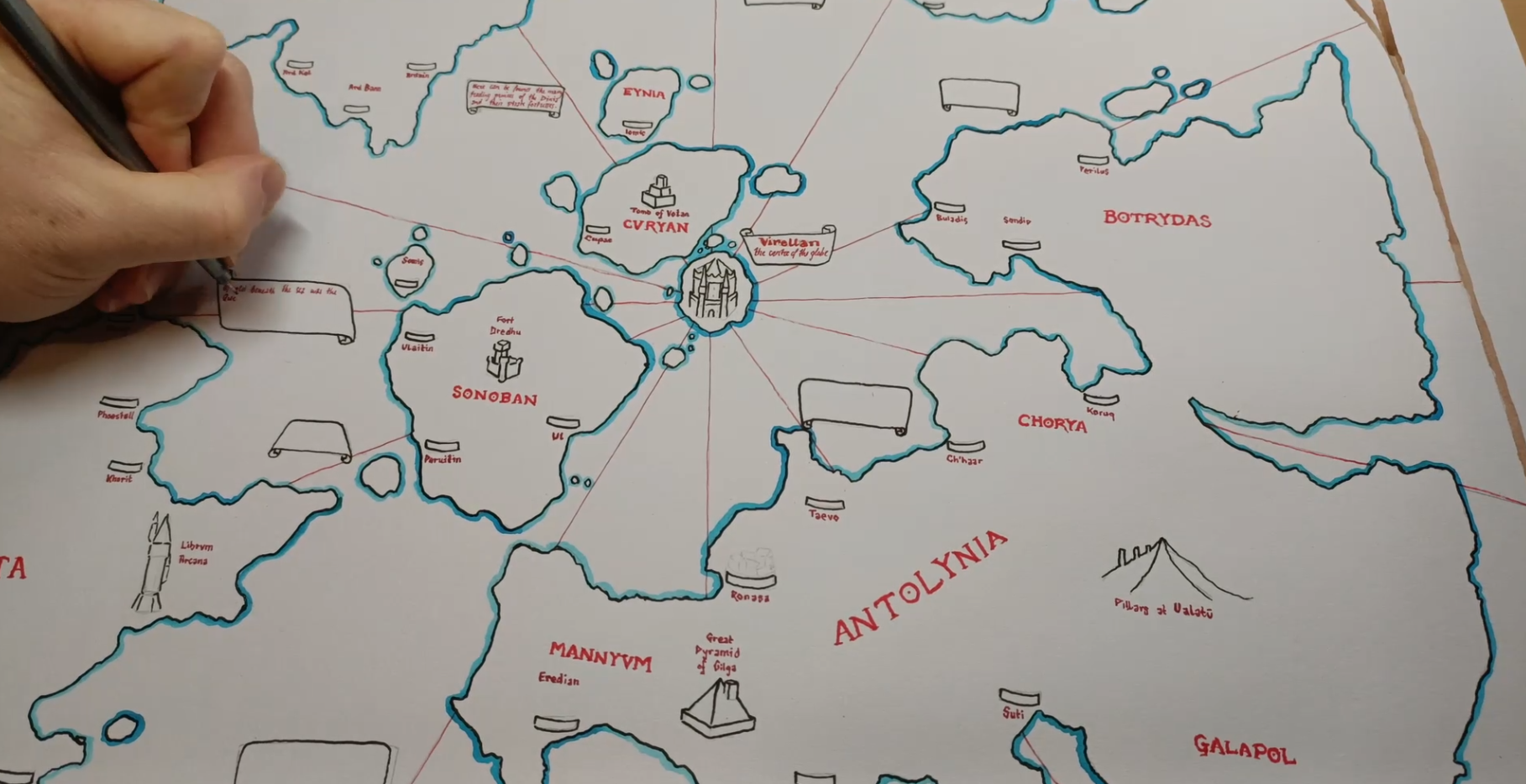
With a soft graphite pencil, I begin sketching the core geography of our map: a sprawling lagoon city-state - let’s call it Virellan - perched on dozens of islands like a jeweled spiderweb.
From there, I sketch the surrounding continents. Rather than organizing them to fit modern expectations, I rotate the map so that east is at the top - just like many Venetian and Islamic maps did. This puts the sea trade at the forefront and suggests that knowledge flows from the rising sun.
Shorelines are ragged and irregular, with lots of inlets and sandbars - perfect for giving that Venetian feel. Every landform is carefully drawn with attention to rhythm and asymmetry - no cookie-cutter coastlines here.
Once the landmasses are in, I ink them with a fine nib and waterproof ink. The lines are deliberate and slow. This is where the magic begins.
Step 3: Grids, Rhumb Lines, and Compass Roses
Next, I use a ruler and pencil to lay out rhumb lines radiating from a central compass rose anchored in Virellan. Twelve lines, spaced like the hours of a clock, cross the map in all directions. This radial system lends the piece a navigational symmetry that’s immediately eye-catching.
Using ink, I trace these lines lightly, keeping them thinner than the coastline. They’re part of the design, not the focal point.
Then I draw the compass rose itself - a lavish design, full of barbs, curves, and embellishments. Watercolour will come later, but even now the inkwork gives it a medieval complexity.
I add two smaller compass roses at regional hubs to suggest navigational importance.
Step 4: Borders, Margins, and Decorative Panels
Now to decorate the frame.
In the wide border space outside the main circle, I divide the ring into twelve rectangular panels - one for each compass direction. In each, I pencil rough sketches of illustrations: a bestiary of sea monsters, legendary scholars, mythic events, and heraldic crests of distant lands.
One panel shows a scholar of Virellan pointing to the stars. Another shows a monstrous eel wrapped around a ship. These images are inked slowly with a brush pen for bolder contrast.
At the four corners of the sheet, I add roundels containing personified winds or gods. Each has a name and a face, like “The Whispering Gale” or “Mother of the Depths.”
This is where Venetian maps shine - outside the map as much as within.
Step 5: Region Notes and Lore Annotations
Using a fine-tipped nib, I begin writing regional descriptions around the landmasses.
Some are practical - “The Mines of Lirvann, closed by imperial decree.” Others are flavor text - “Here, the sky is always yellow, and clocks run backward.” Each block of text is placed deliberately, nestled into clear space without crowding coastlines or major features.
To mimic the feeling of a map passed through many hands, I add notes in red ink: contradictory or amended annotations like, “No longer accurate - city lost in flood” or “This is a lie told to frighten children.”
This layering of voices - the cartographer’s, the scholar’s, the sailor’s - gives the map its richness. It’s not just a diagram. It’s a record of belief.
Step 6: Watercolour Washes and Highlights
With all the inking complete, I start adding watercolour. I use a soft, limited palette: ochres, umbers, sea-blues, and a touch of green for the marshlands. The sea is a gentle gradient of turquoise and indigo, while landmasses are painted with drybrush textures to evoke elevation and terrain.
The decorative panels get richer tones: crimson, gold, deep sapphire. I leave white space around the compass roses and key cities for contrast.
Each stroke must be deliberate - watercolour punishes haste. But this is where the map truly comes alive. Ink gives it form. Colour gives it soul.
Step 7: Trade Routes, Mystical Paths, and Final Details
To finish, I use a very fine nib and sepia ink to draw dotted lines between major cities and ports. These are the trade routes.
Then I add a few unusual paths in gold ink - one that arcs across the sea and ends at a floating island, another that disappears into a whirlpool labeled “Gate to the Forgotten Depths.”
Tiny symbols - a glowing eye, a six-pointed wheel, a broken crown - are placed subtly at the edge of the map’s reach. They hint at mysteries beyond the known world.
And finally, in the corner of the page, I sign the map with a flourish: Drawn by the Order of Virellan, under the auspices of the Navigator’s Guild.

Closing the Build
The result is a hand-crafted, traditional fantasy map that blends the visual richness of medieval Venetian cartography with modern worldbuilding intent.
There are no shortcuts here - only craft, care, and deliberate design. Every scratch of ink, every watery bloom of colour, adds to the weight of the object. This is more than a map. It’s a relic from a world that feels real.
Next, we’ll take this format and twist it. What if the map was meant to mislead? What if the city of Virellan didn’t even exist?
Time to explore a few alternate versions and see how the same form can be pushed in strange new directions...
So here’s your challenge, adventurers:
Make your own Venetian-style fantasy map. But don’t just stop at one.
Create two versions: one that tells the story the world wants you to believe - and one that hints at something darker, stranger, or simply lost. Maybe it’s a state-sanctioned map of your fantasy empire, printed and distributed to schools, temples, and merchant guilds. Then its twisted cousin: smuggled, burned, recovered in pieces, and entirely suspect.
Or maybe your pair of maps tells a personal story - a noble’s official chart of their coastal holdings, and a secret map handed to their heir before their exile, revealing forgotten islands and unspoken debts.
Your prompt:
Design two fantasy maps of the same place, using the visual language of Venetian cartography. One is official, clear, and decorative. The other is secretive, damaged, or dangerously wrong.
Try drawing both by hand - even just sketching them out on copy paper. Start with a circle. Let that limitation spark creativity. Then add in elements from today’s tutorial: dense border illustrations, symbolic figures, wind-heads, diagonal text, even mismatched scale.
If you’ve never made a map before, this is an incredible way to start. The circular form forces you to think differently. And the historical style lends an immediate sense of weight and age to whatever world you’re building.
And if you do make something - I want to see it. Post a photo in the comments, tag me @TheRedQuills on Instagram, or share it with our cartography crew over on Patreon. I check every post. Every time. Seriously.
Now - let’s open this up to everyone watching.
What’s your favorite example of a map that lies? It could be from a fantasy novel, a video game, real-world history, or something you’ve made yourself. Drop it in the comments. I read every single one, and I’ll be featuring my favorites in a future video. Bonus points if it’s confusing, suspicious, or slightly cursed.
Because maps aren’t just about truth. They’re about perspective - and every perspective hides something.
Until next time, adventurers, keep your pens sharp, your compasses steady, and remember…Not all who wander are lost - but some of their maps are very misleading.