
Map like the Maya
This blog post is based upon the video tutorial How to Map like the Maya from the Red Quills YouTube channel, by Ryan of the Red Quills.
The sun is late. The priest frowns. He casts the black seeds once more across the calendar stone, his fingers trembling. Tomorrow, the stars will rise in a crooked line - and that can only mean one thing: the gods are displeased. Somewhere in the jungle, a river is changing its path. Somewhere, a city is lost to the vines. The cycle begins again. The world is remade.
We are so used to maps that tell us where to go. But some maps - especially old ones - were designed to tell us who we are. And few cultures expressed that with more power than the Maya.
Hello, adventurers, and welcome back to the Red Quills!
If you’ve ever wanted to make a fantasy map that doesn’t just guide your players, but feels like an artifact - a relic of an ancient civilization that saw time, space, and divinity as a single spiraling force - then this post is going to open up a whole new way of thinking.
Today, I want to show you how the Mayan Empire can inspire a completely different kind of worldbuilding. We’ll look at their visual language - from their stone carvings and calendar wheels to their painted codices and ritual terrain - and ask: What happens when we map a world based not on direction… but on prophecy?
Read or watch more?
You can watch the full video tutorial on the Red Quills YouTube Channel here: How to Map like the Maya
You can also download the map that I've made, and make suggestions on how I can fill the calendar slots on the Patreon channel.
Or read more at the Journal.
So here’s the mission:
By the end of this tutorial, you’ll have a toolkit for building your own Mayan-inspired fantasy map - one that layers meaning, symbolism, and story right into the terrain. You’ll learn how to:
- Use radial and cyclical layouts to show time and season across your lands
- Design glyph-like icons to represent not just places, but concepts
- Think like a priest-cartographer: every mark on the page is a prayer, a story, a pattern
You don’t need to be a historian. You don’t need to be a scholar of Mesoamerica. You just need to be curious, and a little bit bold.
Because the Mayans didn’t make maps for tourists. They made maps for kings. For gods. For the turning of the ages.
And today, we’re going to try that ourselves.
So this isn’t going to be a straightforward coastlines-and-mountains tutorial. This tutorial is about design and myth. About how culture shapes cartography. And how, as fantasy creators, we can borrow these deep structures - not to copy, but to echo. To gesture at a world where rivers and cities align with the stars. Where the sacred and the geographic are one.
We’ll start with a little historical grounding, then dive into a full build. I’ll be drawing over the shoulder, explaining every step of the way. You’ll get a finished map at the end - but more importantly, you’ll get the ideas behind it. Ideas you can use in your own campaign, your novel, your one-shot, or your next Patreon prompt.
And if you stick around to the end, I’ve got a challenge for you: a prompt designed to stretch your mapmaking skills, sharpen your symbolism, and maybe - just maybe - get you thinking in circles instead of lines.
Ready? Then let’s open the codex and step into the jungle.

Mapping the Mayan World
When we talk about Mayan cartography, we have to remember - we're not talking about maps the way we know them today. The Maya didn’t draw roadways or coastlines in the same style as medieval Europe or Renaissance-era explorers. Instead, they told stories through symbols, spatial arrangements, and cosmic structures. Every piece of Mayan art that references geography does so with myth, ritual, and social order in mind. And that’s what makes their style so utterly perfect for fantasy maps.
The Maya saw the world as a layered cosmology: the heavens, the middle world (our world), and the underworld, or Xibalba. And just like a D&D world with layered planes of existence, each realm had its rulers, creatures, portals, and symbolic meaning. This three-part cosmos wasn’t just an abstract idea - it influenced city design, temple layout, and the ordering of glyphs in their books.
The Dresden Codex
Let’s start with the Dresden Codex, arguably the most famous surviving Mayan manuscript. This codex, created around the 11th or 12th century (and likely a copy of a much older version), is absolutely brimming with potential inspiration. Its pages are filled with ceremonial calendars, depictions of gods, and what we might call “ritual topography.” One particularly fascinating spread, known as the Flood Pages (pages 58–74), shows chaotic scenes of deluge, gods pouring water, and serpentine shapes curling through the imagery. What can we take from this? Movement, narrative, purpose. The placement of each element is carefully chosen to invoke divine power and cyclical change - not just to “show” a place, but to summon its meaning.
Palenque
Another source worth delving into is the Temple of the Inscriptions in Palenque. This tomb, built for the great king Pakal in the 7th century, contains both hieroglyphic texts and an underground chamber meant to symbolize the passage to the underworld. At the top of the sarcophagus lid is a detailed carving showing Pakal at the moment of his descent into Xibalba, framed by the World Tree and cosmic layers. This isn’t just a grave marker - it’s a map of spiritual geography. The use of vertical space, opposing forces, and symbolic layering directly speaks to the Mayan idea of place. Imagine drawing a dungeon map based on this - each level tied not just to physical depth, but to cosmological meaning.
Stone Stelae
We also have the stone stelae of cities like Copán and Quiriguá, dating from the 8th century, where rulers are shown standing among glyphs and cosmic markers. These stelae don't just mark time - they map political power and divine legitimacy. One stela from Quiriguá, known as Stela D (AD 766), shows the ruler K’ak’ Tiliw Chan Yopaat towering amidst swirling sky signs and thunder glyphs. Now imagine a fantasy map where your capital city isn’t marked with a simple castle icon, but with an immense sigil of storm, rule, and sky - a place of myth as much as politics.
Now, why does this matter for our purposes?
Because Mayan geography is not literal. It’s symbolic, vertical, cyclical, and fundamentally narrative. It’s not about the territory - it’s about the meaning of that territory. When creating a fantasy map in this style, we aren’t just showing where things are - we’re showing why they matter, and what they connect to.
Here are the key takeaways to apply in your own designs:
- Vertical thinking: Layer your worlds as the Maya did. Heaven, earth, and underworld aren’t just concepts - they’re places.
- Glyphic markers: Use symbols instead of names for key locations. Create a legend or codex alongside your map to explain them.
- Calendar-mapping: Arrange your map according to time as well as space. Maybe certain areas “awaken” in different seasons.
- Ritual centers: Show temples or cities not just in terms of population, but in their relationship to stars, moons, and mythic cycles.
- Narrative flow: Use movement - water, wind, paths of gods - to guide the eye across your map. Mayan design is in motion.
So rather than treating your map like a photo, treat it like a prophecy. The Maya did. And that shift in mindset might be just the inspiration you need.

Creating a Map in Mayan Style
Alright, adventurers - let’s put ink to page. We’re going to design a small region in our fantasy world using Mayan artistic principles. I’m calling this land Tz’ayel, the Whispering Kingdom, a realm built around ancient rituals, jungle temples, and a moon-cycle monarchy.
Step 1: Divide the World into Three Layers
I start by dividing the page into three rough horizontal bands. The top represents the celestial realm - stars, moon gods, divine animals. The middle layer will be the material world: cities, rivers, roads, people. And at the bottom? The underworld. That’ll hold ruins, tombs, dangerous portals, and monsters inspired by Xibalba.
Even before I draw any landmarks, I sketch in symbolic markers - sun discs, moon glyphs, eye shapes for sacred watching places. These are design anchors, and they’ll help the map feel mythical and grounded in ritual.
Step 2: Add a Calendar Frame
Now for something fun - I’m framing the map not with a compass rose, but with a calendar ring. Inspired by the Mayan Haab’ and Tzolk’in systems, I’m creating 20 symbols to represent the days of a local sacred calendar. These wrap around the border like teeth on a wheel. Viewers who spot this won’t necessarily understand it - but it’ll feel like lore.
If you’re doing this digitally, create a border layer with repeated iconography. If on paper, break out your compass and fine-liner - it’s worth the effort.
Step 3: Define Sacred Centers
Unlike standard fantasy maps that put cities in strategic locations, I’m placing temples and cities at cosmologically significant points: where the river splits, where the moon rises at the equinox, where two ley lines intersect.
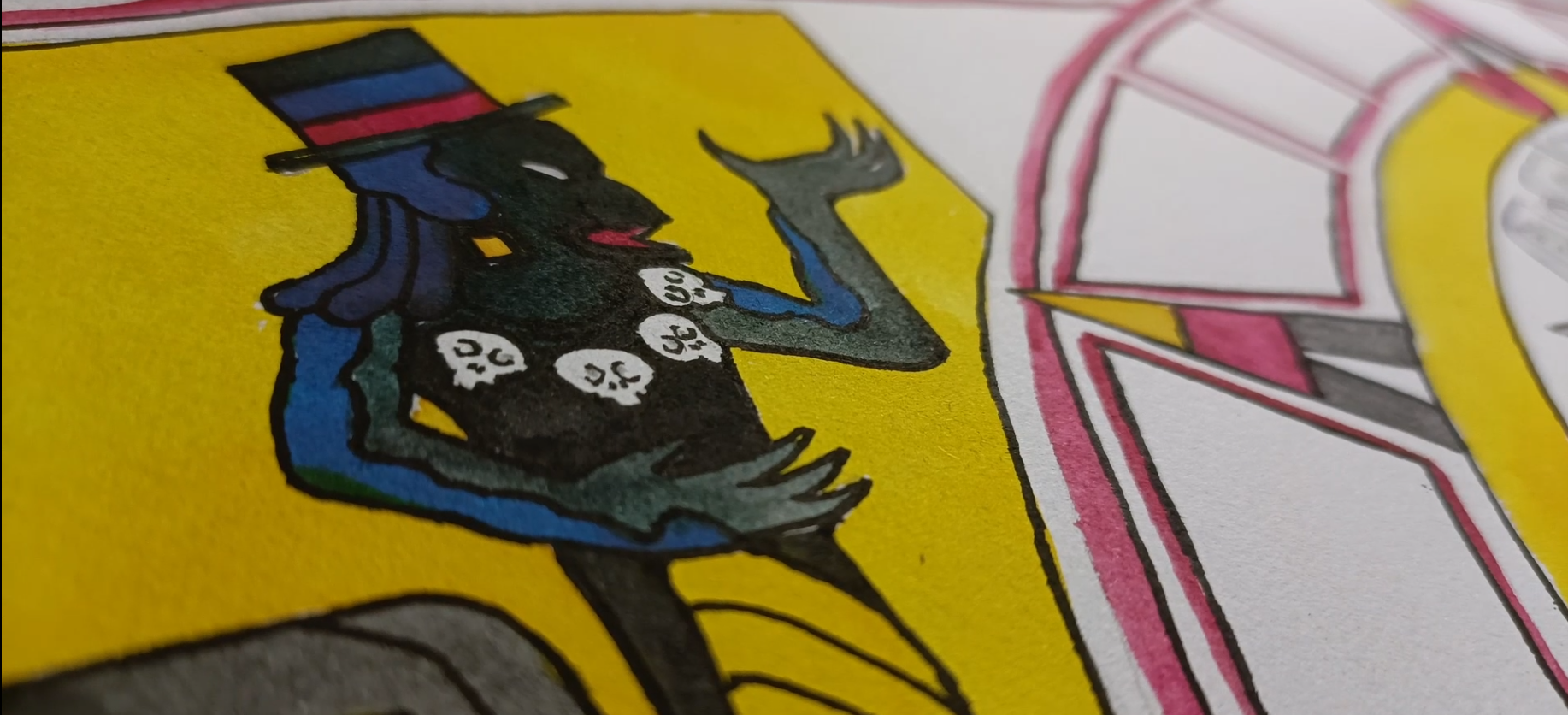
I draw circular pyramids instead of spires or castles, and every settlement is marked with a glyph rather than a name. Later in the legend, I’ll define them - but the mystery is part of the appeal.
Step 4: Flow and Motion
Now I add winding rivers that echo the serpent imagery from the Dresden Codex. Instead of labeling them, I embed icons within them - jaguar heads, feathers, water glyphs. These are meant to suggest the river’s character, not just its course.
Then I draw lines of influence: paths that the moon god travels, seasonal storm paths, ancient trails used only during eclipses. These aren’t roads - they’re stories.
Step 5: Underworld Connections
In the bottom layer, I place cave mouths, skull-shaped hills, and shadowed symbols. The underworld is not a location but a condition. I imagine this area shifting over time - perhaps a player can only see these locations during a full moon.
Finally, I ink everything in bold, blocky lines - no delicate European hatching here. I want this to look carved, like it was etched on stone or bark paper. If you’re doing this digitally, use a chisel brush or distress filter to mimic wear and weathering.
By the time I’m done, the map doesn’t feel like a landscape - it feels like a relic. And that’s exactly the goal.

Mapping Ritual Into Chaos
Let’s say you want to go even further - to really push the Mayan inspiration into narrative territory. How do you take these principles and twist them into something new?
We’ll look at two versions of a region: the first is “classic” Mayan style - structured, balanced, layered. The second is a “twisted” version, warped by a magical event or apocalyptic ritual.
Standard: The Kingdom of Ch’umal
Our classic version is a serene and mystical realm, organized around sacred geometry. At the top of the map, in the heavens, we see three divine stars - each one representing a guardian deity. Their light shines down in lines that connect to three pyramids on the middle-world layer.
Each pyramid-city governs a region: agriculture, rain magic, and death rites. Between them flows a river shaped like a double-headed serpent, and the calendar border shows their festival cycles. The underworld layer contains tomb cities and guardian beasts.
This is a map of order. It’s based on alignment with the stars, harmony between realms, and a known cycle of rebirth.
Twisted: The Shattered Lands of Xob’al
Now let’s imagine that the celestial alignment went wrong. Maybe a comet struck the moon god. Or maybe the festival of bone was interrupted by invaders.
In this corrupted version, everything shifts. The river-serpent coils in on itself like a knot. The pyramid cities have fractured, now each ruled by rival priest-tyrants. The calendar ring is broken, its symbols spiraling off the page.
The underworld has risen. Glyphs once used to mark sacred portals now stretch upward like roots, infecting the middle world. Even the sky symbols bleed into the earthly layer - there is no barrier between realms.
This map tells a different story. One of imbalance, decay, and consequence. It doesn’t just look different - it feels haunted.

Creative Prompt
Alright, friends, let’s land this celestial canoe.
We’ve explored the layered cosmos of Mayan mapmaking. We’ve looked at glyphs, gods, and the rhythms of time. We’ve sketched sacred centers, rivers with personalities, and maps that look more like spells than geography. But now, I want you to do something with all of that inspiration.
This week’s challenge is a creative one. Whether you’re drawing maps for your tabletop campaign, building worlds for your novel, or just playing with ideas in a sketchbook - this is your prompt:
Design a fantasy location that obeys the logic of a symbolic calendar instead of geography.
Let’s unpack that a little. In most Western-inspired fantasy settings, places are defined by physical distance - “It’s three days to the city,” “The mountains block the pass,” “The sea is impassable until spring.” That’s great, but it’s a very literal mindset. And the Mayans didn’t always work like that.
So what happens if distance isn’t physical, but ritual? What if the road to the next village only appears during the fourth day of the lunar cycle? What if your capital city moves, not on a map, but in time, shifting locations based on the calendar wheel? What if a dungeon only reveals its entrance during an eclipse, or a temple is visible only during the Festival of Fireflies?
Here are a few ways to approach it:
1. Calendar-Gated Travel
Design a network of locations that can only be accessed on certain symbolic days. Maybe the “Path of the Twelve Crocodiles” only opens when the glyph for the river god is ascendant. Or a jungle shrine appears on every 13th new moon - so adventurers have to track not just their location, but the calendar.
You could even create a little mini-calendar sidebar on your map that functions like a weather forecast. “Day 1: The Red Jaguar Walks. Day 2: The Drum of Storms. Day 3: The Door is Closed.” Build this directly into your legend or margins!
2. Shifting Geography Based on Ritual
In the Mayan worldview, things didn’t have to stay in place. The gods could rise, walk, merge, die, and be reborn - and so could cities, rivers, even stars. Try designing a map where locations “move” based on ongoing rituals. One temple could migrate through the jungle, a palace could spiral up the trunk of a living World Tree, or a river could vanish entirely when a certain god is asleep.
It’s a way to make your world feel alive - like it’s responding to unseen rhythms.
3. Symbolic Notation Instead of Labels
This one’s an artistic twist. Redraw a corner of your existing world map using only glyphs, icons, or illustrations - no names. Give each location a visual symbol that matches its spirit: a claw for a predatory fortress, a spiral for a place of renewal, a mask for a city of secrets.
Then add a sidebar - a “codex” - that translates those glyphs for your players or readers. You’re not just telling them where to go. You’re asking them to interpret the world.
This is a powerful tool for mystery, immersion, and that delicious feeling of lore waiting to be unlocked.
Now, if you're not sure how to start - don't worry. Here are three smaller creative prompts to warm up with:
- Draw a border made entirely of calendar glyphs. Repeat shapes, add dot clusters, stylize them - create your own “ring of days.”
- Sketch a simple three-tiered map (heaven, earth, underworld) and place one fantasy location in each. Think about how they connect or conflict.
- Invent a Mayan-style name for a place using natural elements and forces. Combine symbols like “storm,” “jaguar,” “mirror,” “flame,” “smoke,” and “water.” What kind of realm would “House of the Mirror Sky” be? Or “Temple of the Seven Ashes”?
These small exercises will get your brain into that Mayan mindset, where time, place, and story are one and the same.
Thanks for joining me in this jungle of stars, symbols, and serpents. I’ll see you next time as we step into another ancient world of mapping magic. Until then - keep your ink flowing and your glyphs glowing.