
Creating Names that Feel Ancient and Real
This blog post is taken from the transcript of the latest episode on the Red Quills YouTube channel. If you wish to read more about how to create fantasy maps, you can also check out our Journal.
A single name can build a world. And a single name can shatter it.
You know the feeling. You've spent weeks, maybe months, crafting the history of your world. You've mapped out the rise and fall of empires, dreamed up forgotten gods, and sketched every last coastline. Then you zoom in on your map, to a small, unassuming town nestled in a river valley. You need to name it. And your mind goes… completely blank.
So, you call it "Riverbend." Or maybe "Oakhaven." And you feel something inside you just… wither. It’s bland. Generic. It feels like a placeholder, a hollow word that has none of the weight, none of the history, none of the soul that you’ve poured into everything else. Suddenly, your epic, sprawling world feels small. It feels fake.
This is the paralytic terror of the blank map, a quiet frustration that every worldbuilder, writer, and game master has faced. You know your world is deep and ancient, but the names you put on it feel shallow and new. They’re like cheap plastic signs on a thousand-year-old temple. They don't just fail to add to the immersion; they actively break it. They pull your audience right out of the story, reminding them that this carefully constructed reality is just a collection of words on a page.
But what if I told you that naming your locations doesn’t have to be this frustrating? What if it could be your single most powerful tool for storytelling? What if one name could tell a story of conquest, of faith, of desperation, without you ever having to write a single line of exposition?
The truth is, the greatest worldbuilders aren’t just inventing cool-sounding words. They’re like archaeologists of language. They understand that a place name is a fossil. It’s a story compressed by time, the ghost of the people who lived there, the land they walked, and the events that shaped them. Names aren't just labels; they are lore. They’re the secret history of your world, hiding in plain sight. And today, we’re going to learn how to uncover them. We’re going to move beyond the generic and craft names that feel like they've been weathered by centuries - names that breathe life and history into your map, making your world feel truly, deeply real.

The Foundation - Start with the Land
Before there were kings, before gods, before borders, there was just the land. And the oldest names in our own world, the ones that have stuck around for millennia, are almost always born from the geography itself. It's the most fundamental principle of naming because it’s rooted in a simple, practical need of the first settlers: to describe where they are. They weren't trying to be poetic; they were trying to be clear.
Think about it. A group of people settles in a valley. What makes their valley different from the next one over? Maybe it's the river. Is the water unusually clear? They might call the settlement Clearwater. Is the river winding and serpentine? Maybe it's Serpent’s Creek. In England, the name of the River Avon literally comes from an ancient Celtic word for ‘river’. So for centuries, people have been living by the “River River.” Sounds a bit silly to us, but it reveals a fascinating layer of history, where one language was built on top of another without anyone knowing what the original word meant.
This is our first and most powerful tool. Look at your map. Don’t think about cultures or history yet. Just look at the physical features.
Let's start with water, the lifeblood of any civilization. A town on a river could be named for its traits. Is it fast-flowing? Swiftford. Slow and muddy? Siltwater. Maybe it’s where two rivers meet. The German city of Koblenz gets its name from the Latin confluentes, meaning 'confluence'. So you could have a city called Twin-Ford or Rivermeet. Think about the color of the water, the rocks in its bed, or the life in it. Is the river known for salmon? Salmoncreek. Is the riverbed full of red clay? The Redwash.
Now let’s look at the highlands. Mountains, hills, and cliffs are some of the most obvious features in any landscape. The most direct approach is to just describe them. The Rocky Mountains, the Black Hills - these names are simple, effective, and timeless. In your world, a mountain range with sharp, jagged peaks could be called the Sawtooths or the Dragon’s Spines. A lone, ominous peak might be the Widow’s Needle. You can also borrow common suffixes from real-world languages to add a little consistency. In Old Norse, ‘fell’ meant hill or mountain, giving us places like Scafell Pike. In Old English, ‘don’ meant hill. So you could have your own versions: Shadowfell, or Kingsdon.
Forests are just as fertile for naming. What kind of trees grow there? Ironwood, Ashwood, or Pinewatch. What's the character of the forest? Is it dark and menacing? Mirkwood is a classic for a reason. Is it ancient and rumored to be magical? The Whisperwood, or the Faewood. A clearing in a forest was often called a ‘ley’ or ‘leigh’ in Old English, which is why we have so many places ending in that sound. A clearing where hunters gather might become Huntsley. A clearing known for its bright, sunlit meadows? Sunleigh.
Even the soil and rocks can give you a name. A town built near a big quarry might be called Quarrytown or Stonegate. A village in an area with rich, black soil? Blackcroft. A city built on a chalk cliff? Whitehaven. The possibilities are endless because the land itself is endlessly varied.
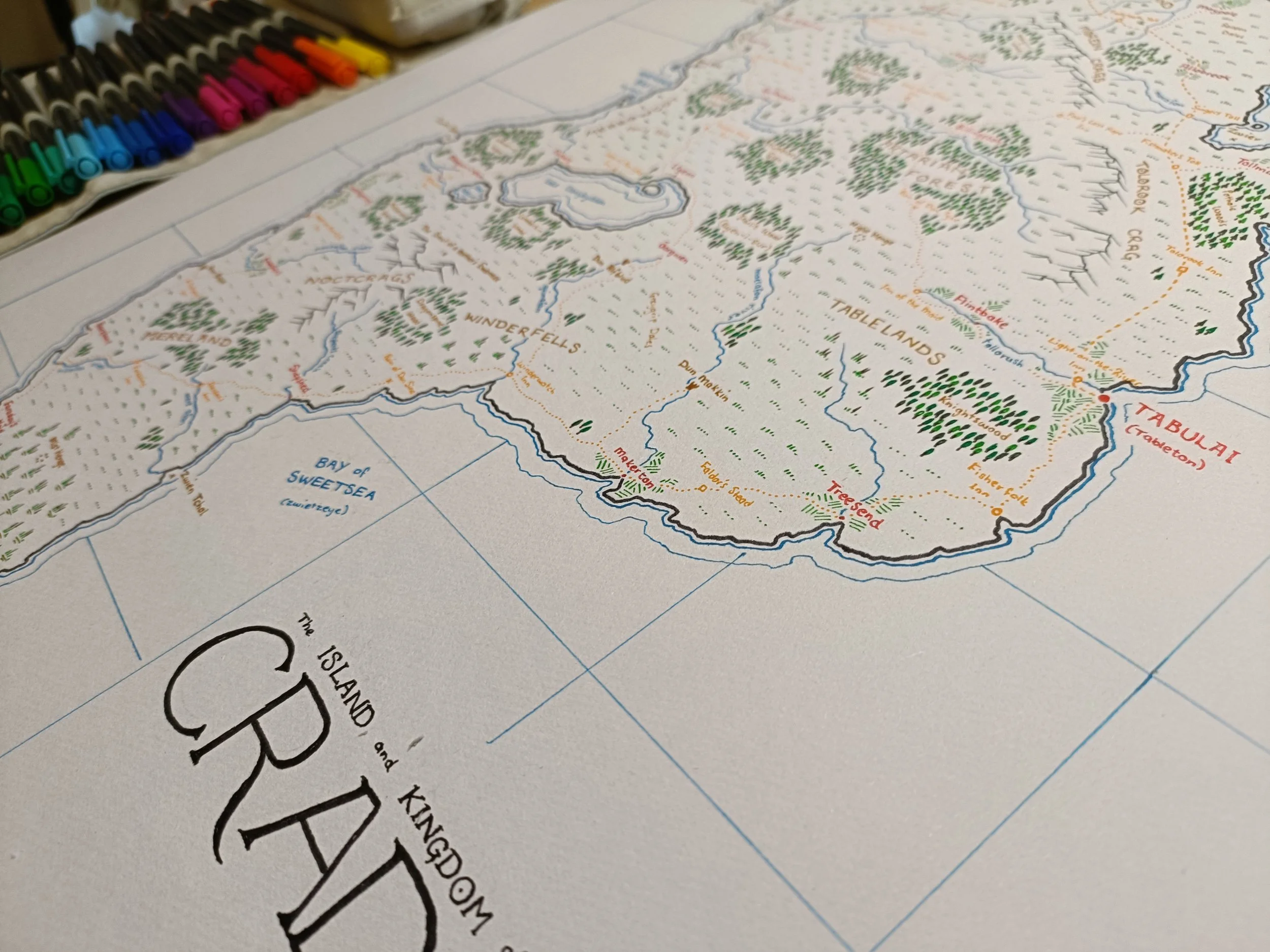
So, here’s a quick exercise. Go ahead and pause the video, and look at your own map. Find one unnamed town. Now, look at what’s around it. What is the single most defining geographical feature? Is it a waterfall, a marsh, a windswept plain? Take that feature and give it a simple, descriptive name. Don’t overthink it. Just describe what you see. Red Cliff. Brightwater Falls. Grey-Moor. Now, just attach a simple suffix that means ‘town’ or ‘settlement’. You can use a classic like ‘-ton’ (farm), ‘-ford’ (river crossing), or ‘-stead’ (homestead). Redcliff-Stead. Brightwater-Ford. Greymoor-ton. See? Already, these names have a sense of place. They’re grounded in the physical reality of your world. They feel less like an arbitrary label and more like a name that grew right out of the soil. This is your foundation. And now we can start building layers of history on top of it.

The People - Reflecting History and Culture
If geography gives a place its body, then culture and history give it a soul. As soon as people settle down, the name of their home starts to get shaped by who they are: their victories, their losses, their heroes, and their gods. Place names are cultural artifacts, little bits of fossilized poetry that tell you what a society cares about.
Let’s start with the most obvious one: naming places after people. This is a tradition as old as civilization itself. The famous example is Alexandria, the chain of cities Alexander the Great named after himself to stamp his legacy across his empire. In your world, a capital city might be named for its legendary founder: "Jaeron's Landing" or "Kaelen's Hope." This immediately tells your audience that Jaeron or Kaelen is a big deal. But you can use this to show a darker history, too. A fortress built by a hated tyrant might be called "Vorlag's Folly" by the people who eventually kicked him out. A city named "Elara's Rest" feels very different from one called "Roric's Fist." Who gets remembered in a name tells you everything about a culture's values.
Beyond founders, names can immortalize a single, critical moment in history. A field where a huge battle was fought might forever be known as "The Field of Lost Kings" or "Victory Plain." A mountain pass where a famous treaty was signed could become "Alliance Pass." Or maybe it was a moment of betrayal that scarred the land, giving you a name like "Traitor's Creek." These names are constant reminders of the past. King's Landing from A Song of Ice and Fire is a perfect example; the name tells you the single most important event in that city's history - it’s where Aegon the Conqueror first set foot to start his takeover of Westeros. It’s a name that just drips with historical meaning.
Religion and myth are also huge drivers of names. People will naturally name places after their gods or the stories that explain their world. A mountain where the storm god is said to live could be "The Thunderer's Throne." A spring with healing powers might be "The Goddess's Tears." A forest believed to be home to ancient spirits could be named "The Ancestorwood." These names don't just add flavor; they reveal the belief systems of your culture without you having to spell it out.
Finally, think about why the settlement exists in the first place. Lots of real-world names are just about what people did there. Oxford is, literally, a place where you could ford the river with your oxen. Sheffield was a field near the River Sheaf that got famous for making steel. This is a fantastic way to create grounded, realistic names. A town whose whole economy is based on mining salt could be "Saltspire" or "Saltdig." A coastal city with a massive port for trading amber could be "Amberport." A village full of lumberjacks? "Logger's Rest." These names are practical, logical, and instantly tell your audience what that place is all about.
When you mix these cultural layers with your geographical foundation, the results are incredible. Let’s take our name from before, "Redcliff-Stead." It's a simple, descriptive name. Now, let’s add some history. What if the founder was a famous warrior named Brenna? The locals might start calling it "Brenna's Stead." Now let's add a layer of purpose. What if the town became known for its amazing blacksmiths? It might evolve into "Smithstead." Or what if a great tragedy struck, like a fire that burned the whole village? Maybe it gets rebuilt and is grimly called "Ashenstead." Each name tells a different story and gives the same spot a totally different feel. The name becomes a living part of your world's story, not just a label on a map.

The Flow of Time - Linguistic Evolution
The worlds that feel most real are the ones that feel like they have a history stretching back long before our story even starts. And nothing creates that feeling of deep time quite like language changing over the years. Place names aren't set in stone; they’re living things. Over centuries, they get worn down, misheard, slurred together, and reinterpreted. This process of verbal erosion is the secret sauce that can turn a simple name into something that feels ancient and authentic.
Think about how this works in the real world. In Roman Britain, military camps were called castrum. The Anglo-Saxons who came later couldn't really pronounce the Latin, so they changed the word to fit their own language. Over time, castrum became the suffixes '-chester', '-caster', and '-cester'. That's how we got Manchester, Lancaster, and Gloucester. The name of the city Worcester is pronounced "Wooster" - a perfect example of centuries of talking smoothing out the rough edges of a word. This "corruption" of names isn't a mistake; it's a feature of a living world.
So, how do we do this on our own maps? You can create a little timeline for your most important locations. Start with an ancient, maybe even forgotten, name and evolve it.
Let's imagine a city founded by elves. Elves are elegant and ancient, so they might give it a beautiful, long name from their language. Let's say they call it Faenar’Banaeq, meaning 'Starlit Harbor'. For centuries, that's its name.
Then, humans show up. They're a more practical, less graceful bunch. They find Faenar’Banaeq to be a real mouthful. So they shorten it. They simplify it. In their mouths, it becomes "Fainerbaque." You can still hear the original, but it’s lost some of that Elven flair.
A few more centuries pass. The kingdom controlling Eldorath falls, and the city becomes a rough-and-tumble port full of sailors and merchants from a dozen different lands. They slur the name even more. "Fainerbaque" just becomes "Farnbaque."
Finally, a new empire conquers the region. Their language is totally different, and they know nothing about Elven history. They hear the locals call the city "Farnbaque," and they try to make it make sense in their own language. Maybe the word ‘bake’ in their tongue means 'fortress'. So they make it official on their maps as "Farbake," maybe even inventing a story that it was founded by a great warrior named Far.
See what we did there? We went from "Starlit Harbor" to "Farbake." The final name has layers. It has echoes of its past. It feels like it has been lived in and fought over. Someone who really gets into your lore might see the name Farbake and spot the ghost of the Elven word inside it, a cool little easter egg that rewards them for paying attention.
This also happens when cultures collide. A mountain range might have an ancient Dwarven name, something guttural and stony, like "Khaz-Baraz." But the humans in the valleys below might just call it "The Grey Peaks." And the Elves in the forest on its eastern slopes? They might call it "Silvanost," or 'Forest-point'. All three names are correct. What a place is called just depends on who you ask. This is the difference between what locals call a place and what outsiders call it, and using both adds an amazing layer of realism.
You don't need to invent a whole language to do this. Just create a few root words and sounds for your ancient cultures. A handful of prefixes and suffixes can do a ton of work. Maybe for your ancient giants, 'Gro' means 'stone' and 'dun' means 'hill'. A place they founded might be 'Grodun'. Millennia later, humans might have softened that to 'Growden'. The meaning is lost to them, but the history is still there, baked right into the name.
This takes a little more thought, sure, but it’s what separates a good map from a great one. It’s the difference between a world that feels like it was made yesterday and one that feels like it has been breathing for ten thousand years.

The Art of Thievery - Borrow and Twist
Let’s be honest for a second. Even the great J.R.R. Tolkien, a professional language scholar, didn’t create his languages from nothing. He based them on real-world languages he loved, like Finnish and Welsh. You do not have to invent dozens of unique languages from scratch. In fact, one of the best ways to create rich, consistent-sounding names is to borrow inspiration from real-world cultures. There are over 7,000 languages on Earth, each a product of thousands of years of history. That's a massive toolbox of sounds, patterns, and ideas just waiting for you to use.
The key here is to "borrow and twist," not to "copy and paste." Just grabbing a real city name like Paris or Tokyo and dropping it on your map is jarring. It breaks the fantasy because it carries too much real-world baggage. And doing a direct, unaltered translation can sometimes feel lazy, or worse, lead to some embarrassing mistakes if you don't really get the language.
So, how do we do it right? It's a simple process: Choose your inspiration, gather your materials, and then smash them together and mess them up.
First, pick a cultural and linguistic vibe that fits the region you're naming. Making a kingdom of seafaring raiders? Check out Old Norse. A classical, organized empire? Latin is your friend. A culture of mystical forest-dwellers? Maybe Celtic languages like Welsh or Irish are a good fit. Let's say we're creating a rugged, mountainous kingdom of proud warriors, and we decide to use Welsh as our inspiration.
Second, gather your materials. You don’t need to be fluent. You just need a handful of words that fit your theme. Use an online dictionary and look up words related to your culture and geography. For our Welsh-inspired mountain kingdom, we could look up: Mountain (mynydd), Fort (caer), Rock (craig), High (uchel), Black (du), and Valley (cwm). We now have a palette of sounds to play with: mynydd, caer, craig, uchel, du, cwm.
Third, combine and corrupt. This is the fun part. Start smashing these words and bits of words together. Twist the spelling. Smooth out the sounds. Make them your own.
Let’s name a fortress high on a black mountain. We have "Caer" (fort), "Du" (black), and "Mynydd" (mountain). A direct combination might be Caerdumynydd. A little clunky. Let's start twisting. Maybe we shorten it to Caerdun. That sounds pretty good. Strong and simple. Maybe we combine Caer and Mynydd differently: Caerinydd or Caernydd.
How about a town in a dark valley? We have Du (black) and Cwm (valley). So, Ducwm. Let's play with it. We could soften it to Ducoom, or maybe flip it and corrupt it into Comdu.
One more: a settlement near a big rock. We have Craig (rock) and maybe the word for town, tref. So, Craigtref. Let's wear it down over time. Craigtref becomes Creitref, which might eventually become Creytreff. It feels unique, but it’s rooted in a consistent sound.
When you do this with the same source language for a whole region, you get a set of names that sound like they belong together. A reader might not know that Caerdun and Comdu come from Welsh, but they'll subconsciously pick up on the similar sounds and rhythms. It creates a feeling of cultural cohesion, making the region feel like a real place with its own identity.
One last, crucial step: always do a quick search for your new name. The last thing you want is for the cool-sounding name for your capital city to be an obscure slang term for something embarrassing. A five-second search can save you a world of future pain.
This method gives you the best of both worlds: the richness of a real language, with the creative freedom to make it your own.

The Beauty of the Mundane
After all this talk of epic history and linguistic depth, I’m going to share one last secret, and it might be the most important one for making your world feel real: not every name needs to be epic. In fact, a map full of names like "Shadowfall," "Dragon's Breath Peak," and "The Sunken City of Sorrow" can get exhausting and, ironically, feel totally unrealistic. Real life is full of names that are simple, descriptive, and sometimes, just plain boring. Your world should be, too.
For every Rome, there's a Newtown. For every Babylon, there's a Westfield. The authenticity of your world is built just as much on the mundane as it is on the magnificent. Small villages, farming communities, and little hamlets are often named for the most obvious things. Names like "North Farm," "Easton" (literally, East Town), or "Bridgewater" aren't exciting, but they're real. Sprinkling these kinds of names across your map provides a crucial backdrop of normalcy that makes your more important, evocative names really pop. It gives your world texture. If every single place name is loaded with deep lore, it can feel like the author is trying way too hard.
Then there’s the power of the misnomer - names that aren't even accurate. Think about Greenland, which is mostly ice, and Iceland, which is surprisingly green. These names were basically early forms of marketing. In your world, a place might be called "Greenwood" even if the forest was chopped down centuries ago. The name sticks around like a ghost of what used to be there. A barren patch of land might be ironically named "Hope's Bounty" by a desperate group of settlers who found nothing. These kinds of names add a layer of irony and history, hinting that the real story is more complicated than the map suggests.
Finally, don’t underestimate the power of a name whose origin is just… lost. In our world, the origins of thousands of place names are debated or completely unknown. Why is a place called "Pity Me" or "Sillywrea"? We don't really know. The names are strange, and they feel ancient precisely because we don't know what they mean. It's perfectly okay - in fact, it's a great idea - to have some names on your map that have no clear meaning, even to you. Maybe you just combined some sounds you liked. These names hint at a history so deep that the original meaning has been lost forever. It suggests your world is bigger than even you, the creator, fully understand, and that gives it a real sense of mystery.
So, embrace the chaos. For every capital city whose name tells a thousand-year story, add a few villages called "Riverton." For every mountain called "The King's Crown," add a hill called "Pudding Hill." This balance between the epic and the everyday is what will ultimately make your world feel less like a fantasy construction and more like a real place.

Conclusion
We started this journey staring at a blank map, frozen by the fear of the bland, generic name. Now, that map should look different. It should look like an opportunity. A chance to tell stories not just in your writing, but in the very words you use to label your world.
We've seen that the strongest names are built on the land itself. We layered them with the soul of a people - their history, heroes, and faith. We wore them down with time until they felt ancient. We learned how to steal like an artist from the real world to create something new. And finally, we embraced the simple and the mundane, knowing that true realism is found in variety.
A place name is your most efficient worldbuilding tool. It's compressed lore. It's a promise to your reader of the stories hiding just beneath the surface. It's the difference between a place called "Evil Fortress" and a place called "Dol Guldur." One is a label; the other is a story.
So the next time you face that blank space on your map, don't see a problem. See a puzzle. What did this place look like to the first people who saw it? What happened here? What languages were spoken, and which were forgotten? The answers will give you more than just a name. They'll give you a piece of your world's soul.
If this guide sparked some ideas for your own world, make sure you hit that subscribe button and ring the bell for more deep dives into the art of worldbuilding. And now I want to hear from you. Go down to the comments and tell me about the most interesting or meaningful place name you've ever created for your own world. What’s the story behind it? I read all the comments, and I can't wait to see the worlds you're building. Now, go fill those maps.