
Making a Genre Map for a Fantasy Horror Campaign
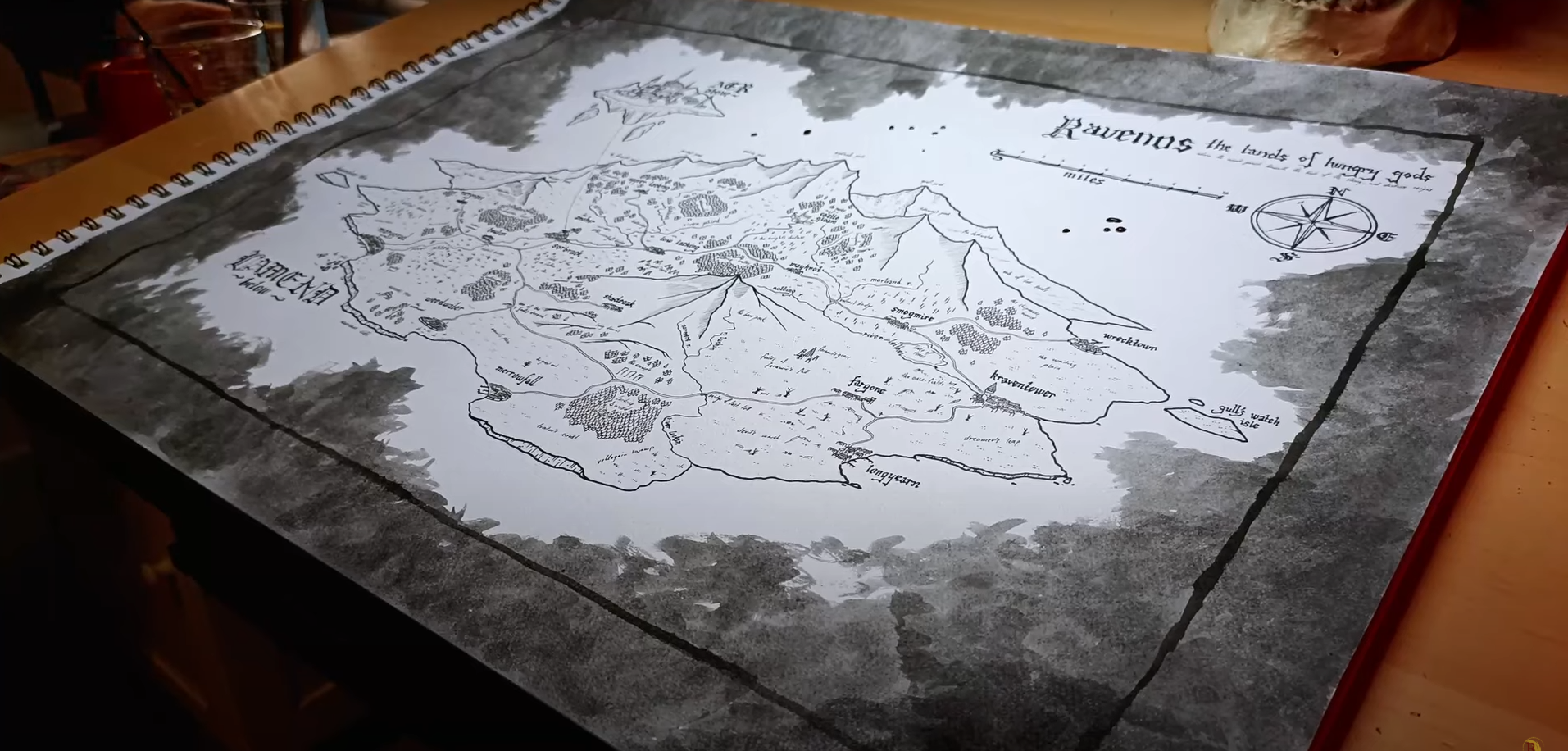
What if your map was the first monster of your campaign? Not just a guide, but an actual source of dread. Welcome to Ravenos, the Land of Hungry Gods… a place trapped by misty seas and ruled from a floating castle. Today, I'm not just showing you how to draw a map. I’m going to show you how to forge a storytelling artifact. We're going to bake horror into the very lines of your world using gothic fonts, grimdark names, and artistic dread to set the stage for a campaign that is genuinely terrifying.
Hello, adventurers, and welcome back to the Red Quills. Today, we’re starting on another series: over the next few weeks, I’ll be creating maps to different styles of campaign - different genres of story. And we’re starting strong, with horror and grimdark. Think Ravenloft, of vampires and nightmares.
If you like the look of the map below, you can download it for free on the Red Quills Patreon.
Or, watch the full tutorial on the YouTube channel.
Every great fantasy campaign needs a map, right?
It's our anchor, the shared space where the story happens. But for a horror campaign, a standard fantasy map - with its cheerful green forests and inviting towns - doesn't just fall flat; it actively works against you. It sets the wrong tone - it promises adventure when it should be whispering about dread. It gives you clarity when it should be wrapping secrets in shadow.
So today, we're flipping that on its head. We’re going to treat our map not as a navigation tool, but as a way to make our players feel oppressed. It’s the very first piece of lore your players will see, and it has to do some serious heavy lifting. It needs to scream the core themes of your world before you've said a single word. Our map for Ravenos has to look and feel like it was scratched into a piece of parchment by someone who lived and died in this grim, terrifying place. It needs to feel like an artifact just soaked in fear.
And don't worry, this isn't about becoming a master artist overnight. In fact, some of the best horror vibes come from keeping it simple, embracing a rougher, more primal style. It's all about making deliberate, thematic choices. Every line, every name, every shadow we put down will have one purpose: to build a sense of unease, hint at dark histories, and promise a world that is fundamentally broken and dangerous. We’re not just drawing geography; we’re drawing a feeling.

The Preparation
Before we even think about touching pen to paper, the most important work happens in our notes. A map is a visual story, and every story needs its key locations and points of interest. For a standard fantasy map, you might jot down "The Sunken City" or "Dragon's Peak." For Ravenos, we need to dig into the vocabulary of horror. We're brainstorming names that aren't just labels, but story hooks dripping with that grimdark flavor.
This is what I call the "story first" method. I always make a list of locations before I even think about the shape of the continent, because it grounds the whole process in narrative. Let’s brainstorm some for Ravenos. Our world is about oppressive rulers, hungry gods, and a land steeped in misery. The names have to reflect that.
So, instead of "Northwood," we get "The Weedwood" - a name that just sounds sick and decayed. A river isn't just a river; it's the "River Leithei." A central town won't be something pleasant like "Oakhaven"; it’ll be "Kraventower," which tells you everything you need to know about justice in this land.
Let's make a quick list to guide our drawing:
The Capital:
Aer Above. Completely different to the rest of the naming structures, and kept away and above them. It is tethered to the ground by The Iron Chain. This immediately shows the power dynamic: a ruling class is literally floating above the suffering.
The Surrounds:
All around the island, there is a vast nothingness. The meaning has to be clear, the question has to be answered. In a lot of grimdark campaigns, the question of “Why don’t they just leave?” comes up a lot. This is the answer. All around is a worse fate than living under the cruelty of Aer.
The Peaks:
In horror and grimdark, everything is hostile, and the peaks are a jagged, sharp way of reminding everyone that that also applies to nature. They push through the lands of the peasantry, curbing and compressing them.
The Wilderness:
The forests, like the Witchwood, and the fens, like the Hagsreach Fens, are throughout the land. Like travellers huddling around a fire in the dark, we want the miserable clusters of houses in the towns and villages to feel fearful, but better than the alternative. The wilderness outside is cold and dark, and life in captivity is still better than death.
The Destruction:
All through the land, we want the evidence that Aer has imposed their cruelty, and that the people live in people. The powerful have control over everything, nature and civilisation alike, and the weak control nothing. Swathes of forests have been reduced to stumps and dead wood, monasteries destroyed, and gallows and monuments are littered throughout.
The Warnings:
Through this map, I wanted to use the concept that mapping - seeing the world in the palm of your hand - is a form of propaganda that can be used to dishearten the oppressed. A map which shows monuments or places of victory in the past can be symbols of hope, if done right. But if the powerful have rewritten the maps to change names, remove icons, and place their own sites? Changing the name of a town like “Riverwood” to “Smogmire” is a cruel stroke in a creepy game.
See the pattern? These names do more than just identify a place; they tell a tiny story. They're active, descriptive, and emotionally loaded. Using a pseudo-Latin or esoteric style can also really crank up the grimdark feel. "Low Lacking" just sounds way more ominous than "Valleymeet" Our names, like Kraventower and The Example, are going for that same effect - grounded, but grim. This list is our narrative blueprint. Now, let's give these nightmares a home.

Forging the Bones
Alright, let's start drawing. We're aiming for a hand-drawn, authentic feel, like this map is a real object from the world. You don’t need fancy tools. A good piece of paper - maybe one with some texture or a cream color - and a couple of simple pens are all it takes. I like to use fine-tipped black ink pens in a few different thicknesses to get some nice variation.
The Landmass
Forget rolling dice for a random coastline. We are designing this landmass with a purpose. Our theme is oppression and entrapment. Ravenos is a land caged in by misty, impassable seas, so our continent should feel like that cage.
Start by drawing a large, central landmass. But don’t make the coastline gentle. Use jagged, sharp, almost violent lines. Think of cracked glass or shattered bone. Make the coastline look like a wound. Let it break and splinter into sharp little islands and rock spires, or one long cliff that cuts away from the island - that’ll be our Traitor’s Coast. Right away, that tells a story of some horrible cataclysm in the past.
Now, let's shape the land to feel hostile. Instead of wide-open plains, create narrow, choking valleys and peninsulas. Throw in mountain ranges that don't just sit there, but look like they're actively clawing at the land, creating natural barriers that cut off communities. These aren't the majestic, snow-capped peaks of high fantasy; these are jagged, cruel fangs erupting from the earth. When we draw our mountains, we won't draw beautiful, individual peaks. We’ll use clusters of sharp, overlapping triangles, like a row of shark's teeth. Keep it simple, almost symbolic. The goal is to create a landscape that feels actively hostile to life.
Think about the flow of the land.
In Ravenos, the whole continent is dominated by a great plateau at its center. This is where the floating castle, the Aer Above, will be tethered. The land then slopes down from this central point, implying that everyone and everything is subservient to that power. All the rivers will flow away from this high point, like tears running down a face, carving miserable paths through the land. Let them meander through oppressive mountain passes and dark forests, never giving anyone an easy way to get from one place to another.
The shape of your world is the first layer of its personality. Make it claustrophobic, sharp, and unforgiving. This isn't a land made for heroes. It’s a prison made of rock and water.

Icons
With the bones of our world in place, it’s time to add our icons - the simple, symbolic drawings for our named locations. The key here is to keep it simple and moody. We're not creating photorealistic drawings. We want spooky, evocative silhouettes that a player gets in a single glance. A great tip is to sketch out your icons on a scrap piece of paper first before you commit them to the real map.
Drawing Aer Above
Let’s start with the big ones. Aer, our capital city, sits on that floating isle. To draw it, don't sketch a friendly castle. Draw a dense cluster of sharp rectangles and triangles. Think of a briar patch made of stone. The silhouette should look chaotic and oppressive, with no clear, welcoming gate. It should look like a fortress designed to keep people in, not just out.
Then, from its underside, draw one single, heavy chain that links it to the center of Sorbrack. That’s The Iron Chain. This one visual is so symbolic. It shows the rulers are literally detached from the world below, held in place by a symbol of bondage. The castle on the floating island can look different - maybe more elegant, with impossibly thin spires, inspired by Gothic cathedrals. This contrast really drives home the decadence of the rulers versus the grim city below.
Creating a Forest of Dread: The Saltflight Barrens
For forests like the Noroak Wood, avoid drawing happy, fluffy trees. Instead, a simple trick works wonders. Represent the forest with a collection of simple triangles for pine trees or gnarled, bare trunks with branches like claws. Cluster them tightly together so they look like a dense, impenetrable mass. On the edges, draw a few lone, dead trees to make it feel like the forest is bleeding out and encroaching on civilization. The outline of the forest itself shouldn't be a gentle curve, but a wavy, almost sinister shape, like a creeping stain.
Illustrating Other Inhabitants
Swamps are perfect for horror. To draw the Hagreach Fens, we won't even draw water. We'll use sparse horizontal lines to show the flat, marshy ground, with little vertical tufts of grass sticking out. The key is to make it look empty and desolate. Maybe add a single, half-sunken ruin in the middle. It's the emptiness that makes it so creepy. The name does the rest of the work.
I love the implications: they’re the best tool for a worldbuilder. The fens are a great example: they are a wilderness, unsuitable for comfortable living, but they are also the territory, or so it is claimed, of the hags. Are they real? Are they a myth? Do they work for the Masters up on Aer?
Marking Ruins and Roads
For ruins like the Lost Abbey, use broken shapes. A single, shattered archway or a crumbling wall is way more evocative than a detailed drawing. For roads, don’t draw bold, confident lines. Use faint, dotted or dashed lines. This suggests they're unkept, dangerous, and maybe not always there. Make them wind hesitantly between locations, never taking a direct route, looking more like scars on the landscape than arteries of commerce.
Each icon is another chance to reinforce your theme. Keep them simple, keep them dark, and make sure they add to the overall feeling of dread.

The Scars of History
Okay, our map has its geography and its locations, but it still feels a little too clean. Too new. A real artifact needs to feel like it's been through some stuff. This last stage is all about adding the layers of text, texture, and detail that will really bring it to life.
Step 1: Gothic Fonts and Thematic Labeling
The names we chose are only half the battle; how we write them is the other half. Your map's font is critical for the mood. We want something that feels gothic, ancient, and maybe a little unhinged. You can find plenty of free gothic or blackletter fonts online, or you can just do it by hand. When you write your labels, add sharp little flourishes, exaggerate the vertical lines, and keep the letters cramped together. It should feel less like clean text and more like something scratched out by a trembling hand.
Now, think about placement. Don't just write names horizontally. Let the labels follow the land. The name "River Phled" should curve and snake right along the river. The name of a mountain range can be stretched diagonally across the peaks. For major locations like Kraventower, use a larger, more ornate version of your font. For tiny spots like The Fool’s Errand, use a smaller, messier scrawl. This text hierarchy makes the map more interesting to look at and tells you about the world at a glance.
Step 2: Adding Symbols and a Compass of Despair
Your map needs a compass, but not a normal one. Design one that fits the world: I’ve got a simple, standard rose with the letters in that gothic hand. Maybe instead of North, South, East, and West, it has symbols for four ruling sorrows. Or maybe it's just a broken compass. The border of your map is another great storytelling spot. Instead of a simple line, decorate it with thematic stuff - skulls, chains, thorns, or weeping eyes woven into a grim frame.
You can also add small, mysterious symbols across the map. A tiny drawing of a noose near Gallows Cross, a bloodstain near an old battlefield, or a strange spiral symbol in an empty part of the wasteland. These are little story hooks that don't even need a label. They’re visual questions that will make your players lean in and ask, "What happened here?"
Step 3: Weathering and Aging the Artifact
Finally, we need to make the map itself look old. If you're working digitally, you can use texture overlays that look like old parchment. If you're on physical paper, you get to do the fun stuff. The classic method is a tea or coffee stain. Just brew some strong tea, let it cool, and then gently dab it onto the paper with a sponge. Let it pool in some spots to create a natural, uneven look.
Once it's dry, you can rough it up a bit. Carefully crumple the map into a ball, then smooth it back out. This creates a network of creases that makes it look like it's been used for ages. You can even very carefully singe the edges with a lighter - please be extremely careful and do this in a safe spot! - to give it that "survived-a-fire" look. These final touches are what sell the fantasy. It makes the map feel less like a prop you made and more like an object a character found; it has a history, it survived something. And that implies that just surviving in this world is a big deal.

Final Reveal
And there we have it. Let's take a step back and look at what we've made. This is no longer just a map of Ravenos. It's a warning.
The oppressive shape of the landmass makes you feel trapped before you even read a single name. The jagged mountains and dark forests promise a tough, dangerous journey. The icons aren't destinations; they're threats - a floating castle built on sorrow, a city that looks like a stone trap, a bog that swallows all sound. The names themselves are a laundry list of despair: Gallows Cross, the Withering Woods, the Shattered Coast. The gothic script feels like an ancient curse, and the stains and burns on the paper tell a story of a long, hard history.
Every choice we made was deliberate, all designed to build this one, cohesive atmosphere of fantasy horror. This map is now a storytelling engine. It gives the players a visual anchor, but it also gives you, the Game Master, dozens of hooks. What really happened at the Sanctuary of Lost Faith? Who was the fool at the Errant? What kind of horrors are born in the Bog of Silence?
This is how you turn a piece of paper into the first monster of your campaign. You give it a voice, a history, and a soul - a dark soul, for sure, but one that will pull your players in and set the stage for some truly unforgettable stories.
I hope this got you thinking about your own maps as more than just tools.
Ravenos is just one idea. What does your nightmare world look like? What grimdark names and oppressive geography would you use?
Share your concepts for a fantasy horror map in the comments below. I'd love to see what terrifying worlds you're all dreaming up. Brainstorming with other creators is one of the best parts of this hobby, so let’s build some nightmares together.
Thanks for joining me on this trip into dark cartography. If you found this useful, think about subscribing for more world-building and storytelling guides. Now go forth, and draw your dread.