
This Art Style Makes Apocalyptic Worlds Feel Real
This article is taken from the transcript of the latest episode of the Red Quills Mapmaking channel. You can watch the full tutorial here.
Have you ever wondered why some apocalyptic worlds feel like cheap movie sets, while others feel like they have a real, breathing history? Like you could actually step inside and feel the grit of the dust, and hear the strange quiet of a world that moved on without us?
It’s all in how you tell the story. And today, I’m going to show you how to use the clash between permanent, unforgiving ink and wild, unpredictable watercolor to build a post-apocalyptic world that feels truly alive. This isn't just a painting tutorial; it's a lesson in environmental storytelling. We're not just making a pretty picture of the end of the world. We're going to design and build a world with a soul - a place I’m calling Neo Yumaria. By the end of this, you'll see how the very materials we use can tell a story of stark endings and chaotic, beautiful new beginnings.
The core idea here is simple, but really powerful.
We’re mashing together two mediums that are basically opposites. The ink is our past. It's the harsh, unchangeable truth of what was lost. The lines are permanent and structural. They are the concrete skeletons of skyscrapers, the twisted metal of bridges - the final, brutal facts of the world that ended.
Then you have watercolor. Watercolor is chaos. It's life. It’s nature. It bleeds and blossoms and moves in ways you can't always predict. It’s the perfect medium to show the relentless, beautiful, and sometimes terrifying force of nature taking back what's hers. It's the moss cracking through pavement, the flash of a mutated flower, the rust weeping down the side of a forgotten machine.
Together, they create this visual argument. It's a constant push and pull between order and chaos, death and life, the rigid past and the fluid present. That conflict, that tension, is what makes a world like Neo Yumaria feel real. It gives it a history. And it gives it a future. Today, we bring that city to life, and we’ll start, like all worlds do, with a plan.

Materials and Composition
Before a single drop of ink or color hits the paper, we need to think like world-builders, not just artists. The story of our piece starts right here, with the choices we make before we even begin.
First up, our tools.
Every material we choose is a narrative choice. I’m using a cold-press watercolor paper, about a 140-pound weight. The 'cold-press' part is key because it has this noticeable texture, or 'tooth'. This texture grabs the ink from our pens, making the lines feel a little gritty and imperfect. It also creates these beautiful, random patterns when we add watercolor, letting the color settle into the little valleys of the paper and adding to that feeling of organic decay. If we used a smooth hot-press paper, we'd get clean lines, which is great for an architectural drawing, but we want the opposite. We want the paper itself to help tell the story of a weathered, textured world.
For the ink, I’ve got a bunch of waterproof technical pens. And they have to be waterproof. If they’re not, the second the watercolor touches the ink, your whole piece will bleed into a gray, muddy mess. The permanence is part of our analogy: the past, the ruins - they don’t change. They're set in stone, or in this case, waterproof ink. I have a few different nib sizes. A thicker one, like a 0.8, is for the major structures in the foreground - the things closest to us that need to feel heavy and solid. Then, I’ll use finer nibs, maybe a 0.3 or -0.1, for details farther away. It's a classic trick to build depth and create a sense of vast, ruined space.
Finally, the watercolors.
I’ve got a simple palette here; you really don’t need a hundred colors. The story of Neo Yumaria is all about contrast. So I have earthy tones like burnt sienna and yellow ochre for all the rust and dust. I've got a set of vibrant, almost unnatural greens and maybe a pop of magenta or violet for the mutated, tough-as-nails plant life that’s coming back. And a few darks, like Payne’s gray and indigo, to push our shadows and create a somber, mysterious mood. The secret is to let these colors mix themselves on the paper, creating what artists call ‘happy accidents.’ We’re not controlling the watercolor; we’re unleashing it.
Now, composition.
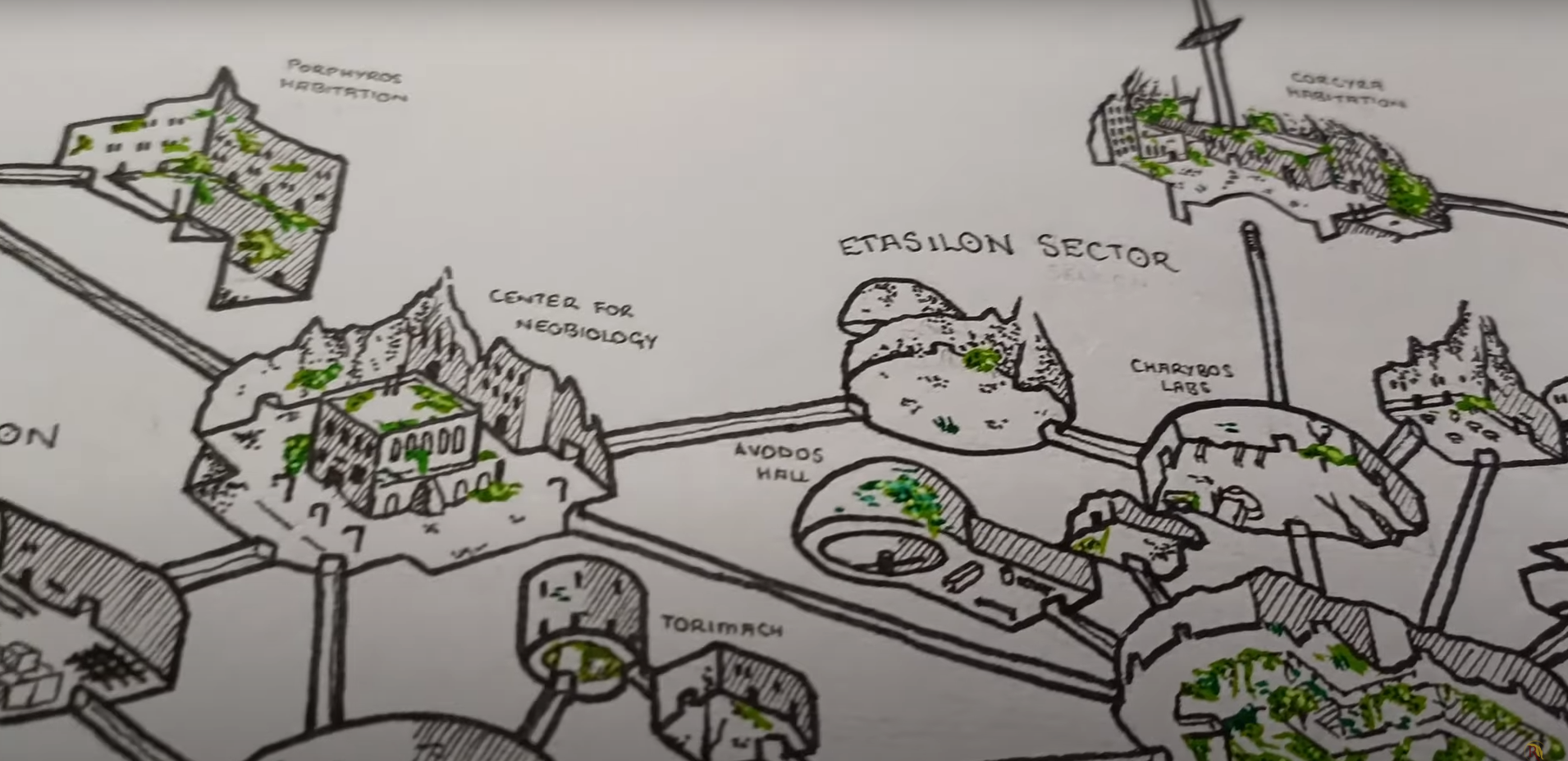
The layout of our city is the first chapter of its story. I’m thinking of an isometric perspective. It gives us a slightly elevated, god-like view, so we can see the tops of ruined buildings and even hints of what’s underneath, like chasms or subway tunnels.
I'll start with a super light pencil sketch. This is our ghost, the last faint echo of the city’s original grid. You want to use a hard pencil, like a 2H, and draw with a really light hand. These lines are just guides; we don't want them showing up in the final piece. I’m mapping out the key spots. Maybe in the center, there's a massive, collapsed broadcast tower - a monument to the old world’s last, desperate attempt to communicate. Over to the left, a district of shattered skyscrapers, their windows like vacant eyes. To the right, a flooded area where a river burst its banks, and you can only see the tops of buildings. And woven through it all are signs of the new world: huge, strange roots breaking through a plaza, and dark, cavernous entrances leading underground, where who-knows-what lurks now.
I’m also thinking about where to put little narrative focal points - small details that hint at a bigger story. Maybe a makeshift bridge between two rooftops, which suggests survivors. Or a zone where strange, cybernetic beasts are known to patrol. We're not just drawing buildings; we’re creating landmarks that make the world feel lived-in and full of stories. The composition should take the viewer on a journey through this history. We're setting the stage for a tragedy, but also for a story of survival.

Inking the Bones
Alright, now we commit. This is the part where the story of the old world gets written in permanent ink. Every line we draw from here on out is a final statement. There's no erasing. That unforgiving quality is exactly what makes ink the perfect medium to show the stark reality of the apocalypse. It demands confidence, but we can use that to our advantage. Don't be afraid of the permanence; embrace it. Every shaky line, every accidental slip, just becomes another part of the city’s ruined history.
I’m starting with my thickest pen, the 0.8, focusing on the big stuff in the foreground. This massive, toppled skyscraper right here in the corner. I’m not drawing straight, clean lines. That building is dead. It's a skeleton. So my lines need to show that. I'm using broken lines, letting the pen skip across the textured paper to create a rough, concrete-like feel. I'm adding cracks, fissures, and chunks of missing facade. Think about the story of how it fell. Was it an explosion? An earthquake? The lines can tell that story. Jagged breaks suggest a violent end, while crumbly, rounded edges might imply a slow decay over centuries.
As I draw these buildings, I think of them as characters.
This one was a sleek corporate headquarters. Now its steel guts are exposed, twisted like arthritic fingers reaching for a sky they don't own anymore. I’ll use cross-hatching to build up shadows on the undersides of these broken structures. Cross-hatching is a classic technique, but we can make it messy. Let the lines be chaotic, overlapping unevenly. This isn’t just shading; it’s visual noise. It’s the texture of ruin, the buildup of dust and decay. The trick is to balance how much work the ink will do versus how much the color will do. Here, the ink is doing the heavy lifting for structure and deep shadows.
Now I’m switching to a finer pen, a 0.3, to move into the mid-ground. The lines get thinner, less defined. This immediately pushes those buildings back, creating that crucial sense of scale. This city needs to feel huge, like the destruction stretches on forever. I'm not putting nearly as much detail into these buildings. They're just silhouettes, ghosts of a city.
And here’s where we can drop in those little narrative breadcrumbs.
On the side of this building, I'll draw the faint, faded logo of a corporation: "OmniCorp." It’s a classic sci-fi trope, sure, but it instantly hints at a past of technological hubris. Down below, maybe I'll add a barricade made of rusted-out cars - a clear sign of a past struggle, of people fighting to survive. This isn’t random detail; it’s what turns a setting into a story.
One of the hardest things when you're starting out is knowing when to stop. It's so tempting to just cover every inch of the paper with detail. But we have to leave room for our next character: the watercolor. The most detailed ink work should be in our focal points. Other areas, especially ones that will be covered in plants or deep shadow, can be left more open. We're creating a balance between the defined and the undefined. We've just inked the bones of Neo Yumaria. We've set up its harsh, broken history. Now, it's time to breathe some chaotic, messy, beautiful new life into it.
We've built the skeleton of our world, defining its past with the unforgiving finality of ink. But a world isn't just its history; it's what happens next. As we get into the watercolor phase, where chaos and life start taking this city back, I've got a question for you: What's the name of a post-apocalyptic world you've designed or dreamed up? Drop it in the comments below. I'd love to hear about the worlds you're all creating.
And hey, if you're finding this whole narrative-driven art thing helpful and you want to learn more ways to make your worlds feel real, think about subscribing. We’re only halfway through the rebirth of Neo Yumaria, and you won’t want to miss how this story ends.

The Chaos of Rebirth
This is where the magic happens. We've put down the rigid, black-and-white truth of the past. Now, we bring in the unpredictable, vibrant, living force of the present. Watercolor is the perfect actor for this role because it honestly has a mind of its own. We can guide it, but we can't completely control it, and that chaos is a perfect mirror for nature itself.
I’m starting with the sky. An apocalyptic sky isn't just plain blue. It tells a story. Is the air polluted? Is there a weird, perpetual sunset from atmospheric dust? I’m wetting the entire sky area with clean water first. This is a wet-on-wet technique, and it'll let our colors blend and flow beautifully. I’m dropping in some yellow ochre near the horizon, a sickly, jaundiced color. Then, maybe a touch of muted purple higher up. See how they bleed into each other? I’m not forcing it with my brush; I’m just tilting the paper and letting gravity and water do the work. This creates a soft, unsettling atmosphere that feels way more natural than anything I could paint myself.
Now for the main event: the overgrowth.
Nature is taking back Neo Yumaria. This isn't the neat, tidy green of a suburban lawn. This is wild, mutated, aggressive life. I’m mixing a few different greens on my palette - a vibrant, almost toxic-looking sap green, and a darker, more olive green.
I’m focusing on the areas we decided would be reclaimed first, like that central plaza. Again, I might wet a small section of paper. Then I’ll drop in the lightest green and let it flow. While it’s still wet, I’ll touch the tip of my brush loaded with the darker green into the wash. This is called charging. The colors just explode into each other, creating these incredible, organic patterns that look just like dense moss or foliage, and I didn't have to paint a single leaf. This is what watercolor does best. I’m letting the green wash spill right over the hard ink lines of the pavement. This is our theme in action: nature literally destroying the rigid structures of the old world.
Okay, let's talk about something that gets everyone: muddy colors. Mud happens when you mix too many colors on the paper, or when you mess with it too much with your brush. The key is to be decisive. Lay down a color, and then let it do its thing. If you want to add another layer, you usually need to let the first one dry completely. Patience is your best friend here.
Now, for the rust.
Rust is basically the color of time passing. It's the city’s metal bones slowly decaying. I use a mix of yellow ochre, burnt sienna, and sometimes a pop of bright orange. On these exposed steel beams, I’ll lay down a watery wash of yellow ochre. While it’s still damp, I'll drop in thicker dabs of burnt sienna. See how it spiders out, creating that perfect, crusty texture? For a neat little trick, while the paint is still glistening, sprinkle a tiny pinch of table salt on it. The salt crystals push the pigment away, and when it dries and you brush the salt off, it leaves behind this speckled texture that looks incredibly realistic.
I'm using these same ideas all over the city. Splashes of vibrant green showing life in the shell of an old building. Watery blues and greys in the flooded district, with dark tones hinting at whatever's in the deep. Every color choice is a storytelling choice. This green isn’t just green; it's a pocket of defiant life. This rust stain isn’t just brown; it’s a tear from a dying giant. When you think this way, you're not just coloring in the lines anymore; you’re painting a world with a soul. We're not going for photorealism. We want a feeling. The looseness and chaos of the watercolor aren't mistakes - they're the whole point.

The Final Details
The city is built. The story of its fall and rebirth has been told in broad strokes. Now, we zoom in. This is where we add that last 10% of detail that makes the whole piece just pop and feel alive. We need to slow down here, be more deliberate, and add sharp little notes of contrast that make everything else sing.
First, I'm going back in with my finest ink pen, the 0.1.
The watercolor has to be completely dry - and I mean bone dry. If you try to ink over damp paper, the pen will just tear it up and the line will bleed. I’m not adding new buildings, just enhancing what’s already here. And I'm adding super fine textures - a few delicate lines for wood grain on a barricade, some light stippling on concrete to give it more grit. Most importantly, I’m using ink to redefine some of the edges that got soft from the watercolor. A sharp, black line right next to a soft, blurry wash creates this incredible pop of contrast. I’ll add some fine, chaotic squiggles over the green areas to suggest vines or weeds. This back-and-forth between ink and watercolor is like a conversation.
Next, highlights.
We've got our shadows and mid-tones, but a world needs light. I’m using a white gel pen or a little bit of opaque white gouache. This is just for the sharpest, glinting highlights. A tiny dot on the edge of broken glass. A thin, bright line along the top of a metal rail catching the sun. You have to go easy with this, though. Too many highlights will flatten the image. But a few well-placed pinpricks of white are like little jewels that draw the eye and add a sense of dimension.
Now for one of my favorite finishing touches: splatters.
This adds a final layer of chaos and energy. I’ll get a brush wet with a dark color, like our Payne’s gray and burnt sienna mix, hold it over the piece, and give the handle a good tap. It'll send a spray of fine droplets across the page. I know, it can feel terrifying to do this to something you just spent hours on, but the effect is so worth it. It adds a texture of grit and dust that just unifies the whole image and makes it feel weathered. I’ll do the same with a bit of our vibrant green, splattering it lightly over the foliage to enhance that wild, untamed feeling.
Finally, let’s add one last narrative element.
Remember those cybernetic beasts we planned for? We don’t need to paint a detailed monster; that kills the mystery. Instead, I’ll use a very faint wash of a cool grey, almost a ghost of a color, to hint at a few patrolling shapes in a dark alley. Their forms are blurry, just suggested. It’s so much more effective and creepy than drawing a clear monster. It tells the viewer there are dangers here without spelling it out. It invites you to fill in the blanks with your own nightmare.
And with that… we’re done. Let’s take a step back and look at what we’ve made.
There it is. Neo Yumaria. Not just a painting of a ruined city, but a world designed from a story. A world where the unforgiving lines of the past are being eaten by the chaotic, beautiful colors of a new beginning. Where every texture, every color choice, every single mark is a sentence in its story. That's the power of mixing these two mediums. You create a dialogue and a tension that makes your world feel real.

____________________________________________________________________________
So, we’ve journeyed through the ruins of Neo Yumaria, using the stark finality of ink for its past and the chaotic life of watercolor for its rebirth.
The main thing I want you to take away from this is that your materials aren't just tools; they're part of your story. That contrast between the rigid and the fluid, the permanent and the unpredictable, is what can give your art a soul.
I really hope you give this technique a try. You don't have to make Neo Yumaria; create your own world. Tell its unique story of collapse and reclamation. What was lost? And what strange new beauty is growing in its place? If you make something, please share it with me on social media. I would be so excited to see the worlds you bring to life.
If you enjoyed this deep dive into storytelling through art and want more tutorials like this, make sure you’re subscribed and hit that notification bell so you don't miss anything. For another project, you can check out this video here on creating fantasy maps that feel like they have a real history. Thanks for building this world with me today. Now go tell your own story.