
How to Map for Questing in D&D
This written post is the tutorial accompanying the video How to Map for Questing in DnD by Ryan of the Red Quills.
The road to Fenlock is rutted with spring thaw, and the wagons sink deep into the muck with every mile. Long-limbed birds stalk the waterlogged fields, and on the hillsides beyond, the crocus push through the frost. By day, the peasants whisper about false cries in the woods—pleas for help in familiar voices, calling from shadowed groves. By night, lanterns burn in every window, and the village dogs sleep beneath beds rather than by doors.
In the glade known as Cutter’s Hollow, a hideous creature was spotted keeping pace with a caravan on the road. On the banks of the Picarwend, a forester’s body was pulled from the reeds, eyes wide and throat gored. And in Ronbrae, the grain wagons rot, untouched, for no one dares enter the woods.
A contract has gone out. Pinned with wax seals and thorns of iron, its copy is nailed to every town board between Shallowport and Lodban. It speaks of a creature—of illusions and mimicry, of beaks and horns and haunting calls. They call it the Eidercorn.
Starting to Make a Questing Map
Hello, adventurers, and welcome back to the Red Quills! I'm Ryan, and today we're diving into one of my favorite uses of fantasy maps: the quest map—the kind of map you pass across the table with a conspiratorial grin as your players realize they’re not just going on an adventure... they’re stepping into a mystery.
Want to watch the full video? Check it out here: How to Map for Quests in D&D
You can find more information about the Eidercorn and the downloadable for the map at the Red Quills Patreon.
Or read more at the Red Quills Journal.
This video is a special one, because it's not just my quill scratching at the parchment this time. It’s a collaborative effort with the wonderfully creative folks at the Fluffy Folio, whose monsters and stat blocks are as deadly as they are delightful. Together, we’ve built a one-shot handout map centered on a terrifying, unicorn-like creature known as the Eidercorn—a predator that lures prey with mimicry and illusion.
In this episode, I’ll walk you through five core elements:
- The purpose and value of quest maps in tabletop roleplaying games like Dungeons & Dragons
- A quick dive into the history of stylized and illustrative maps that inspired this piece
- A full tutorial breakdown on how to create your own quest map from scratch
- Our example: the map of the Duchy of Fenlock and the Eidercorn contract
- And of course, a wrap-up with some final tips, tools, and links to resources—including your free downloadable version of this map and the Eidercorn stat block
So, grab your dice, your ink pens, and your well-worn copy of the Monster Manual—let’s talk about how to make maps that tell stories before a single die is rolled.

Historical Maps
Quest maps, as we know them today, are largely a fantasy construct—tailored more for narrative impact than actual navigation. That said, the concept of a map that includes narrative cues isn’t new.
From medieval Europe’s mappae mundi to the richly detailed town plans of the Renaissance, many historical maps served not just as guides, but as storytelling tools, moral lessons, or records of local folklore. They helped people navigate ideas as much as they did geography.
Let’s look at a few key examples:
1. The Carta Marina (1539, by Olaus Magnus):
Created by a Swedish ecclesiastic in exile, this map of Scandinavia is packed with sea monsters, shipwrecks, and legends. It tells stories in every corner—of krakens off the coast of Iceland, of towns where giants supposedly lived. What makes the Carta Marina so valuable to fantasy mapmakers is its intentional mythologizing of real space.
If you're crafting a map for a quest, your job is similar: take something familiar—a town, a glade, a marsh—and make it strange, dangerous, unknown.
2. Portolan Charts (14th–16th century, various Mediterranean cartographers):
Though more practical in nature, these sea charts often included stylized coastlines, decorative compass roses, and notations of notable events—like storms, pirate attacks, or sea monsters. Their aesthetics influence many of us today who love compass roses, intricate borders, and mysterious annotations.
They remind us that beauty and function can go hand in hand, and that the margin of a map is a place where imagination can roam.
3. The Peutinger Table (copy from the 13th century, based on a Roman original):
This long, scroll-like road map of the Roman Empire wasn't drawn to scale—it was designed to show connections, not distances. In many ways, it’s the prototype for the fantasy-style travel map: a tool to move you through a narrative, not necessarily from A to B.
For game masters and storytellers, the takeaway is this: accuracy isn’t everything. A good map is a good tool, and the best tools are made for the job at hand.

How to Make a Quest Map
Let’s get into the real cartographic spellcasting: how do you make a quest map?
This kind of map isn't about logistics like trade routes or rainfall patterns. It’s about atmosphere, clues, and pacing. It’s about what the players feel when the parchment hits the table.
Here’s the step-by-step breakdown:
Step 1: Define the Core Components of the Quest
Before you draw a single line, ask yourself four questions:
- What is the player objective?
- What creature or antagonist are they facing?
- What is the immediate setting of the quest?
- What clues or mysteries should the map provide?
In our case, the objective is to hunt the Eidercorn, a predator stalking the Duchy of Fenlock. The antagonist is mythical, eerie, and manipulative. The setting is rural, grim, and dotted with old ruins and strange woods. Clues are scattered: site of last attacks, places where its been seen, places that people have disappeared.
Answering these questions keeps your map focused and immersive.
Step 2: Sketch Your Geography
Your map should cover just enough ground for the quest to feel expansive, but not so much that it becomes overwhelming. The Duchy of Fenlock includes:
- A central town - in this case, Shallowport. It’s away from the quest, so the characters are safe there, but they’ll need to venture out from there.
- Three to five points of interest (several towns, the mine, the clearing of the old lair)
- Roads and footpaths that suggest movement and choice
I recommend working at a scale that makes these places feel connected but distinct. A day’s walk apart is a good general rule.
Step 3: Add Stylization
This is where the magic happens.
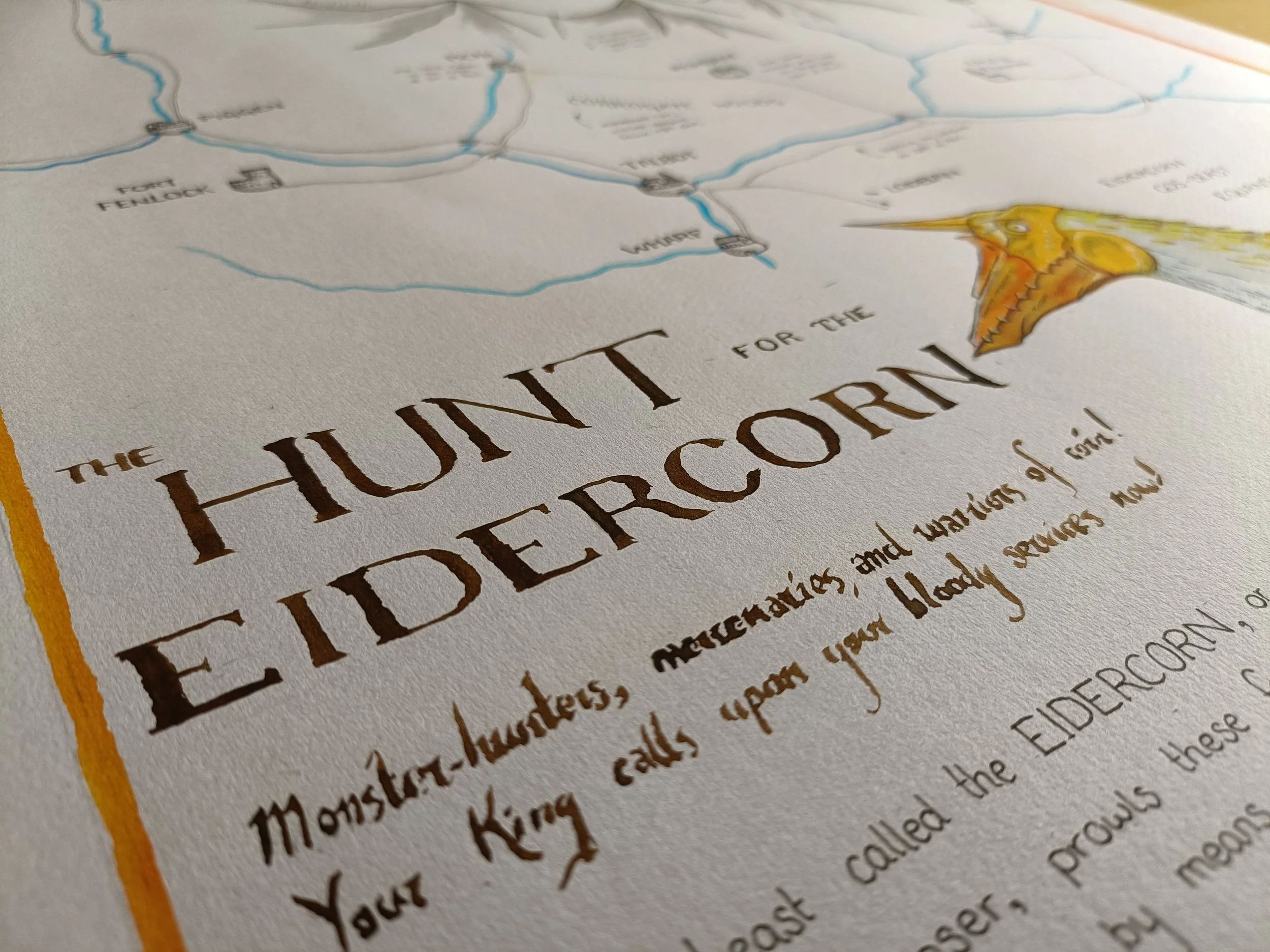
Use medieval-inspired symbols— I’ve got nods here to my map of ancient Endon, using small pictured markers. I’ve got painted coastline and mountains. Add inked labels, handwritten in a style that looks almost too perfect. Use watercolor washes to create a faded, natural texture.
Then add notation. Think:
- “Abandoned lair, victim’s remains”
- “Two miners missing from Fallent Mine.”
- “One child taken in the night.”
Add dates, so that they can make a timeline. These turn your map into a mystery board.
Step 4: Add Narrative Elements
This is where our collaboration with the Fluffy Folio really shines. Alongside the map, we've included a contract handout, written in in-world language, offering a bounty for the creature’s head. The text provides flavor, lore, and rules of engagement.
This is crucial. The map tells the where. The contract tells the why.
Also, the Eidercorn’s portrait is illustrated in the corner of the map: a watercolor rendering of a horse-bodied, goose-headed illusionist predator. It’s beautiful. It’s grotesque. It tells the players that they’re in for something weird.
Step 5: Final Touches – Texture and Function
Scan your map and add grain, folds, or wax seals digitally, or do it by hand and photograph the result. This makes the artifact feel used. Like it’s been carried. Like someone didn’t make it for you—they just handed it off in a hurry.
And of course: make sure the map is legible. Let your stylization never interfere with usability.

And there you have it, adventurers—a full quest map, from narrative seed to finished artifact. You’ve seen how storytelling and geography work hand-in-hand, how history inspires design, and how you can use maps not just as props, but as promises to your players: that what lies ahead is rich, weird, and unforgettable.
If you'd like to use this map in your own campaign, you can find it available for free download over on my Patreon, along with the beautifully horrifying stat block and creature art of the Eidercorn, courtesy of the brilliant folks at the Fluffy Folio—check the links in the description.
We’ve got more videos coming in this “Back to Basics” series, covering different types of maps you might want to include in your fantasy worlds—from basic continent sketches to kingdom banners, route maps, and siege plans. So make sure you’re subscribed, and come hang out on our Discord server, where the community is always buzzing with map ideas, campaign questions, and good old-fashioned nerd joy.
Until next time, remember:
A map doesn’t just show where you’re going—it tells the story of how you got there.
Happy mapping, and I’ll see you in the next one.