
What to Add to your Fantasy Map
This written tutorial is paired with the What to Add to your Fantasy Map video tutorial available on the Red Quills YouTube channel. You can watch it here.
You spread the map across the table, tracing its lines with your fingertips. Your players are gathered around, eyes flicking between their character sheets and the aged parchment before them. But something is missing. The rivers and mountains are there, the cities marked with careful notation—but it feels empty, like a blank stage waiting for actors. You need more than geography. You need history, depth, and the weight of centuries pressing in on every inked detail. You need a map that does more than guide the way—you need a map that tells a story.
Hello, adventurers, and welcome back to the Red Quills! Today, we’re stepping beyond the basics of coastlines and mountains to explore how you can make your maps feel like true artifacts of your world. We’ll discuss how illustrated landmarks, lore-filled borders, meaningful titles, and decorative elements transform a simple layout into a living, breathing piece of worldbuilding.
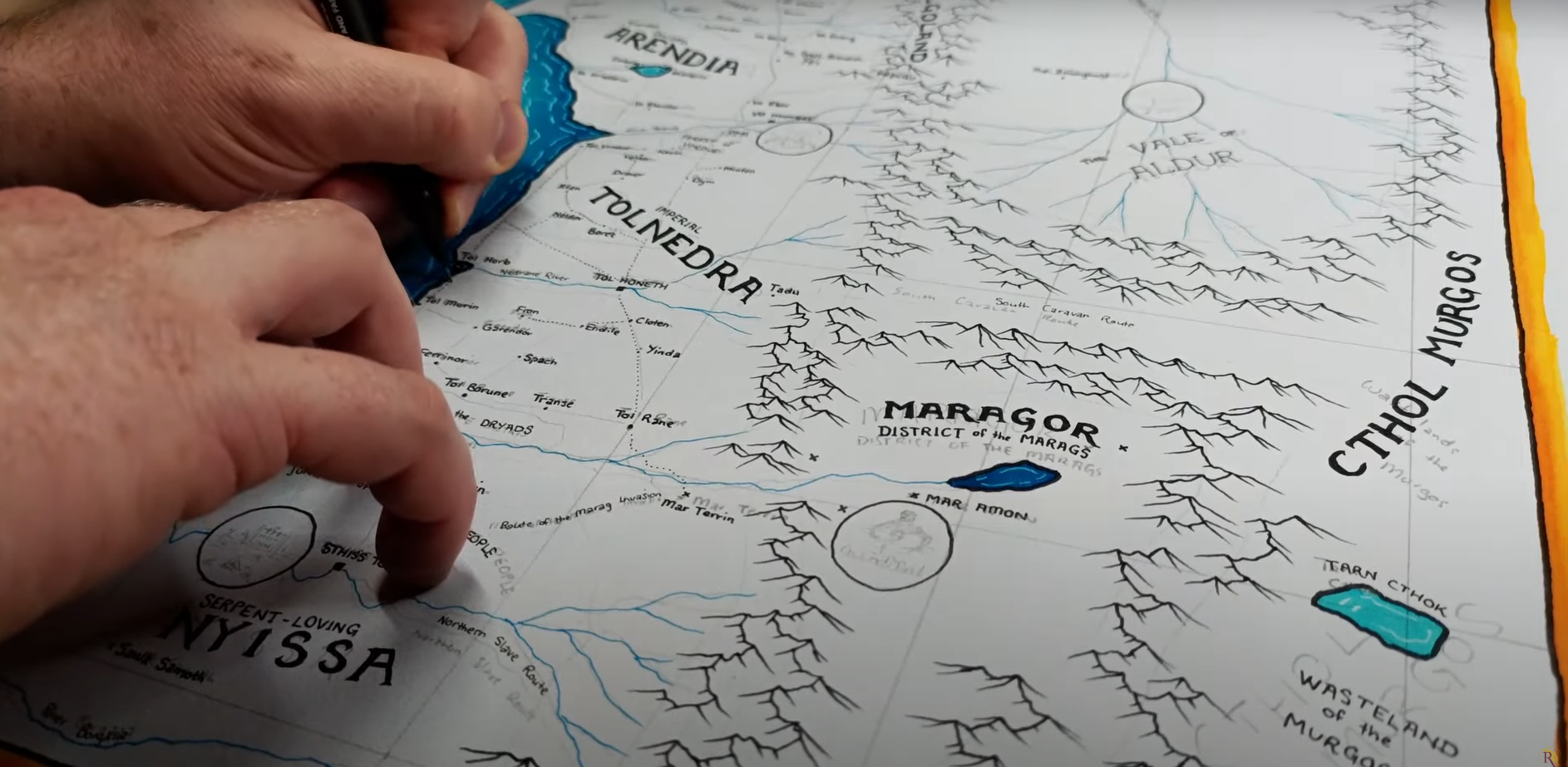
Along the way, I’ll demonstrate these techniques on my map of the Kingdoms of the West from The Belgariad, where I incorporate epithets for the kingdoms, pictorial representations of key landmarks, and a reference section detailing the gods, their totems, and the cultures that worship them.
If you’d like to get your hands on a high-resolution version of this map, you can find it on our Patreon. And if you want feedback on your own maps or just want to chat with fellow worldbuilders, come join our growing Discord community.
Of course, if you want to read more in this vein, check out the Journal of blog posts we have right here on the Red Quills website.
Now, let’s get started!

The Power of a Detailed Map
Maps have always been more than just navigation tools. They’ve been declarations of power, expressions of faith, and records of discovery. More importantly for us, they are one of the most effective ways to make a world feel real. Let’s look at some historical maps that didn’t just show land—they told stories.
- The Hereford Mappa Mundi (c. 1300) – This medieval map is crammed with religious and mythical symbols. It wasn’t meant to guide travelers but to frame the world in terms of faith, showing how people saw their place in creation. For a fantasy mapmaker, this is a reminder that maps don’t need to be literal. If your world has gods, myths, or supernatural forces, consider how they might shape the way maps are made.
- The Tabula Rogeriana (1154, by Al-Idrisi) – Created in the Islamic world, this map was incredibly detailed, listing cities, trade routes, and cultural landmarks. It serves as an example of how maps can be more than geographical—they can be historical records. If your world has vast empires or shifting political borders, your map can reflect that by marking ruins, lost kingdoms, or old trade networks.
- The Cantino Planisphere (1502) – A map of ambition and discovery, this one detailed new lands, territorial claims, and exotic creatures encountered by explorers. This kind of mapping is great for campaigns where discovery is a major theme. If your players are venturing into unknown lands, consider adding speculative coastlines, mysterious notes, or creatures rumored to live beyond the horizon.
- The Fra Mauro Map (c. 1450) – Unlike most medieval maps, this one is covered in annotations. The Venetian mapmaker recorded histories, trade routes, and even rumors about far-off places. If you want your maps to feel authentic, adding handwritten notes—whether accurate or mistaken—can make them feel like true historical artifacts.
Each of these maps tells a story beyond the land itself. They serve different purposes—religious, political, exploratory, or scholarly—and yours should, too. Ask yourself: who made this map? Why was it created? Who is meant to use it?

Bringing It to Life
If you want your map to be more than just a setting reference, you can design it as an integral worldbuilding tool. Here’s how:
- Illustrated Landmarks – A map gains weight when it contains real, illustrated places. In my Belgariad map, I depict castles, ruins, and sacred places in a pictorial style. You can do the same—whether it's sketching an ominous tower or a sprawling capital city, these details make your map an immersive artifact.
- Border Lore & Timelines – Instead of a blank frame, I use the border to add references to the gods—what they represent, their colors, and their symbols. This could be done with historical timelines, family trees, or religious inscriptions in your own maps. A well-decorated border can make a map feel like something that belongs to your world’s people, not just to your players.
- Epithet-Titled Locations – Instead of just marking a city as "Drasnia," it becomes "Drasnia, the Silver Veil." These kinds of names hint at culture, trade, or history, making locations more memorable and evocative.
- Decorative Elements with Meaning – My map features pictorial representations that reflect the cultures within the world. If your world has warring factions, the border could be adorned with crossed swords. If magic is dominant, swirling arcane symbols could weave around the map edges.
- Cartographer’s Notes & In-Universe Details – Who made the map? A scholar, a royal cartographer, a wandering explorer? If they made notes in the margins, what would they say? Maybe a caution about an ancient battlefield, or a complaint about how hard it was to map the jagged coastlines of a particular kingdom.
By using these techniques, your map won’t just be a functional guide—it will become a piece of your world’s history, something that could exist within the setting itself.

Your players unfold the map before them, their eyes scanning its details. There, at the bottom, they find a list of gods and their symbols—who do they worship? In the margins, an old scribe has written warnings about a ruined fortress. The capital city is given a grand title, hinting at its storied past. Every mark on this parchment invites curiosity, draws them deeper into the world you’ve created.
A great fantasy map isn’t just a chart of land—it’s a doorway. When you combine cartography with storytelling, you create something your players and readers will return to again and again.
And that wraps up today’s tutorial! If you want to get your hands on the Belgariad map I’ve been working on, you can find it on Patreon. And if you want to share your own maps or get feedback, come join us on Discord.
Next time, we’ll be exploring some mapmaking tips hot from the Red Quills Press, so don’t forget to subscribe! Until then—happy worldbuilding, and keep mapping!