
5 Best Mapmaking Tips | Essential Advice for Fantasy Cartographers
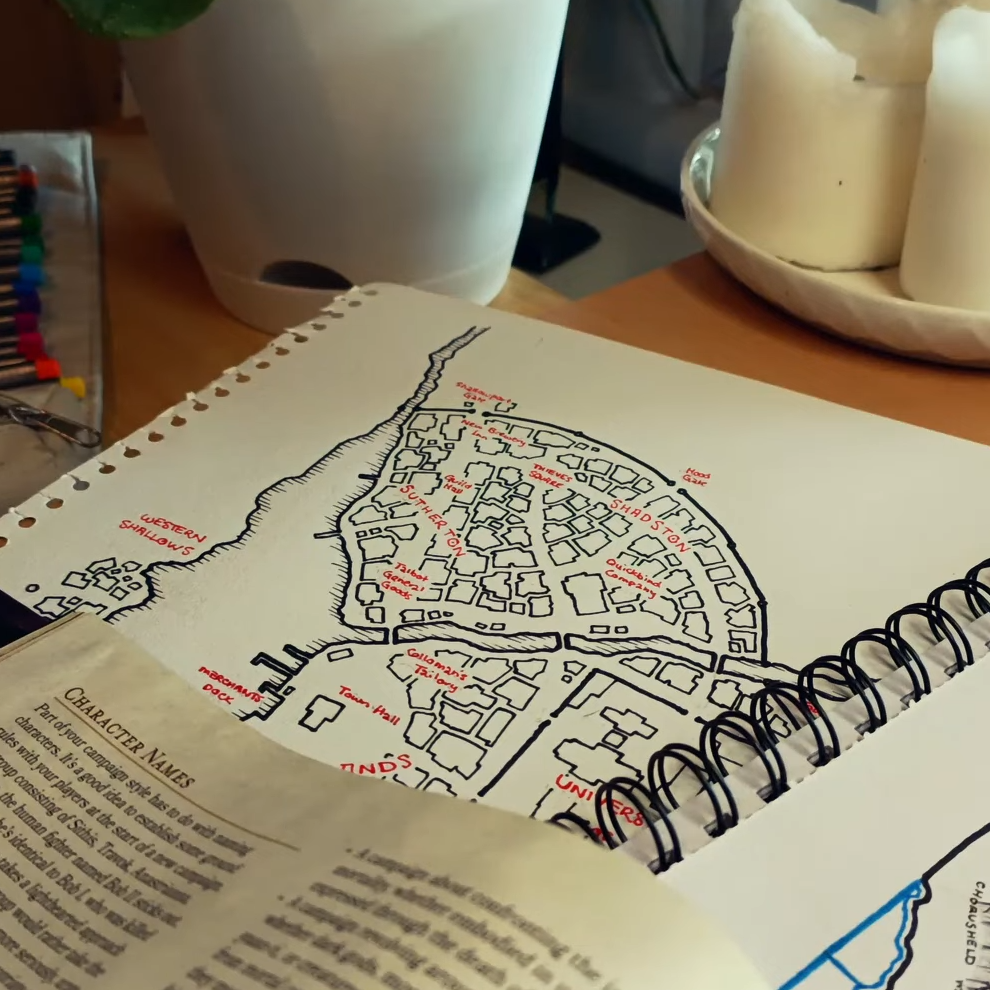
This blog tutorial is paired with the My 5 Best Tips for Fantasy Mapmaking video published by Ryan of the Red Quills. You can watch that video here.
You sit at your desk, a fresh sheet of paper before you, the possibilities endless. In your mind, a world takes shape—a kingdom of towering mountains, a sunken city lost beneath the waves, a sprawling desert where shifting sands reveal ancient ruins. This world is yours, but how do you bring it to life?
You’ve seen the great maps of fantasy legends, the intricate cartography of Middle-earth, the swirling currents of Earthsea, the arcane symbols of a dungeon master’s lair. But when you put pencil to paper, the blank space seems overwhelming. How do you start? What should you include? How can you ensure your map doesn’t just look good but serves its purpose—whether for storytelling, gameplay, or immersive worldbuilding?
Creating your own fantasy world can be a titanic - and daunting - task. But it doesn’t have to be. The key is to follow a few essential principles. And while my videos are focussed on different styles and techniques, this video is a resource that can be put to use regardless of the map style, when you’re creating your fantasy world. These five mapmaking tips will help you refine your ideas, avoid common pitfalls, and create a map that truly does your world justice.
Hello, adventurers, and welcome back to the Red Quills! Today, we’re covering five essential mapmaking tips to help you bring your fantasy world to life. Whether you’re sketching a continent, designing a dungeon, or mapping out a single city, these tips will help you create maps that are practical, immersive, and uniquely yours.
We’re going to break down each tip in depth, with examples and strategies to help you apply them to your own work. By the end of this video, you’ll have a stronger grasp of how to make maps that are not just pretty to look at but functional and engaging.
Over the past couple of months, I’ve been creating videos that look back at the basics of creating a fantasy map and a fantasy world, so if you want to take a look at them - in order, from the sketching process, to choosing styles and adding details - check out the other tutorials I have on my blog.
Every week, I’ve been showcasing a map in the videos, having it available for download for free on my Patreon. This week’s map is a map of the Discworld, from the beloved Terry Pratchett series. I will be showcasing different maps in this video, but if you want to check that out, follow the link in the description below.
I’ll be focussing on five tips, and five maps - and as I go through I’ll talk a little about the styles and difficulties for each. So - let’s get started!

1) Start with a Simple Idea, Not a Complicated One
This one is an absolute essential for novice mapmakers, or game masters just starting out on their journey. One of the biggest mistakes new mapmakers make is trying to build an entire world in one go. You may have grand ideas of continents, oceans, warring factions, and legendary cities, but starting with too much detail can be overwhelming and lead to an unfocused, cluttered map.
Instead, start with a single, simple idea. Maybe it’s an island with a single fortress at its center. Maybe it’s a mountain pass connecting two rival kingdoms. Maybe it’s a lone desert city with a river running through it. This approach allows you to develop your map naturally, expanding outward as needed rather than drowning in unnecessary complexity.
If you do need to create a huge landmass - or even a full fantasy world - start with only the details that you need. Take the map of Tamriel that I drew for How to Draw a Basic Fantasy Map: it’s a simple black-and-white style, only using fineliner pens, and it shows the coastlines, the mountain ranges, the major roads, and the cities. There are other labels, to show where marshlands and forests are, but we haven’t gone overboard in design or worldbuilding.
Once you have your core idea, you can expand strategically. Add regions based on logical geography and narrative needs. Think about how people in your world would navigate, trade, and explore, and let those considerations guide your additions.
If you’re starting in a particular area, make another, smaller map. But if your instinct is that your world map needs to be as filled with details as you can make the local map, think again. Broad strokes, and leave room to annotate and update later.
The most important things to focus on are the major landmarks, the towns, and the cities. Everything else is optional. And make sure that your text is legible. A simple map is simple because it’s easily read.
But leaving some blank areas, implying things with what you don’t put on the map brings us to our second tip…

2) Give Yourself Prompts for Later
When you’re creating a map, remember that you’re not making a pretty picture. A map is a useful tool - not just for players or readers who are navigating the world, but for you in expanding it out. If you expand it out too quickly, if you fill it with details for the sake of filling it with details, then you’re squashing the opportunity to improvise or extrapolate later.
So, what you want to do is add in details that you can deliberately use to flesh things out. Give yourself some prompts for later. A good map is more than just a layout of locations—it’s a storytelling tool. And in order to make your world feel alive, you can plant seeds for future ideas.
This means leaving space for the unknown. You can mark areas with labels like “Unexplored Territory” or “The Wastes” to hint at mysteries. Sketch in ruins, caves, or abandoned cities that could become future plot points. Even something as simple as a road vanishing into an unmapped forest can invite curiosity.
But you don’t need to stop at the labels - the things that the in-world mapmakers don’t know (though, who doesn’t like a good “Here Be Dragons” label?). You can add things that are deliberately preserving the core of an idea that you can flesh out later.
Take this map of the Kingdoms of the West, that I did for What to Add to your Fantasy Map. Some of the things that you can add in are simple, they don’t require too much planning or forethought - you can add epithets to the titles of lands: ranging from things as simple as “Imperial Tolnedra”, telling us about the politics of the region, to “Divided Arendia”, giving some insight into history and culture. And that’s only with a couple of added words.
But other things that you can add, which imply worldbuilding without spelling it out - a timeline referring to specific events without going into details, a list of the gods and their totems, tiny illustrations of major landmarks to get your creative juices flowing when you return to that location in the story.
If you’re a writer or a game master, these prompts can serve as inspiration when your story needs a new direction. A map should not just provide information—it should spark adventure, it should bring a certain sense of genre and style. And speaking of…

3) Choose an Immersive Style
I now have dozens of videos of different map styles on this channel: each of the videos gives a different method of painting, drawing, inking, or otherwise scrawling out a fantasy world - ranging from topographic maps, to representational drawings, to highly-detailed murals, to something more typical of traditional fantasy novels.
I couldn’t possibly list them all in this video - well, I could, but that’s not what we’re doing here. And I’m working on creating a style reference guide so that you can more easily find different styles and methods, but the point is that when you’re making your map, you should make a piece of that world: the style of your map should match the tone of your world.
Is your world dark and gothic? A medieval parchment style might suit it best. Is it a futuristic sci-fi-fantasy hybrid? Perhaps something sleek and minimal with symbols instead of terrain details.
And beyond aesthetics, consider its usability. If you’re making a map for a game or a campaign, clarity is key. Highly stylised, decorative pieces look great on the wall, but you also want something that the players can use. Use bold labels and clear iconography so players can quickly grasp important locations.
A good style that you can return to for a lot of fantasy worlds is the ancient, weathered, crude map. I did something similar for my video How to Make a Weathered Map of the D&D Planes: the process is easy, straightforward, and you are left with something that could easily have been found in a forgotten tomb.
And when you hand something like that to your players, it lends them a sense of immersion, it brings them into the world, it hands them a piece of their own imagination.
Experiment with different styles to see what fits your world best. If you’re unsure, look at historical maps from different eras and regions to find inspiration. Mapmakers through history have different styles and different opinions about what a map needs to have, and I’ve talked about them a lot in recent videos.

4) Think Only About What You NEED to Map
And speaking of what a mapmaker thinks their map needs to have, you should too. Imitation is the sincerest form of flattery, but don’t add in things to your map unless you know why you want to have them on there.
It’s easy to feel like you need to map everything, but that’s rarely necessary. The best maps are those that focus on what’s relevant to the people using them. Ask yourself: Who will be looking at this map? What information do they need?
If your map is for a tabletop RPG, it might need to emphasize major cities, roads, and important adventure locations. If it’s for a novel, it might highlight political boundaries and important landmarks. If it’s an in-world artifact, it might be intentionally inaccurate, reflecting the limited knowledge of its creator.
On a broader example, take the idea of a world map. I’ve been running campaigns in my own D&D world for six years now, and I only made a world map earlier this year, and only because of this channel. It’s an extreme example of only doing what you need, but that’s the point - I didn’t need a world map. My story has taken place in a space roughly the size of the Mediterranean, and a world map was unnecessary. And what’s more, if I had done a world map when I started, I would have had to fill it with details that I never referred to and would have forgotten the significance of by the time I actually required it.
Details are fun, but ask yourself what details the map needs. Forests look nice and decorative, but they are unimportant for most maps - if you’re adding them, do it last. Mountains and coastlines tend to be fairly universal. A scale and legend? Legends are only strictly necessary when you need to credit the map and explain the symbols. And a scale isn’t necessary if you’re using another method of showing distance.
By focusing only on what’s needed, you avoid clutter and make your map easier to read and use.

5) Don’t Imitate – Think Outside the Box
Finally, don’t be afraid to break conventions. Many fantasy maps borrow heavily from real-world geography—particularly Europe—but there’s no reason your world has to resemble any existing continent.
Think about alternative map shapes. Maybe your world is a ringworld, a shattered archipelago, or a series of floating islands. Maybe it’s a flat plane with an endless waterfall at the edge, or a hollow sphere with continents on both the inner and outer surfaces.
Earlier this year, I pushed the mapmaking conventions I knew and made a fantasy globe. It looks great, sitting on my desk, but it’s far from the first time I’ve thought outside the box. Invisible ink, disappearing continents, naturalists’ maps, coded maps, modular gridmaps – I’m always trying to find ways of pushing the boundaries.
And the thing to remember is that many of them don’t work out well! Many of them look clunky or weird. But by experimenting and trying new things, I come out with maps that make my players drool when they see it.
If you’ve got a clear vision, that’s great. But I strongly advise you to push that vision, reflect on whether you’re imitating for the sake of imitation, and try something new that fits your world.
By pushing beyond traditional layouts and features, you make your world feel more original and lived-in. Experiment with new ideas and trust your creativity.
And that wraps up our five best mapmaking tips! Whether you’re starting with a simple idea, using your map to spark future adventures, experimenting with styles, focusing on essential details, or thinking outside the box, these techniques will help you build better, more immersive worlds.
I’m going to continue to come out with new maps and new styles, so like this video, subscribe to the channel, and let everyone know about your new favourite fantasy mapmaking resource. If you have opinions, let me have them in the comments below - I particularly want to hear about your experiments and worlds, I’m always keen to read about them.
If you want to explore these techniques further, check out the full videos linked in the description, or head on over to the Red Quills Patreon to download that map of the Discworld. Thank you to everyone who supports me on Patreon and YouTube, I really couldn’t do this without you. And if you want to connect with fellow mapmakers, we have an active Discord community where we discuss techniques, trade ideas, and workshop our worlds.
Keep your eyes peeled for my next livestream video, which will be coming out soon - I’ll be talking more about it on my channel, on Patreon, and on the Discord, but tune in for that! Until next time, adventurers—keep your ink fresh and your lines steady. Happy mapping!