
The Making of my D&D World (in Maps)
This blog post is the written version of the latest video on the Red Quills channel by Ryan of the Red Quills. You can watch the full video here.
When people ask me what the most important map for worldbuilding is, I always have to pause.
Because the answer, really, is: any map that helps you run your game. Not a world map, not a regional map, not a city map—just the right map for the next session. And that looks different depending on where you’re at in your game and how you run it.
So in today’s post, I want to walk you through the maps I made for my own D&D world. From crude early sketches to full-colour regional illustrations, each one was made for a specific purpose—and none of them were made just to look pretty. These maps were tools. Planning tools, player handouts, reference sheets, and storytelling aids.
Hello, adventurers, and welcome back to the Red Quills! My name is Ryan, and today’s a little bit of a discussion, rather than a tutorial.
You can download all of the maps that I talk about in this post on the Red Quills Patreon.
You can even read more about the specific maps on this Journal.
This post is also standing in for what was going to be the next update in the Fantasy Atlas series. That episode is delayed for a good reason. A few weeks ago, I was contacted by the team at LegendKeeper, a worldbuilding and lore-management platform that lets you build a digital wiki of your fantasy world. I’d mentioned in my first Atlas post that I was searching for a system to manage everything, and they reached out after watching that. We’ve been chatting about ways to bring the Atlas project into a shareable, navigable format using their system.
Because of that, I’ve decided to combine the next Atlas episode with the launch of the Red Quills wiki—essentially, a public version of my notes and maps that will grow alongside the project. It’s going to take some time to organise, so the update is postponed by a month or two.
In the meantime, I thought I’d go back to where it all started, and show you the maps that built my campaign.

The First Map of Endon
The very first map I ever made for my campaign wasn’t impressive. It was a shaky, A4 sketch of the Kingdom of Endon—blocky mountains, wonky coastlines, trees that all looked like broccoli. I drew it in black fineliner on printer paper, probably while watching Critical Role or folding laundry.
But it worked. It gave me somewhere to place the starting town, and somewhere else for the players to go next. And that’s all it needed to do. It gave the players a sense of space, even if it was vague and abstract. Endon had rivers, mountains, roads, borders—and when I looked at that map, it stopped being a blank canvas and started being a world.
The players saw the map during the first session, and it instantly sparked questions: What’s this town? Is this forest dangerous? Can we go here? Suddenly, I had more material than I knew what to do with. And it all came from a map I didn’t even plan to show them.

The Town Map of Shallowport
But as soon as we started the campaign properly, I realised the Kingdom map wasn’t actually what I needed. Because I was running a local, low-level game. The players weren’t travelling across the realm—they were walking around one town, getting to know the baker and the bailiff and the shady thieves in the alley.
So I made a new map: Shallowport.
It was tiny—about 12 by 16 centimetres. Just a quick sketch of streets and houses, drawn in pencil and glued to a page of town information. It had everything they needed: shops, NPC homes, a sketch of the docks, and the location of the tavern where their first mission began. No frills. No legends. Just information, delivered in map form.
And in a way, that tiny map taught me more about practical game prep than any fantasy cartography guide ever could. Because it was useful. It grounded the players. It let them make informed decisions. It gave their choices context. You don’t need a pretty map—you need a functional one.

The Dungeon Map: Sunderking’s Barrow
From there, I moved to the third kind of map every DM inevitably makes: the dungeon.
Sunderking’s Barrow was the first proper dungeon crawl of the campaign. A tomb from a forgotten age, full of spectral echoes and dusty hallways. I drew the whole thing out in my sketchbook the night before the session, with notes on enemy locations, secret doors, traps, and ambient details scrawled in the margins.
And I don’t think it’s an exaggeration to say that dungeon maps taught me how to run sessions. Because when you make a map of a place like that, you’re not just drawing a floorplan—you’re planning your encounters, your pacing, your narration. You start asking questions like: Why is this corridor here? What does this room smell like? Who built this?
Suddenly, the map becomes a design document. And that’s what I started doing. One dungeon map per session. A new town map every other session. I slowly built up a box full of these things—little glimpses into the world, driven entirely by what the players might do next.
The Continent Sketch
But after a while, the players started pushing beyond the borders of the Kingdom of Endon. They wanted to travel, explore, hunt down leads and rare books and forgotten ruins. And I hit a wall.
Because the world beyond the kingdom… didn’t really exist yet.
I knew they didn’t need a world map. That’s like giving someone the whole dictionary when they just asked how to spell “ocean.” But I did need something bigger. Something that gave me enough room to breathe and plan and build.
So I sketched a very simple pencil map of the continent. Roughly the size of the Mediterranean. Just coastlines, mountain ranges, and a few major regions. This gave me the space to imagine distant empires, cross-sea voyages, and ancient wars—without committing to every detail just yet.

The Map of the Greenlit Sea
That first continent sketch led, very quickly, to my first “proper” map: The Greenlit Sea.
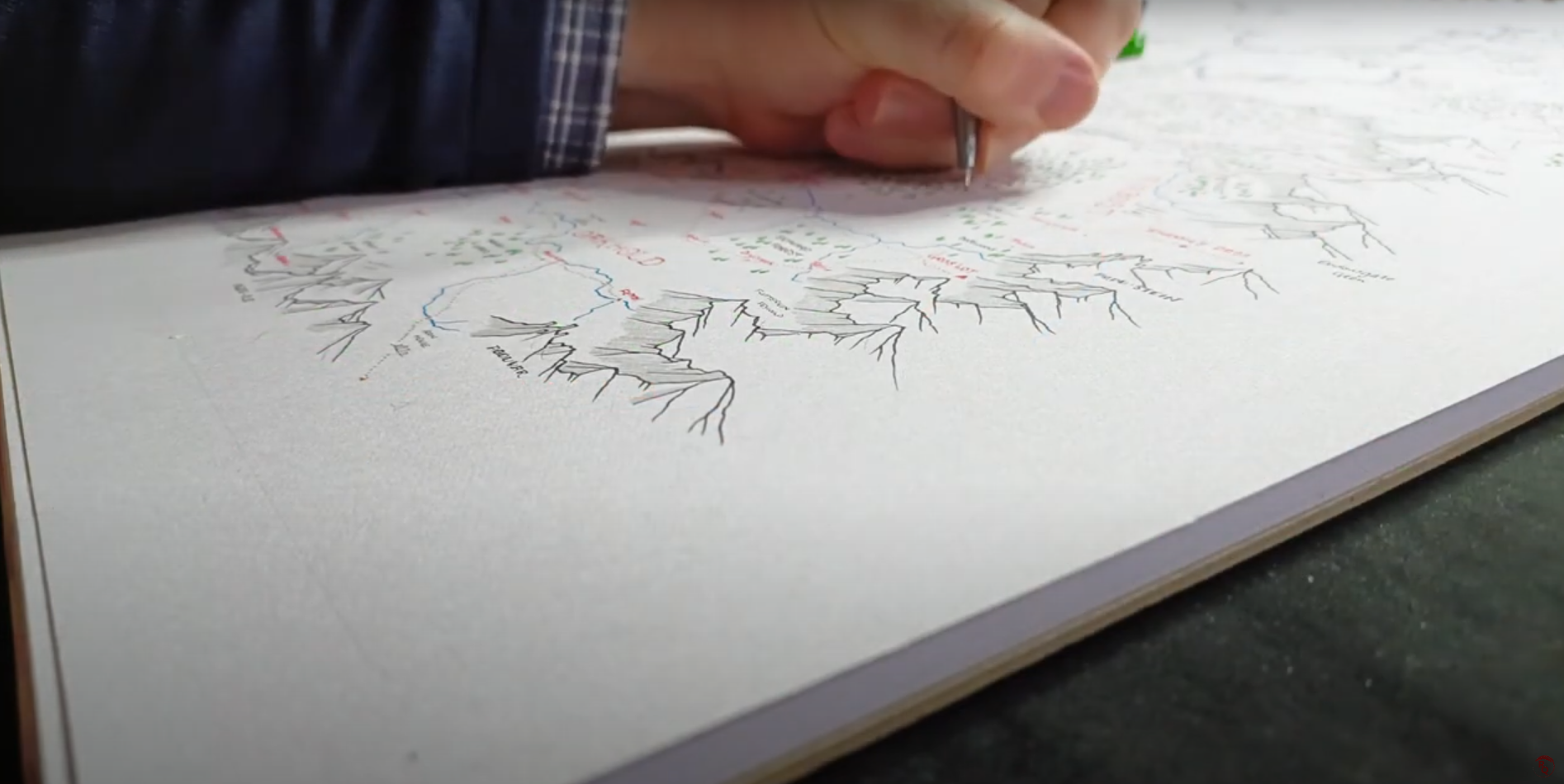
I took the pencil sketch, refined it, and inked a full A4 version in a neat, illustrative style. This one had compass roses. Wave lines. Mountains with actual shading. I still didn’t feel like I’d found “my style” yet—but I was getting closer.
This was the first map where I started thinking not just about information, but about atmosphere. It needed to tell a story. This was a map players could find as a handout, or see pinned to a wall in a library, or win in a gamble. And it needed to feel like a real object.
At this point I had four maps that really served me well:
- The Kingdom map of Endon
- The continent map of the Greenlit Sea
- A stack of dungeon maps
- A small collection of town maps
But the campaign didn’t stop. And neither did the need for maps.

So I expanded. I redrew the Endon map on A2 paper, with more towns, roads, forests, and ancient ruins. It took me about twelve hours, and became my core planning reference for the next forty sessions. It still hangs above my desk.

Likewise, I expanded the Greenlit Sea map to A2, and this time, something clicked. This was the first map I was really proud of. It was readable. It was styled. It felt finished. And more importantly—it was useful. I could zoom in and out of regions, draw more detailed versions as needed, and let the players slowly piece the continent together from the scraps they found.
By now we were a couple years in—thirty sessions or so. Fewer than I’d hoped, thanks to lockdowns and scheduling—but still, a campaign with weight to it.

And the players were venturing further and deeper. I started branching into location-specific maps. A regional map of the Underdark, complete with lava rivers and fungal forests. New town maps. Dungeons with specific flavour: an alchemist’s tomb, a ruined prison, a crumbling coliseum under the sand.
I also started experimenting with hidden details: runes in the margins, coordinates that led to other maps, puzzles embedded in the geography. It turned the map itself into a game mechanic. Not just a record of space, but a mystery to solve.
At the same time, I started cataloguing everything. If I drew a map, I wrote a page or two of notes to go with it—quest hooks, local politics, regional histories. That way I didn’t lose track of things. Because at a certain point, your own campaign will start surprising you. And when it does, you’ll need some kind of order to stay afloat.
About a year and a half ago, a friend of mine said: “You’ve got so many maps. Can you show me how to make one in your style?”
So I did.
I sat down and filmed a tutorial. It was rough. The lighting was bad. I didn’t know how to edit. But it sparked something. I realised how much I loved teaching this stuff—how much I’d learned, and how much I could share. That video became the foundation for this channel.
Since then, I’ve revisited a lot of those early maps. I’ve redrawn some. I’ve upgraded others. And I’ve kept building, both the world and the methods behind it. What started as a scribble on A4 printer paper has turned into an ever-growing Fantasy Atlas. And with the upcoming wiki launch through LegendKeeper, I’ll finally be able to share it all in a searchable, explorable form.
But all of it started with one scrappy little map. Not perfect. Not pretty. Just useful.
So if you’re starting your own D&D world and wondering what maps you need, here’s my answer:
You need the map that helps you run your next session. That might be a continent. Or a tavern. Or a dungeon crawl through a haunted orchard.
You don’t need to start with a perfect map. Just a useful one. You’ll get better as you go. And in a few years’ time, you might look back and realise that those quick sketches were the best thing you ever made.