
How to Map like an Egyptian
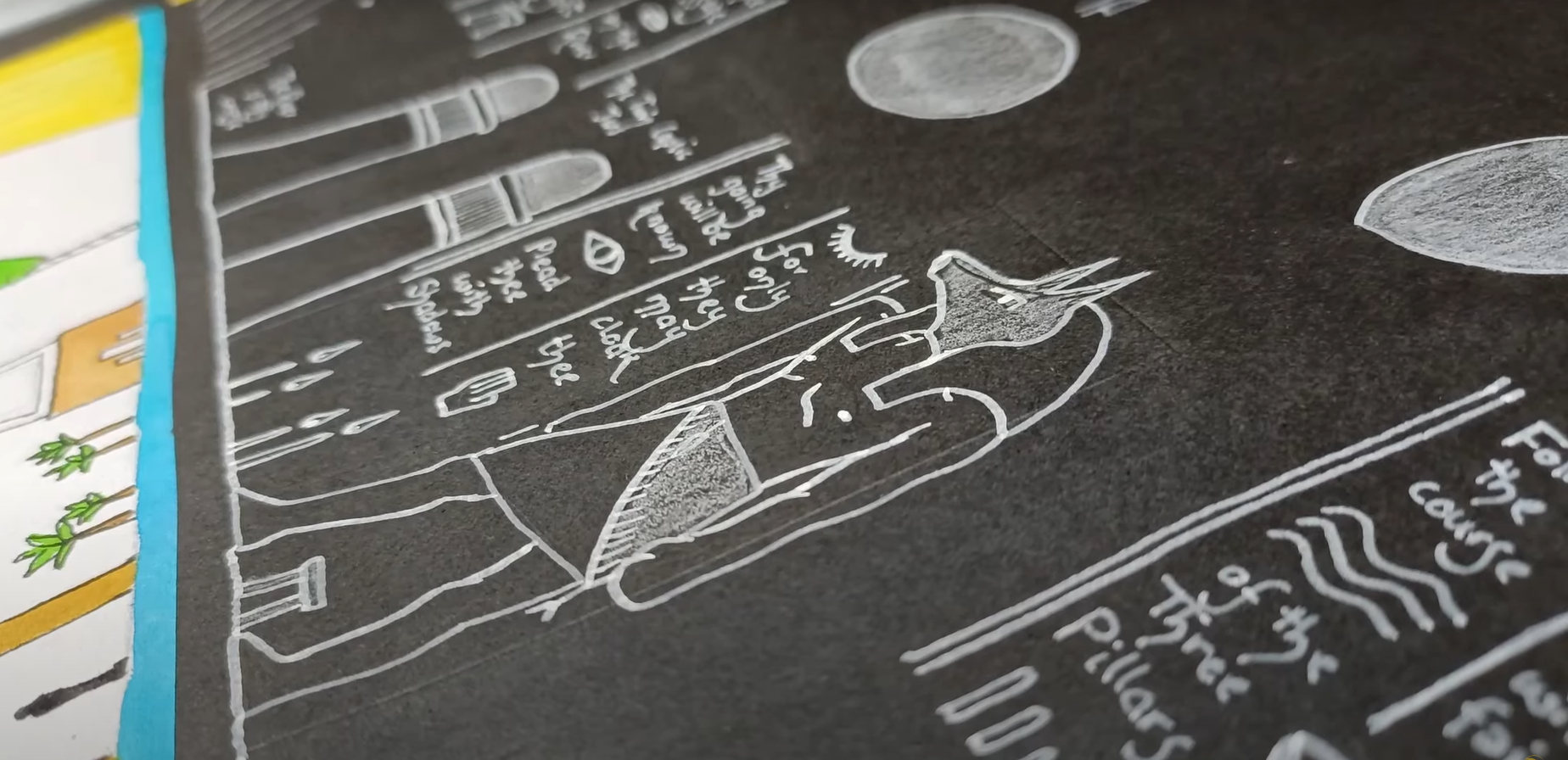
This tutorial is based on the video How to Map like an Egyptian, by Ryan of the Red Quills. You can watch the full video tutorial here.
In the heart of a golden land, where the river stretched like a living ribbon across endless sands, the mapmakers of old did not simply chart the earth - they captured the heavens, the gods, and the journey of the soul. Their maps were spells. Their maps were prayers. And sometimes, their maps were warnings.
Hello, adventurers, and welcome back to the Red Quills!
Today, we’re diving into one of the oldest traditions of world-mapping: the sacred, symbolic, and incredibly evocative maps of Ancient Egypt. And more importantly - we’re going to talk about how you can use this approach to make your own maps feel alive with myth, magic, and mystery.
If you want to download this map, you can find it on the Red Quills Patreon.
Or you can read more about mapmaking on the Journal.
By the end of this tutorial, you’ll know:
- What made Egyptian maps different from modern ones.
- How you can bring sacred geography into your fantasy world.
- Step-by-step how to build a map that’s less GPS... and more Book of the Dead.
- Plus, I’ll show you a fantasy example you can use in your own games.

Why Ancient Egyptian Maps Are a Worldbuilder's Secret Weapon
Let’s start by laying out why Ancient Egyptian cartography - if you can even call it that by modern standards - is so powerful for fantasy worldbuilding.
Unlike our modern maps, which prioritize accurate measurements and scalable navigation, Egyptian maps were more about spiritual truth. Where you were going mattered - but why you were going there mattered more.
Landforms were sacred. The desert wasn’t just a desert - it was a barrier between life and chaos. The river wasn’t just a river - it was the literal bloodstream of the world, a metaphor for life, death, and rebirth.
Maps were storytelling devices. They weren’t about getting from Point A to Point B. They were about moving through the unseen currents of fate.
Which means: If you want your fantasy maps to feel old, sacred, mysterious, and powerful... stealing a few tricks from the Egyptians is a fantastic idea.

Historical Inspirations (with Specific Examples)
Alright, time for a bit of history. Because you know me - I can't resist pulling examples straight from the ancient record.
1. The Book of the Dead (specifically Papyrus of Ani, c. 1250 BCE)
Our first, and maybe most iconic, Egyptian map-adjacent document isn’t really a 'map' at all - it's the Papyrus of Ani, a version of the famous Book of the Dead. This incredible artifact contains illustrated spells, pathways, and symbolic depictions of the soul’s journey through the underworld, or Duat.
You see rivers. Gates. Guardians. Floating islands. It’s a cosmic map of an afterlife, layered with dangers, trials, and blessings.
The lesson for us? A map doesn't have to represent physical geography. It can represent experience, destiny, or the passage of time.
2. The Turin Papyrus Map (c. 1160 BCE)
Next up, one of the only surviving 'realistic' maps from ancient Egypt: the Turin Papyrus Map, created under the reign of Ramesses IV.
This map actually shows a real quarry region, including hills, roads, and mining sites. But it’s stylized - mountains are exaggerated like waves. Roads bend poetically instead of following strict angles.
It’s practical information, sure - but it’s also a piece of ritual art.
The takeaway? Even practical maps can be stylized for mythic impact. Mountains should look dramatic. Rivers should feel alive.
3. Tomb Wall Cartography (e.g., Tomb of Senenmut, 1479–1458 BCE)
Lastly, we have maps that weren’t even meant for the living.
In tombs like that of Senenmut, architect and steward of Queen Hatshepsut, ceiling and wall paintings show constellations, navigational charts for the soul, and symbolic representations of land and sky.
Here, mapping wasn’t a tool - it was part of preparing for eternity. And remember: Egyptian maps often ran vertically - flowing like scrolls, not flat projections.
That idea alone - a vertical map of the soul’s journey - is incredibly juicy for fantasy.

How to Make Your Own Egyptian-Style Fantasy Map
Alright, let’s talk about how to do this yourself.
I’m going to break this down into six easy steps you can follow - and feel free to adapt as wildly as you like.
Step 1: Choose Your 'Sacred Axis'
First things first: pick your world’s Nile.
I don’t mean literally. Pick the single most important natural feature - a river, a mountain chain, an astral road, whatever - and anchor everything else around it.
In Egyptian maps, the Nile was life. So: what’s your world's Nile?
Examples: A crystal river flowing through a shattered moon; A mountain range shaped like a sleeping dragon; A blood-red trench dividing the living world from the dead.
Step 2: Orient the Map by Meaning, Not Compass
Next up: forget about north being at the top.
Egyptian maps often oriented things toward the east (birth) or west (death). Or toward the flow of the Nile, no matter the actual 'direction.'
Orientation tells a story.
Examples: Death to the right, rebirth to the left; Center sacred cities around the highest sun point; Make the top of your map represent the afterlife.
Step 3: Symbolize Instead of Scale
Then, exaggerate important features, and shrink or stylize others.
In the Turin Papyrus Map, mountains were huge, squiggly waves. Tiny paths were big winding rivers.
Ask yourself: What needs to feel big? What needs to feel distant?
Examples: The palace is larger than entire towns; The tombs of heroes are more prominent than mountains.
Step 4: Embed Myths Directly into Geography
Egyptian maps often wove in stories of gods and monsters.
Why not show a literal doorway to the land of the dead? Or a sacred island that's always hidden under mist?
Examples: Draw a cracked mountain where a goddess tore the sky; Mark a cursed grove as a literal 'X' of spirits; Have rivers spiral into whirlpools guarded by ancient beasts.
Step 5: Use Artistic, Hieroglyphic Elements
Your map isn’t just a guide - it’s a work of symbolic language.
Try: Pictorial labels instead of word names, Decorative borders showing seasons, stars, or gods, Story panels in the corners explaining key landmarks.
Examples: A phoenix symbol for the volcano; A tiny mirror marking an oasis; Scenes of ancient battles across a mountain range border.
Step 6: Layout as a Journey, Not a Static Place
Finally: make the map read like a pilgrimage or an epic. In Egyptian culture, moving across land often mirrored a mythic journey through life, death, and rebirth.
Examples: The top half of the map shows a land of light; the bottom, a land of shadow; Rivers flow upward to heaven and downward to the underworld; Players or characters must follow 'rites' at different regions to unlock passage.

Quick Visual Summary (Red Quills Style)
Let’s hit the key points again, but this time, super-fast:
- Sacred Axis: Anchor your map around a mythic feature.
- Orientation: Arrange the map toward meaning, not magnetic north.
- Scale by Symbolism: Make important things bigger and bolder.
- Myth Embedded in Land: Turn geography into story.
- Artistic Decoration: Use visual language, not just labels.
- Map a Journey: Design your map as a story in itself.
Simple? Maybe. Powerful? Absolutely.

Creative Challenge for You
Alright, time for your creative challenge, adventurers! Design a map where the land itself tells the story of the afterlife. You don’t have to copy Egyptian style exactly - pull from your world’s lore, your campaign setting, your personal mythologies.
Bonus points if you:
- Create a sacred river, road, or passageway.
- Embed gods, spirits, or mythic events into geography.
- Think vertically - maybe even stack different planes of existence!
And if you want to show off your results, remember: you can tag me on social media or drop it into the Red Quills Discord, where we talk maps, worlds, and sometimes curse the river of deadlines we’re all floating down.
Ancient Egyptian maps show us something powerful: That a map isn't just a tool. It's a story, a philosophy, a glimpse into how a people saw the world.
And maybe - when you make your own maps - you’re not just making places. You’re making myths that will outlast memory.
Until next time, fellow worldbuilders - this is Ryan of the Red Quills, signing off. And remember: every line you draw can be the start of a legend.