
Maps Inspired by Imperial Rome
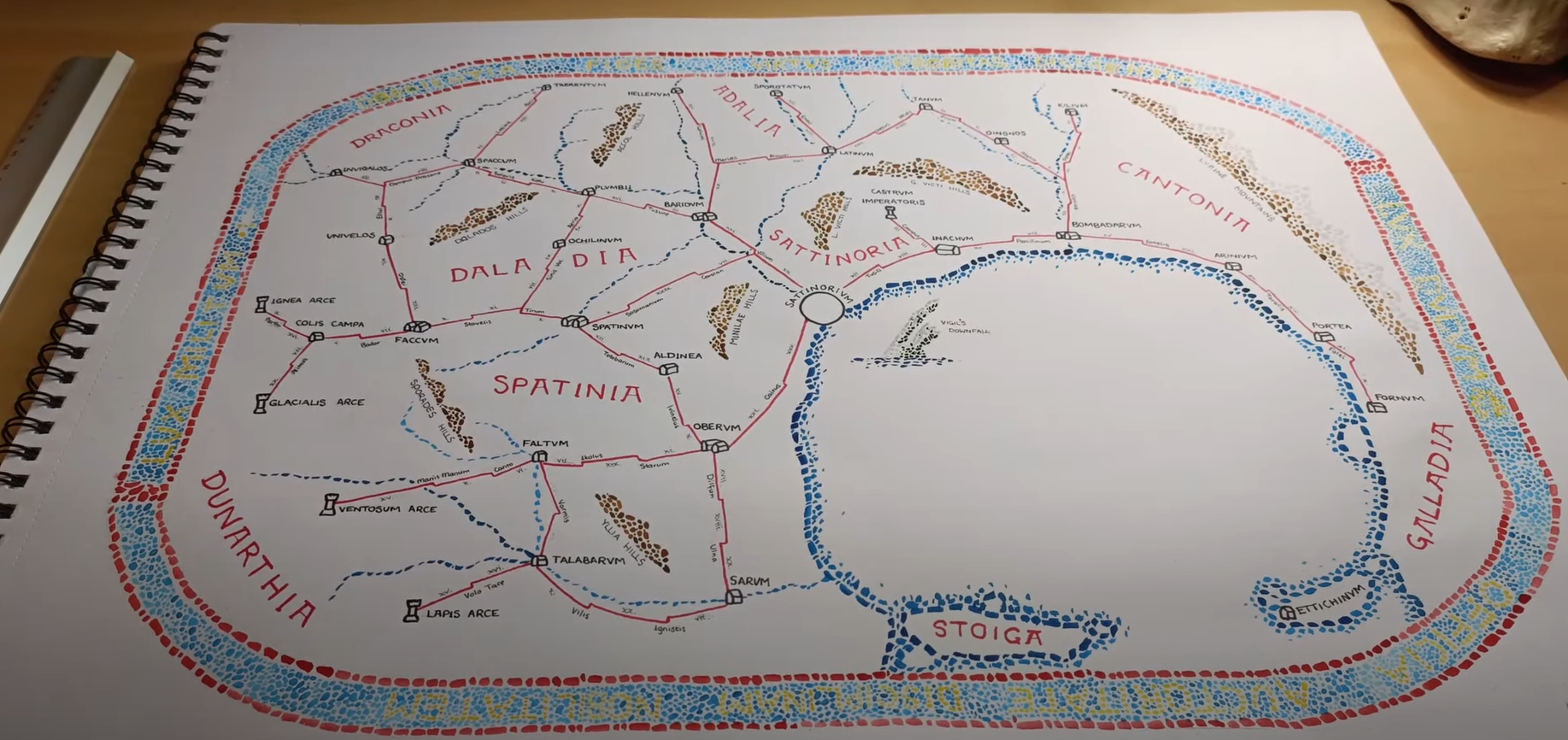
This tutorial is the written version on how to make Roman maps, of the video tutorial How to Map like a Roman, on the Red Quills YouTube channel. You can watch the full video here.
In the misted dreams of forgotten empires, there stands a city built on seven hills, its roads stretching like veins across the body of a world that once bowed to its banners. Soldiers in scarlet cloaks march across desert and mountain alike, emissaries carry scrolls heavy with treaties and demands, and in the heart of marble forums, geographers and scholars unroll parchment maps that define the known world: orderly, efficient, and inevitably Roman.
Today, we unravel the mapmaking spirit of the Empire that shaped the West, learning how to infuse our fantasy worlds with the relentless structure, ambition, and grandeur of Rome.
Hello, adventurers, and welcome back to the Red Quills! Today, we’re diving into one of the most enduring and influential powers in history – Rome – and looking at how we, as worldbuilders and mapmakers, can draw inspiration from their practical, disciplined approach to mapping the world.
You can find the downloadable version of this map on the Red Quills Patreon.
Or find more written tutorials at the Journal.
We’re going to cover some of the actual Roman maps we still have fragments of, break down the ideas and priorities behind them, and then walk through a step-by-step method for creating a Roman-style fantasy map excerpt. Stick around to the end – I’ll be giving you a storyform example you can use in your own games and settings. Let’s get started.

Why Roman Mapping?
Roman maps were practical before they were pretty.
Unlike medieval mappae mundi or abstract spiritual maps, Roman maps had a clear purpose – to control, administer, and conquer.
In a fantasy setting, drawing a map in a Roman style immediately tells your players something:
- This is an empire that values order.
- This is a world that has been measured, catalogued, and claimed.
- Travel, trade, taxation, and governance matter.
Today, we’re going to talk about how to capture that feeling. Roman-style maps are perfect for fantasy worlds where empire-building, logistics, and political dominance are key themes.
And, by the end of this video, you’ll have a full guide to creating your own.

Roman Mapping in Action
Before we get into how to draw one, let’s dig into a few real-world examples. Even though many Roman maps haven’t survived, the ones that did give us fascinating insights.
The Tabula Peutingeriana (4th–5th century AD)
Possibly the most famous Roman map we have - though the surviving copy is medieval, the original was Roman. The Tabula Peutingeriana is essentially a roadmap of the Roman Empire, but stretched out horizontally to fit on a long scroll. It’s not about geographic accuracy - it’s about connections: roads, cities, waystations.
- Key Features: Overemphasis on major cities, stylized rivers and mountains, distances listed between locations.
- Relevance: A fantasy version would prioritize roads, major settlements, and military forts over physical geography.
The Agrimensor Texts (Gromatici Veteres – 1st–5th century AD)
Agrimensores were Roman surveyors who specialized in land division. Their manuals, collected later as the Gromatici Veteres, show how obsessed Rome was with measuring and recording land.
- Key Features: Emphasis on straight lines, grid divisions, practical layouts for ownership and taxation.
- Relevance: Perfect for a setting where imperial bureaucracy and land ownership are major themes.
Maps in the Itinerarium Antonini (circa 3rd century AD)
More of a travel guide than a map, but lists roads, distances, and stations across the empire.
- Key Features: Focus on waypoints and travel times rather than landscape depiction.
- Relevance: Great for building "realistic" travel logistics into a fantasy setting.
In Short: Roman maps weren't worried about north being at the top or coastlines being exact. They were tools – efficient, structured, powerful tools. We can learn a lot from that attitude when designing a fantasy world that wants to feel like it’s truly ruled by an empire.

Step-by-Step Roman Mapmaking
Now let's roll up our sleeves and build one ourselves.
Step 1: Define the Purpose
A Roman map doesn’t exist for "exploration" or "wonder" - it’s about administration.
So first question: what does your empire need this map for?
- Surveying newly conquered territories?
- Listing key trade routes?
- Cataloging military outposts?
Pick one clear goal. It’ll define everything else.
Step 2: Plan the Layout
Forget naturalistic shapes. Roman maps tend to stretch and squash geography to fit the purpose.
- Roads should dominate – use bold, clear lines connecting major points.
- Rivers matter for transport – show them clearly.
- Mountains, forests, and other terrain? Represent them symbolically, not realistically.
Quick Visual Tip: Think of old subway maps - not geographically accurate, but very readable.
Step 3: Choose Your Icons and Symbols
- Cities: Little circles with towers or walls.
- Roads: Straight, thick lines, maybe with mileage markers.
- Forts: Squares or rectangles with battlements.
- Rivers: Flowing lines, often with wavy decorations.
- Mountains: Small ridges, almost like a comb pattern.
Color can be simple: black ink for features, red for roads or important cities.
Audience Engagement Tip: (Prompt a poll or comment)
"Which feature do you think would dominate your fantasy Roman empire - roads, rivers, or forts? Let me know in the comments below!"
Step 4: Emphasize Scale and Distance
Include notations of travel time or distance wherever you can. Roman maps almost always prioritize travel time over literal measurement.
Example: If a city is three days' march from a fort, label it right on the road between them.
Small Detail that Matters: Roman milestones were inscribed stone markers placed every mile along major roads – adding little dots or marks at intervals along your drawn roads can give it an authentic feel.
Step 5: Add the Decorative Flair
Roman maps aren’t wildly decorative, but they love formalism.
- Borders should look strong and clean.
- A cartouche or title block can add a lot: “Survey of the Southern Provinces, Year 34 of the Reign of Imperator Lucianus” sounds instantly more immersive.
- Bonus Points: Add little notes like "Salt mines here" or "Frequent bandit attacks" - Roman maps often had functional marginalia.

Storyform Usage In-Game
Now, let’s imagine this map being used in a game setting.
Your players have just been handed an old Roman-style scroll – the Itinerarium of the Emperor’s March. It’s a worn, beautiful piece, painted in red and black, listing roads, forts, and towns. There’s a note on the side: "Beware: the bridge at Vallus has collapsed." And a strange, erased mark near a river, where rumors say a lost legion disappeared.
Suddenly, it’s not just a map - it’s a quest hook, a worldbuilding tool, a history lesson all in one.
Your players can:
- Plan their travel based on the most intact roads
- Discover hidden or forgotten locations based on obscure marks
- Realize that certain regions once under imperial control are now wild
Maps like these don’t just tell - they imply. And implications create stories.
Storytelling Tip: When using a Roman-style map in-game, leave gaps, errors, or outdated information. Roman maps often reflected political "reality" more than geographic reality - a region might be marked as conquered even if rebels still ruled it.

Lessons from the Legions
Let’s wrap it up. Today, we learned:
- Roman maps were tools for administration, not for exploration
- They prioritized roads, cities, and control points over geography
- Artistic elements were secondary to function - clarity ruled
- Small details like distance markers and stylized symbols bring authenticity
- Using a Roman-style map in a fantasy game can suggest deep imperial history, bureaucracy, and hints of decay
And most importantly: Maps are power.
A Roman-style map tells your players that they are stepping into a world where someone, somewhere, once believed they ruled everything. Whether that rule has faded or not... well, that’s where the story begins.
If you enjoyed this journey into imperial mapmaking, don’t forget to like the video and subscribe for more tutorials, deep dives, and storytelling tips. And if you’re drawing your own Roman-inspired maps, I’d love to see them - tag me on Instagram or post them over on our Discord server, where our amazing community of worldbuilders is always trading ideas.
Next time, we’ll be traveling even farther east - exploring the disciplined, beautiful cartography traditions of the Han Dynasty. Until then - keep your ink flowing and your banners flying high.