
How I’m Making a Fantasy Atlas
This article is by Ryan of the Red Quills, and discussed how you can bring your fantasy world to life and create your own fantasy atlas. It pairs with a video tutorial on the same topic on the Red Quills YouTube channel, and the initial version of the atlas he is working on can be found for free on his Patreon.

As a dungeon master, you create a world as best you can, and as you play within its borders longer and longer, it’s only natural that you come to love it as a second home. You know it, after all: you know its mountains and its oceans, the colours of the sky, and the sound you hear echoing down the city streets in the evening.
You work patiently with your friends to make this world and fill it with detail, and it is the monument of your endeavours, a story to be told again and again. And eventually, you come up with a new idea.
You gather your players and you tell them about your plan: they love your world almost as much as you do, and they eagerly agree to bringing in a new NPC, gathering their own notes, and even making their own suggestions about some lore and culture.
When you gather everything together, you have a small compendium of lore about this world, and its enough to begin. Every session, when you finish fighting dragons, you and your players make another addition to the pile: a new map of a town, a new blueprint of a dungeon.
And you begin to grow your own Atlas.
Hello, adventurers, and welcome back to the Red Quills! My name is Ryan, and today I’m going to be talking about the project that I am most excited about this year, the fantasy atlas that I’m making for my own world, the Kingdom of Endon.
I’ll give you an overview of the concept that I’m working on, and ideally the tools that you need to create your own. Because the worlds that we make are a work of loving art, and they deserve to be remembered and explored properly. So, let’s get into it.

"You're making a fantasy atlas?"
Those who are new to the channel, my ongoing project this year is to create an Atlas of the location in which my adventures are based, the setting for my players’ campaign, the Kingdom of Endon.
Now, yes, the word “Atlas” is used to refer to a collection of maps of the world, but that’s not always the case. This project won’t take up all of my time, and I’ll only occasionally refer to it in these videos, and give updates on my Patreon channel, but the reason that I’m doing it for the Red Quills is because the process is teaching me a lot about what kind of details I’m finding it helpful to include, and what I need to do to compile everything together into one big… pile.
If you have disparate maps of your world, if you want to bring them all together into one reference text that you can find useful, then you’re trying to do the same thing that I’m trying to do. So, let’s do it together.
I’ve been exploring the Kingdom of Endon, and the world that it’s set in – called Arreia – for over five years now as my own homebrew setting. My campaign is now over a hundred sessions in, (we had a few breaks for covid) and my players are still going strong. And over the past five years, I’ve made – with no word of exaggeration – hundreds of maps of this world, and dozens of them have featured on this channel.
My world is very open world, and that feeling is what I want to focus on in fleshing out this setting. Where they go and what they do is up to them, and they often do stop in at various towns and ask unexpected questions. But the creation of the foundation of the Atlas over this time has allowed me to tie so many details is, and make the world so immersive.
So, in this video I’m going to go over what I’m aiming to do, what steps I’m going to take to get there, and how I can use the Atlas when it's done.
But first, I want to talk about Atlases as a whole.

The history of atlases
I have a lot of opinions about maps - this isn’t a surprise to anyone. And whenever I create a map, it’s only very rarely for my use and mine alone. I want my maps to be used by my players, and that leaves me with a problem of immersion.
It was only very recently in history that maps could be viewed as even halfway accurate, and in societies like the ones that fantasy worlds are based on, their maps would not be useable with any kind of certainty. They were rough guides at best, and often more a statement of philosophy than a viable chart.
So when I make a map and give it to my players, I personally often think about what that means about the in-world cartography. It’s an anachronism, unless you find some way around it. To know what I should and shouldn’t be doing, I often look at and research historical maps.
Atlases are particularly interesting and important. Maps of the world – as the mapmaker knew it – have existed at least since Babylon in 600BCE, but the idea of bundling together accurate maps that referenced one another is much more modern. We’re talking the late 1500s in Italy, with two of my favourite mapmakers, Ortelius and Mercator.
There’s more history there, but that’s a brief overview. Which is great, really, if you’re running a renaissance-era kind of fantasy world, like I am. Phew.
So, we do have a precedent for creating a bundle of referential maps, and for it being mostly accurate. The other concepts that I’m including in my own Atlas were not present: they were generally only collections of maps, whereas I’m making a guide to the Kingdom, complete with descriptions of locations, overviews on culture and social norms, and illustrations.

Actually making a fantasy atlas
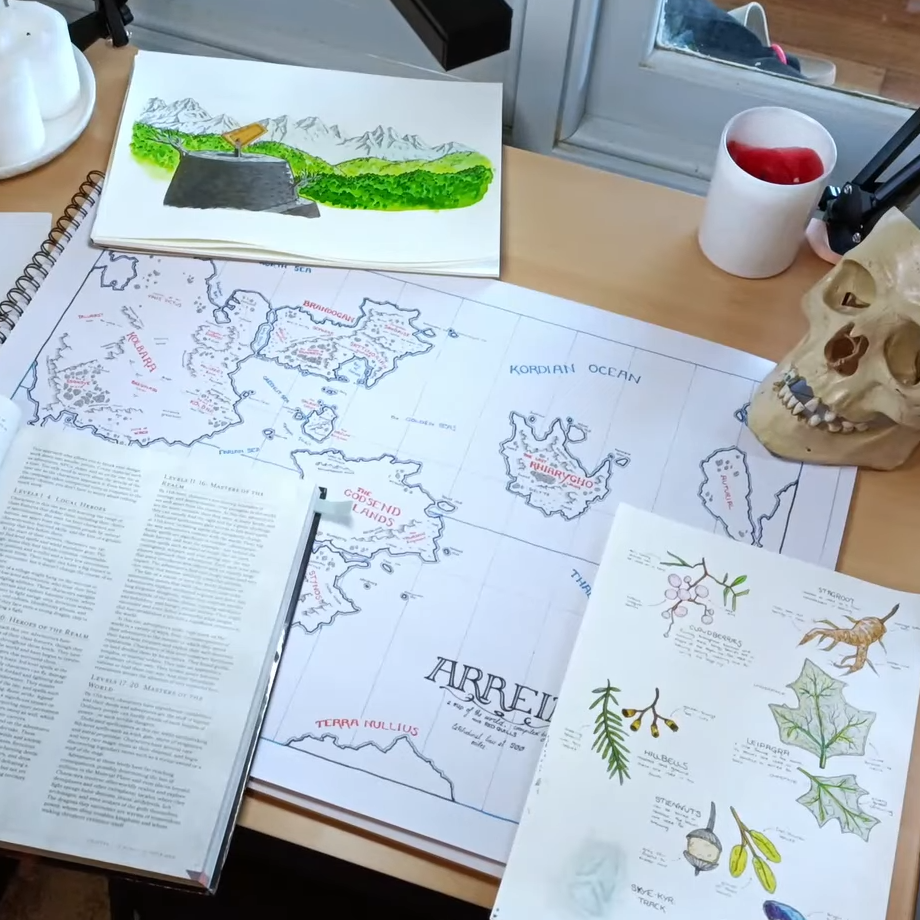
The process that I’m using is long and arduous, but it’s fairly simple to follow the process along. The first thing that you need is a reference map. It is the map of the area that you intend to explore. In my case, it’s a map of the Kingdom of Endon: all of the details in other maps, all of the spelling and the distances, all of the terrain and the flora, everything is based upon that map as being absolute truth.
This is an important point, because the important thing to remember about the atlas is that it cannot contradict itself. If the author is unreliable, then its value as a resource plummets. If we’re taking its word as truth, then it needs to be beyond question. So, that map is first and foremost.
Then I went through and made three lists: a list of the major areas (in my case, the duchies, the stretches of hills or mountains, and large forests and marshlands); a list of the significant towns and cities; and a list of the dungeons, ruins, and castles.
To give you an idea of the level of detail that I’m going for, I have eight duchies, twelve natural areas, thirty-eight towns and cities, and fifty-two assorted sites. Which sounds like both a lot and not very much. I’ll be working over this year to compile them, redraw any old maps to match my newer styles, and fill out the details.
So, the second step is to ask yourself: what do you want to include? I have sections for Towns and Cities, Dungeons and Ruins, Castles, and I’ll have the Atlas split into regional sections later, so I need maps for those specific duchies and their major natural landmarks. But I also have maps of other, more specific categories, like the Tower Network and the Cities of the Giants, and the ruins of the fallen yuan-ti empire, the Ssthessic Vrasa. Make yourself up that list and stick to it.
Then you draw. And draw. And draw.
For an atlas, you’ll need dozens, if not hundreds of maps of your own, so you need to be sure that the style that you use for the maps remains fairly consistent. For that reason, I’d recommend doing the less important maps first – things like individual dungeons or villages, rather than the big cities or regions – so that you can iron out any kinks.
And the Red Quills tutorials can help you with stylistic choices as you go through. I’ll be making specific videos when I do the regional and natural maps.
Finally, we get to the descriptions. For each map, write somewhere between half a page and two and a half pages. I’ll make a whole other video on this point, because there’s so much there.
But that gives us the basic structure of creating your atlas.
Let’s say that you want to bring this into your own world, you want to create an atlas of your own. It’s a big task, but that’s not really a problem, only an opportunity for you to tie it into your campaign.

And you can get your friends involved
You’ve made your world lovingly over years of patient work. Your players have had their highs and their lows, saying goodbye to beloved NPCs and welcoming new ones over session after session. The world feels real now, almost as real as our own, and you want to bring it even more to life. You can sit beside its peaceful rivers or feel its moonlight on your skin, you want to do something.
You gather your players together and tell them that you want to work on something that you can all have, something to tie you to this fictional place that’s becoming something more. They’re still invested in the world, still eager to explore, and they agree immediately, keen to help you to flesh it out.
So their characters welcome a new NPC, someone that they can tell their stories, relate their adventures to, and bring back descriptions of these faraway or dangerous places. Each session, this mapmaker makes a new chart, a new page to add to a collective description of the place you love.
It starts slow, as all important work does, but it grows, and eventually they begin to bring their own suggestions to add to the growing tome: songs they’ve written, illustrations of amazing views, and folk stories of the myths and legends they’ve encountered.
Together, over months and years, page after page is added together until you’ve made it. An Atlas of your world. A work lovingly rendered not just by you and your players, but their characters and your NPCs.
That is what I’m doing, how I'm making a fantasy atlas. That’s what I’m creating, and it’s what you can do to. This isn’t just a project for me alone, it’s an example of what you can do for your own world. An atlas is a big project, but it’s a monument to the enjoyment that you have for your world, as well as an opportunity to really immerse yourself.
I’ve got an initial start to what I’m compiling. It doesn’t have even half of my maps yet, as I’m still working on filling out the details and making sure that it’s stylistically consistent, but it’s available for free on my Patreon – take a look for inspiration, or even use it as a setting, if you’d like.
In this upcoming series, I’ll be making more maps of the world that Endon inhabits, and the surrounding cosmos. I’m also thrilled to announce that I’m an affiliate of the Shop of Many Things, and that they’ve sent me some of their awesome special ink pens to showcase in the upcoming videos. I’ll be using the Elemental Ink Pens, which will vanish when heat is applied and reappear in the cold, and the Moon Light Pens which appear under UV light.
I’ll start demonstrating them properly next week, but both pens can be found in the description below, and if you use the links below, you can get a special discount code, grab the pens for free and only pay shipping! I’m also really pleased to be affiliated with the Shop of Many Things, so if you shop around and grab a couple more things while you’re there, you’ll be helping me out here at the Red Quills too!
Let me know what you’re doing for your own world maps, I’d love to see them. Please, if you have thoughts about your own atlas to share, you can do it in the comments below, but it’s much easier to do it on the Red Quills Discord, the link is in the description below.
Please like and subscribe to help the video find more worldbuilders, and let me know if you have any questions. And this map is available for free on the Red Quills Patreon, check that out while you’re there.
Thank you for watching, and I’ll see you next week!