
How to Make an Ancient, Cosmic Map
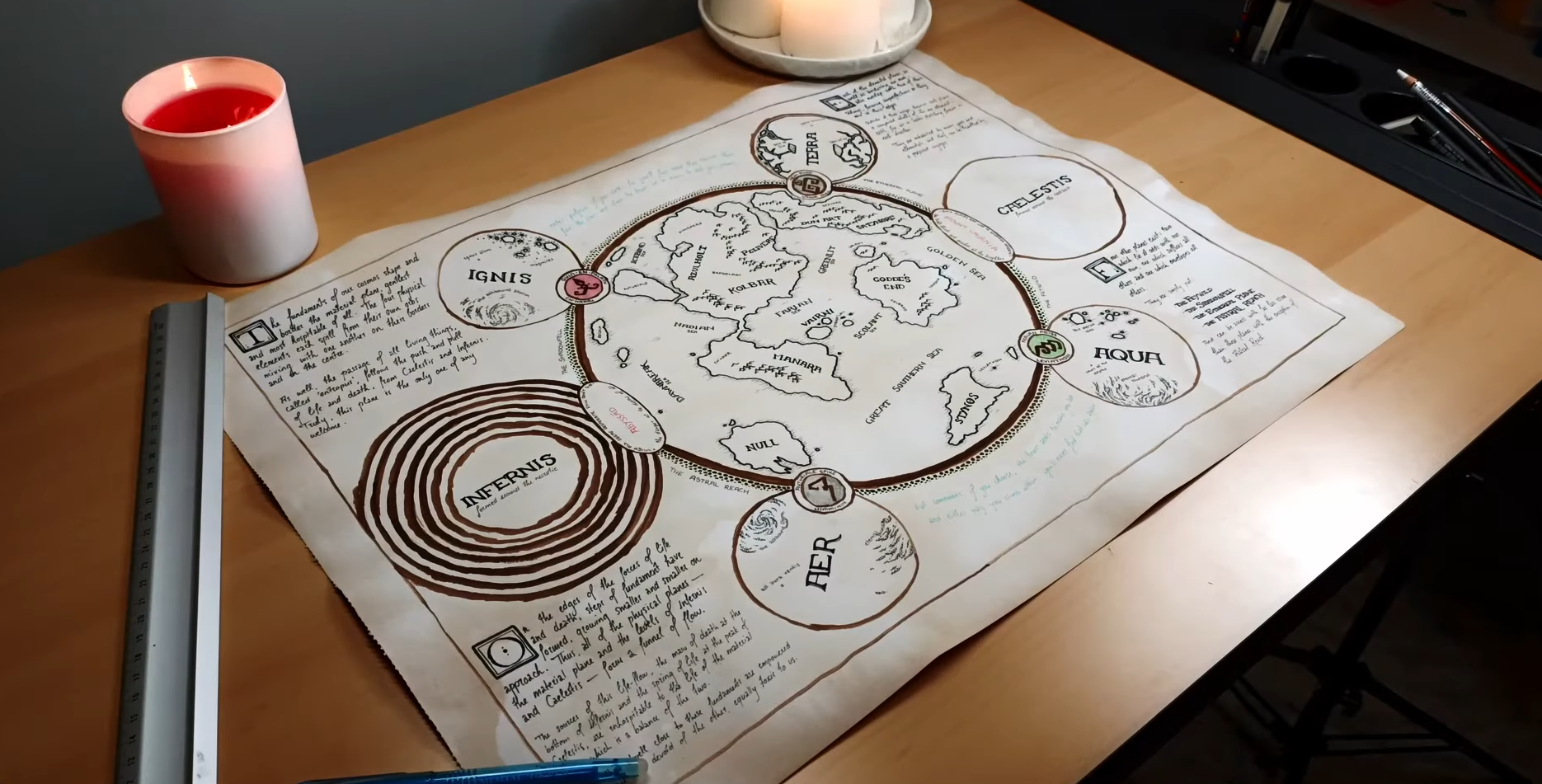
This article is by Ryan of the Red Quills, and focuses on his process for making an ancient cosmic map: creating a weathered map of the planes for his world. The full video tutorial can be found on the Red Quills YouTube channel, and the map itself is downloadable for free on Patreon.

Deep within a dark vault lies an ancient map, worn and weathered, penned by the greatest explorer in history. It has been forgotten for hundreds of years, but the knowledge that it contains is of titanic importance. A group of intrepid warriors seek to travel the planes of the cosmos in search of a legendary artefact, and only this map can tell them how. Filled with secrets, and hidden away, it is their only chance for safe passage into the wide universe.
Hello, adventurers, and welcome back to the Red Quills! My name is Ryan, and we are venturing out into the cosmos for this series, creating maps of the world and its place in the stars as we map for the adventures of a high-level party. Today, we're looking at how to make an ancient, cosmic map.
I’ve mapped many smaller locations in the past, particularly kingdoms and realms, dungeons, and cities. But I’ve never actually mapped the big pictures, like the world or the cosmos. In this series, I’m going to be looking at how you can create maps which are not only useful to you in creating and exploring your world, but also can be given to your players.
I will be creating world maps, cosmological maps, world tree maps, and more, and I’ll be tying them in together in my own world of Arreia, on which my Atlas project is focussed.

"An ancient, cosmic map?"
When you’re running a D&D campaign early on, you don’t need a world map. I know that many DMs start by outlining their world, and that’s not wrong, but in many cases it's unnecessary. For me, having run my own campaign now for five years and counting, these maps in this series are my first attempt to create my world map, because I never needed it. Now my players are level 16, and they’re starting to ask awkward questions about what’s happening in the rest of the world
What’s more, there’s more of a universe out there for them to look at. The elemental planes and the other planes of existence are a fact in D&D, as so many spells and creatures refer to them for their origins, and while there’s some leeway to explain it all, planes are something that every DM running a campaign for long enough will need to address.
So today, I’m creating a handout map. My players want to start voyaging out into the realms of the planes, and they’re going to want a guide. I’m creating a map that will tell them how to get out there, and warn them about the dangers, and I’m going to use some special ink tools from the Shop of Many Things to hide some clues in the handout so that I can reveal things later on.
But first, as I outline the shape of the map and do the illustration of the world, let’s talk about the history of planes.

Planes of existence in history
Different planes of existence have been a concept that’s been around for a long time. Esoteric cosmology deals with the ideas of having different interconnected planes of reality.
Esotericism is the concept that there are spiritual or fundamental truths that are known to a select few, dealing with the reality of the world. In this case, that the world as we know it is influences by planes of matter and energy that permeate and encompass everything we know.
Gary Gygax introduced the first concepts of the cosmology of the planes for D&D in 1977, and even the players handbook in 1978 had details on how the universe of D&D was constructed of overlapping cosmic planes.
In the D&D immortal rules in 1986, they introduced even more rules, about the presence of the connecting Astral plane, and how large the various planes are.
When Spelljammer campaigns first launched in 1989, they started to discuss how you could use planar travel to hop between settings like Greyhawk and the Forgotten Realms, which were in the same cosmos, via the Astral plane.
D&D has always had a fairly loose approach to conceptualising planar travel for D&D, giving examples but purposely avoiding definitive rules, so that DMs can work their own stories and mechanics in.
Generally, D&D uses the Great Wheel cosmology.
For this map, I’m referring to maps created in the renaissance for a stylistic and inaccurate approach to cartography, and to the circular illustrations of Jainism for an aesthetic of the overlap of the planes.

How to make this map
- The first thing that I’m going to do is create a weathered sheet of paper
- Then, using some dark watercolours, outline the main circular material plane (as the inhabitants know it), and the overlapping fundamental planes. Taking a leaf from the direction that DMs can come up with their own mechanics and stories, my world has six elemental planes: fire, air, water, earth, life and death, the latter two accounting for the heavens and the hells.
- I’m using fineliner pens of various thicknesses to illustrate the map itself, and I’m approaching the map as a renaissance cartographer would. By deliberately introducing inaccuracies - not lies, but shortcomings - I can flesh out more of the world later, and give myself the opportunity to add some story tie-ins that I can come up with in response to their exploration
- Finally, I’m going to use the Elemental Ink Pens from the Shop of Many Things to add in some clues for them to use to explore the world. This gives the map two uses: the first is as an understanding of how the cosmos is constructed, and the second is as a guide and a warning. I’m going to write in some specific warnings about heading out of the material planes, and an understanding of how and where you can access specific planes.
Let’s give an example of how this map can be made, encountered, and used.

Bring this into a campaign
The world is in great danger.
The Pantheon Wars are raging across Arreia: new gods are springing up wherever new followers can be found, and while natural disasters lay waste to continents and armies of inquisitors try to wipe out worshippers wherever they can find them, there is no solution to this conflict to be found in the mortal world.
But legends tell of the Well of Ages, a legendary spring which grants the drinker immunity to the powers of the gods. Should a warrior drink the water of the Well, they would be able to stand against the vainglorious gods, facing only what mortal threats that god can summon.
However, the Well has been lost for long ages, cast out into the other planes of existence by the very gods that it defends against. It is clear: a group of brave and foolish warriors must venture out into the dangers of the cosmos, drink of the waters, and come back to defend the worshippers from their gods.
It is said that there are many entrances to the other planes of existence: the hells of Infernis, the paradises of Caelestis, and the roiling storms of the four elementals. After long search, they hear a rumour that a map of the planes was made long ago by the ancient explorer Ithsmenes. The map has the locations of the planes’ intersections, and clues about how to track down the Well of Ages.
They need only find the map, held deep within the vaults of the Bank of Indusaal, the most secure location in the world.

A good map is a combination of history, mythology, and speculation, and that mixture is what allows a good DM to create a tool for storytelling. But you can bring whatever tools and flair you like when you map an ancient, cosmic map for your own world.
This map was easy to make, and looks great, and what’s more, gives several layers of clues to reveal over time, as well as stages of a quest to find it.
This map is for my own world, and while it references the Shadowfell and the Feywilds, the Astral Realms and the Aethereal Plane, it only really deals with the six elemental planes of my cosmos - fire, air, water, earth and the planes of life and death, Caelestis and Infernis.
The tools from the Shop of Many Things made this a great tool that I can give to the players. They work well, vanish fully when heated and reappear quite easily. I’m keen to show this to my players and see what they can figure out!
Elemental Ink Pens (temperature-activated ink) | GET THEM AND USE THEM
Use heat to make the ink disappear and cold to make the ink reappear, and you can combine with regular ink to create interesting puzzles and reveals. They work on pretty much any surface.
It won’t light your paper on fire unless you keep the flame on the same spot for a long time. The Elemental Ink disappears at 104°F (40°C) whereas normal paper lights at 451°F (233°C). Direct flame works well but also a hot lightbulb, a hot mug of just boiled water or even an iron work too.
As for reappearing, freezer cold works well but dry ice or other arrangements work too if you want to take it to the next level!
If you have your own realm projects that you’re working on, please show me and the follow mapmakers on the Red Quills Discord, and take a look at my Patreon if you want to download the digital version of this map to use as a reference.
If you’ve got thoughts, inspiration, or questions, leave a comment below, please like and subscribe for more mapmaking tutorials. Thank you for watching, and I’ll be back next week!