
How to Map the World Tree
This article was written by Ryan of the Red Quills, and details his process for how to map the world tree, a fictional cosmological entity. For the video tutorial, you can watch it on the Red Quills YouTube channel, or download the map itself for free on Patreon.

A rusting observatory has sat beneath the waves for thousands of years, the relic of a long-dead civilisation. Once, it was the pinnacle of advanced science, but its people and their knowledge are gone and forgotten. The observatory recorded the night’s sky, and was that peoples’ attempt to find a way to navigate the stars.
When a group of adventurers stumbles upon the ruin and investigates the watery depths, they find that it contains a map, and a glimpse of a much greater cosmos.
The very cataclysm that destroyed that lost civilisation broke the observatory, and accidentally created the conditions to record – only for a split second – the very thing they sought: the branches of the World Tree.
Hello, adventurers, and welcome back to the Red Quills! My name is Ryan, and today we are discussing the Astral Plane, wildspace, and the vast starry sky of a D&D world. I’ll be creating another map of the cosmology of my own world, which I started last week with the introduction of the map of the planes, and talking about how I make a handout map that my players can find, puzzle over, and eventually use to venture out into the cosmos.
This is part of a series of videos on cosmological maps, how to map and explore different parts of a very large universe. So, while I start with a black sheet of paper and a white pencil, let’s talk astral.

Why I made the World Tree
Last week, we dealt with planar travel, and discussed how the idea of planes were deeply woven into the history of both D&D and real-world philosophies. This week, I’m doing something more more ambitious, using tools I’ve never used before to try to make a map that’s going to blow my player’s minds. I’m going to map the world tree.
When you’re dealing with high-level players, you start to reach out beyond the bounds of cities and kingdoms, and out into the wider universe. It’s not a requirement, per se, but even in the DM’s Guide, it says that higher level players are heroes of the multiverse. So I can’t justify keeping my group locked up.
Last week, I created a map of the elemental planes, in which I included the heavens and the hells, and the overlapping planes of the feywild and the shadowfell. And while that’s a great initial guide to the concept of planes, and I mentioned the Astral Plane in that map, the concept of the Astral Plane is so large that it really needs its own map.
I want to create something that moves the plot forward, creates a puzzle for my players to discuss amongst themselves, and fills out the worldbuilding of a whole universe. Which is a pretty tall order, and for which I’m going to have to be a little imaginative. So I’m going to make two maps in one: one of the night’s sky and the constellations, and one of the astral winds that make up the world tree, so that the players can more easily navigate the Astral Plane.
But before we go into all of that, let’s talk about what the Astral Plane and the World Tree are, and how they fit into D&D.

Exploring the stars in D&D
The Astral Plane exists well outside of the bounds of D&D: far from being made up for this particular role-playing game, it has a very long and complex history and is a part of dozens of theologies and philosophies. Concepts like it exist in Jainism, Hinduism, Buddhism, Islam, and so many more, and Ancient Greek philosophers like Plato and Aristotle talked about the celestial bodies being composed of a different element from the major four, the same element that the human soul was made of.
A lot of the time, the Astral Plane in history is discussed through the lens of out of body experiences, meditation, and near death experience - we’re talking about how people can leave their bodies and wander around.
In D&D, they split these ideas into the Ethereal Plane (the soul plane) and the Astral Plane (the starry plane).
In the last episode, we talked about the history of the planes in D&D, and the astral plane is depicted in some of the oldest official cosmologies, where it permeates and connects all of the other planes.
However, some specific books have really expanded and focussed on it, opening it up, starting really with the 1996 Guide to the Astral Plane, which give rules for astral travel, gravity, and the Githyanki.
Here things get a little murky in official lore, because technically, the Astral Plane, wildspace (which is the closest thing we have to space), and the Phlogiston, a cosmic river that connects worlds, are all the same thing and also not the same things. Various editions have come up with new explanations, combined old ones, and ignored others, and it all just goes to remind us that D&D is a storytelling tool, and not a story itself.
So, I’m coming up with my own cosmology for this that combines several concepts, and this is how I’m going to do it.

How to make this map
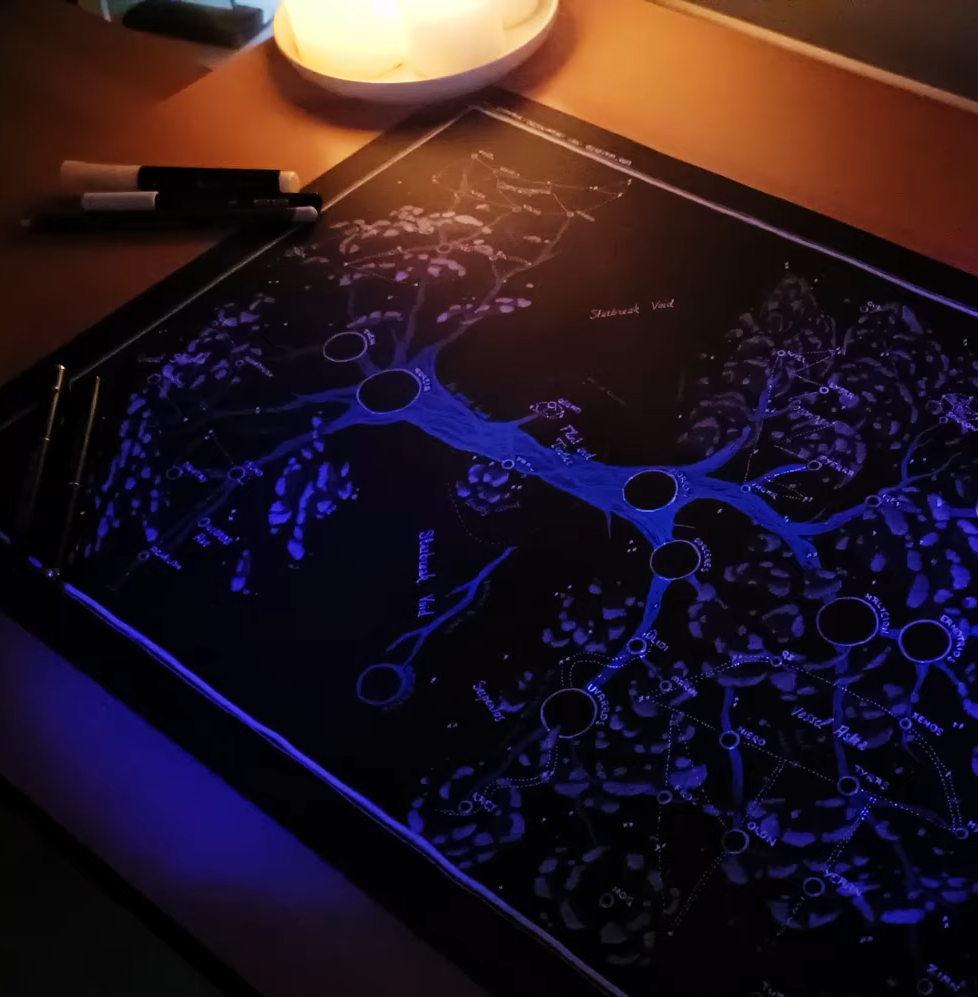
I started by going out and buying a nice large A2 sheet of black paper, 180gsm, and an assortment of white inks and pencils. I’m going to make this a two-layered map: the first is a ‘mundane map’ of the night’s sky. To achieve that, I’m going to use white pencil shading to create clouds of nebulae and their deeper, more dense cores. Then, using the white pen, I’ll outline the systems on the map, label them, and then use uninhabited stars to create constellations.
There are two major clouds of nebulae, which I’m aiming to make look like a tree in the end, so I’ll have a thinner curved band around where the roots will be, and a much thicker, bushier expanse of them on the branches. It makes the map look a little unbalanced, but that will be alright later.
I’m using circles of different sizes to denote the systems that are inhabited, with the size of the circle showing how many inhabitants it has. Larger ones towards the core, with the systems getting smaller and smaller as they move to the exterior of the tree.
The constellations are more for decoration than anything else, and I didn’t want them to overpower the map, so I left them fairly simplistic, and because I didn’t want to have to work in whose mythology this was from, I used objects rather than legendary heroes or gods, which are generally the accepted constellation subjects.
And finally, using the Moon Light Pens from the Shop of Many Things - shoutout to the them, I’m so pleased to be using them, they’re a great tool - I’m going to connect the systems together using the branches and roots of the world tree. Drawing a tree is very easy, you just need to remember that the trunk’s width is no larger or smaller than the width of all of the branches.
I’m also going to add in some hidden clues.
So the map can be used to look at the night’s sky, given to the players just as a worldbuilding tool, but when they get certain tools or head to a certain location, it will show them how to navigate between worlds.
Let’s give an example of how to use it in-game.

How you can introduce this map
The night’s sky, stretching overhead, is a constant reminder of the vastness of the cosmos. Our world is but one small corner of a much larger universe, where colliding planes and clouds of cosmic gases dwarf the fields and forests of our home. It’s a wonderful, dangerous place, and does not reward the foolish and unwary. But sometimes, when there is no other choice, the call of adventure leads up to that starry expanse.
Legend has held for millennia that all of creation - the planes, the stars, and the material plane - are connected in one enormous living organism. They call it the World Tree, the vast permeation of life and energy that thrums through all living things. World hang from its branches like fruits, and all of the wondrous universe is its soil.
However, though this story has persisted throughout history, passed from generation to generation as myth and legend, there is said to be a map of the branches of this titanic organism.
Deep beneath the waves, in the ruins of an advanced and forgotten civilisation, an ancient calamity has left a subtle mark. In the rusting bronze contraptions of their observatory, a group of adventurers find a star map showing the night’s sky. When they accidentally activate the contraption, it shines with light just for a moment - long enough to fill that astral map with the branches of the world tree.
They leave the sunken ruin of Pel Dothair and return to the surface, clutching the discarded remnants of the dead civilisation: the outcome of their mastery and science, achieved only through cataclysm, and held now by their savage and unlearned descendants.
And so the adventurers find a map that can lead them through the Astral Plane… if they can only find a ship to sail the World Tree.
So I’ve made a map of mundane and astral features, that can be given to the players to lead them through the astral plane, and connect it to the history and worldbuilding that I’ve been laying down in previous maps!
In end, I combined many of the astral concepts of D&D, and tidied them up to fit into my own worldbuilding - as was intended. The Astral Realms in my cosmology are a combination of the Astral Plane, wildspace, and the Phlogiston: the Astral Place is the dead space between the roots and the branches, the wildspace is the clouds of stars and gases, and the roots, trunk, and branches of the World Tree can be sailed like the Phlogiston.
It’s not a perfect model, but it works for my world.
The use of the UV ink in the Moon Light Pens allows me to create a handout to give to my players with that added level of immersion: it also allows me to give it to them even if they haven’t figured out how to read it, as it will just be a picture of the night’s sky then.
I’ve got the star-circles that I can use to add details of what can be found where later on, as they start navigating and if they have particular aims and goals.
The tools from the Shop of Many Things made this a great tool that I can give to the players. They work well, vanish fully when heated and reappear quite easily. I’m keen to show this to my players and see what they can figure out!
If you have your own realm projects that you’re working on, please show me and the follow mapmakers on the Red Quills Discord, and take a look at my Patreon if you want to download the digital version of this map to use as a reference.
If you’ve got thoughts, inspiration, or questions, leave a comment below, please like and subscribe for more mapmaking tutorials. Thank you for watching, and I’ll be back next week!