
How to Map your D&D World
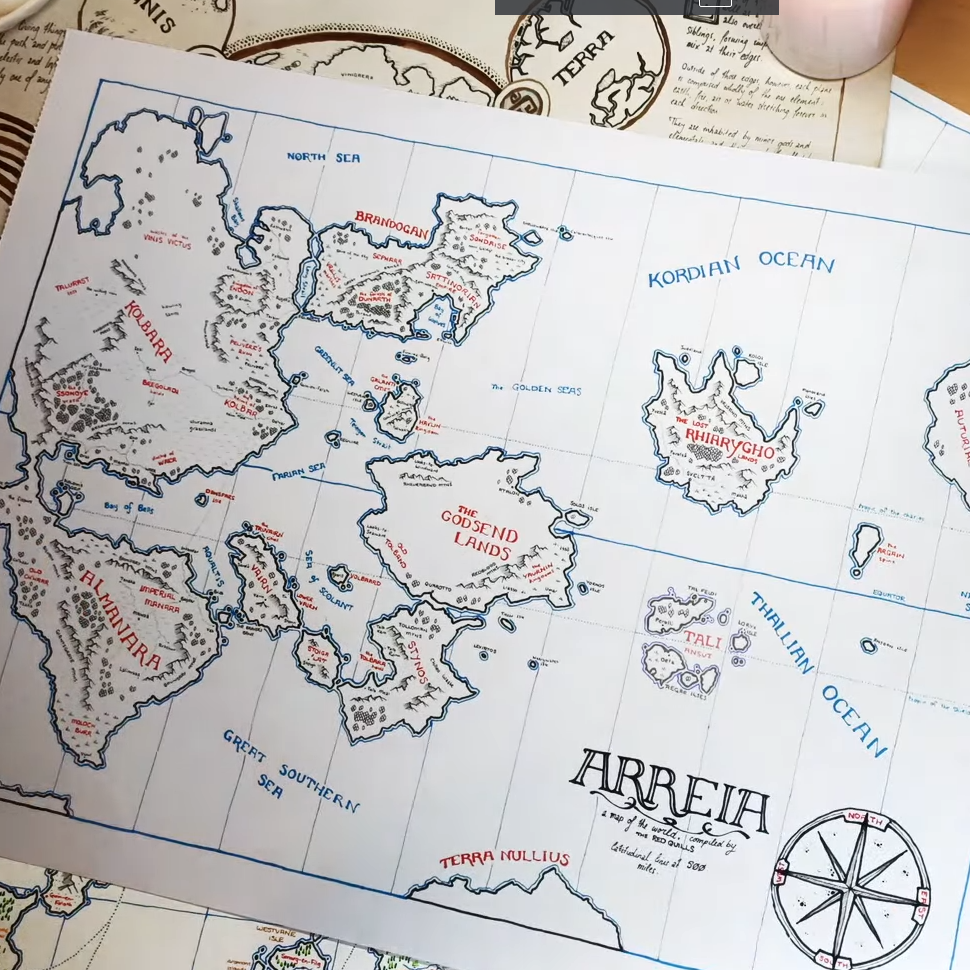
This article was written by Ryan of the Red Quills, and details his tips and tricks for how to map your D&D world. You can watch the full video tutorial on the Red Quills YouTube channel, or download this map for free on Patreon. This map extends the world of Arreia, the maps of which are recorded in the other posts on this site -- of the Kingdom of Endon, locations like the Drifting Isle and the Still-Beating Heart, and many more.

The Emperor of faraway Sattinoria has a plan to conquer the world. His legions are massing, his mages are preparing, and soon he will strike. But he will take no chances in his bid for power, and wishes to be assured of success.
In secret, a squad of his soldiers has taken the famed chief cartographer of the Red Quills and taken him to Sattinoria. In the Emperor’s personal library, he is being forced to create the first accurate world map, with the legendary skills of that guild.
With that map, the Emperor’s forces would strike with incredible accuracy and without warning. It would be a significant tool in his arsenal.
A group of adventurers has been sent to retrieve the cartographer, rescue him from the palace of the Emperor, and return him home – with the map safely in hand.
Hello, and welcome back to the Red Quills! My name is Ryan, and today I’m sitting down to make the first full and complete map of my world.
I know, I know: I’m a mapmaking channel, and I’ve been exploring the world with my players for over five years now. It’s almost criminal that I haven’t made one yet. But there is a reason for that, and now that I am doing it, I want to do it right.
A map of the world doesn’t seem like much. A mere novelty, an interesting insight into the way the world is made. They don’t tend to hold knowledge of earthshaking importance, or tell the reader how to achieve arcane power. But maps have power, and are of great use to the powerful.
Today, I’ll show you what I’m making, how I’m making it, and how I’ll bring it into the game as the powerful worldbuilding tool that it is.

So, finally making a world map?
This year, I’m working on creating the Atlas of Endon, which is my attempt to make a cohesive setting from all of the locations that my players have explored over the campaign of the past five years.
It includes a great many places, incredible amounts of lore and history, and no small amount of creativity.
But even then, despite the dozens of towns, hundreds of dungeons and ruins and sites, and ten thousand square miles of kingdom, they have also had to venture far overseas in search of answers in previous quests.
The Kingdom of Endon is filled with lore, but it is still only one small part of a much larger world, a world that I have attempted, as much as possible, to fill with details, implications, and nudges towards revelations about the truth of history.
But to this day, I have not made an actual world map. Despite literally hundreds of charts and maps and overviews, I have never attempted to sit down and put all of the worlds’ many locations on one piece of paper.
The reasoning for this should be obvious: there’s so much detail in a world map, that it’s practically useless for anything other than charting a course across the globe. And it has to imply so many things that you generally have to either spend hundreds of hours working through an incredibly complex history, taking different cultures, mythologies, and conflicts into account; deliberately leave things vague; or use real-life cultures as a sort of place-holder to give you some inspiration when you get there.
But more importantly, I never really needed one. I have several maps of the kingdom of Endon itself, about one hundred and fifty miles long and one hundred miles wide, and a map of an area roughly the size of the Mediterranean for when they have needed to go further afield, but before they reached the higher levels, that kingdom was more than enough for them, particularly when you take the caverns of the Underdark beneath it into account.
However, they are growing adventurers, getting too big for the tiny kingdom that they once called home. Like hermit crabs, they have to find a bigger shell to call their home. And in this series, I’ve been slowly preparing myself for what that looks like in the best way I know how: making maps.
So today, I’ll map the world of the Kingdom of Endon, Arreia.

What have world maps looked like through history?
I’ve done any number of styles of map in the past, and one of the first hurdles a mapmaker needs to think about is what style of map to use. If I’m mapping the world, how do I show it? And there are always implications for whatever style you use.
Whenever you make a map, you have to consider who is going to be using it. The maps we make here are always for the mapmaker’s benefit first and foremost - after all, the process of making a map is a great tool for sharpening that worldbuilding. But weathered or incomplete maps are great to give to players, because they give you more flexibility if you want to add anything later.
But in this case, I’ve recently made a weathered and ancient world map, and filled it with inaccuracies and shortcomings. So this is a map that I will make that will show the world roughly as it is, and be usable for navigation. It’s a little beyond the technology of my world, which we’ll get to in a moment, but I can explain that in-game by way of the amazing processes of the Red Quills.
So, when thinking about world maps, consider just how long they’ve been around, in our history. The first world map we know of is Babylonian, from around 600BCE, carved into stone, and – it’s worth noting, but no shade – is fairly inaccurate.
The maps that followed for the next few hundred years in the same area showed the world as being round, surrounded by water. Generally, they were fairly clear on the idea that there were three great continents (Europe, Asia, and Libya) and the conquests of Alexander the Great only improved their mapmaking.
Most of the depictions of the world that came after that, we wouldn’t really recognise as being a map, but it was nearly two thousand years later that we started getting actual world maps, with Latin maps around 1000CE showing more of what we would recognise, while still barely accurate.
So it’s not until around 1400CE in Italy that we begin to get maps that are even remotely accurate or appear to be the same as what the world actually looks like, and even the first real globe in 1492 doesn’t include the Americas. You have to wait until Ortelius in 1570 for a real world map. (No hate)
All of which isn’t necessary to know to make a map, but as someone who tries to give players things which make sense in world, I find it helpful to know how accurate the maps would be, for the level of advancement in a fantasy world.
They certainly would not have a Mercator map, which is what I’m going to be making here. In this house, we love Gerard Mercator and what he did for navigation, but it should be noted that it is also technically not accurate. The brilliance of the Mercator map is that it takes into account the curvature of the earth, so that a sea captain can plot a straight-line course from any two points on the surface and be sure of arriving where they want to be.

How to make one
A Mercator map should technically be just about square, but most of the versions that we are familiar with cut out the mainly useless part which includes Antarctica, and so we tend to use a rectangular portion.
While I could faff around and try to make the distortion as accurate to the Mercator map as possible, I don’t want my brain to fall out, so I’m going to eyeball it. Believe me when I tell you that the brilliance of the Mercator map is that it reduces incredibly complex mathematics down to something you can glance at.
I’m going to start with a blank sheet of paper, and then use the other maps I’ve made previously as reference to add in some continents. It’s worth noting that I need to take into account that the distortion of this map and the deliberate inaccuracies in previous maps give me a little leeway in making them all join together properly.
I’m going to keep the colour palette pretty simple for this map, using black fineliners for the physical landmarks, red for the continents, regions and major cities, and then blue for the ocean, as well as the latitudinal lines (twelve, each two hours of a day-night cycle), the equator and the tropics.
Yes, my world does have an axial tilt which creates seasons. I’ve named the tropics after constellations from last week’s map.
Then, later on, I’m going to use some of the special pens from the Shop of Many Things to add in some secret details that I can reveal later, and to give you all some inspiration for the kinds of things you can include. Once I’ve gone through and outlined the world, I’ll use the Elemental Ink pens, which vanish when heat is applied, to create a vanishing continent. Oh, yeah, I’m keen. It’s going to be super cool.
And the other addition I’m going to make is ley lines. I’ve mentioned them in previous maps occasionally, but now that my players are getting very big and important, I’m going to add ley lines to this map, irregular curves hugging the planet, that the wizard can use to calculate the teleportation circle symbols of the junctions. Where the lines intersect, if the wizard has the map and the lines, he can use some arcane maths to determine what its teleportation coordinates are. It’s an easier way of getting them out in the world, and gives them a sense of achievement.
So, as I’m adding in details, let’s talk about how I’m introducing this map to my players after five years of playing in this world, and what hurdles they need to jump through in order to make use of it.

How to make a world map plot-relevant
Adventurers tend only to use maps as a vague guide - after all, their calling is to delve to forgotten places of the world, venture out into the unknown, track their quarry through the wilderness. All of the things that they defend against make their territories in the borders of the maps, and rarely in the picturesque fields of the maps’ centre.
The offices of the Red Quills Cartographic Society does a great deal of business with mercenaries, warriors, and explorers, in their ongoing quest to map as much of the world as possible. Funded by the crown and patronised by the elite, their reputation as navigators, historians, and diplomats is unrivalled.
The charts and maps that the Red Quills creates are hailed as being the most accurate in the world, and their cartographers take great pains to make certain that all information is credible before being added. While the masses do not take much notice of the accuracy of maps, there are those who do. Those who need accurate maps to chart trade lines, plan for wars, and navigate vessels across vast distances. The people in charge of the world care a great deal about accurate maps.
And the reputation of the Red Quills has gathered unwanted attention. Recently, the chief cartographer of the Red Quills in Endon has been taken by the legions of the Sattinatorian Empire. Their Emperor, keen to spread his influence across the known world, wants accurate charts to allow his forces to strike quickly, efficiently, and without warning.
The Red Quills is known for its accurate maps, but the explorers of the Sattinorian Empire have ventured to every corner of the globe, and this cartographer now has access to every chart they ever made. Making them into a map of the world is his dream, and the Emperor does not need to threaten him to get what he wants.
A group of adventurers has been sent to venture into the heart of the Empire, rescue the cartographer and come back – either with the map safely in hand, or in ashes.
So, that’s what I think of world maps. I know that I’m more obsessed with maps than most, but I think that they serve as a solid worldbuilding tool, the object of a great quest, as well as an immersive aid.
In the end, I’ve created a map of Arreia that references previous maps, allows for inaccuracies and stitches together many projects. It can be used for mundane navigation, arcane teleportation, and the hiding of even more secrets – in the form of the phasing continent, Tali Ansut.
You can do a world map however often and in whatever style you like, but the Mercator map is one that is quite recent and very recognisable. If you want to do earlier styles, inaccurate styles that allow you more wiggle room in improvising the world later on, I suggest looking to history for inspiration.
Once again, I was so pleased to be able to work with the tools from the Shop of Many Things for this map: in this case, I actually used both of the tools they sent me for this series - the Elemental Ink Pens for the disappearing islands of Tali Ansut, which will vanish when heat is applied and reappear in the cold, and the Moon Light Pens for the enigmatic ley lines for teleportation. Both pens can be found in the description below, and if you use the links below, you can get a special discount code, grab the pens for free and only pay shipping! I’m also really pleased to be affiliated with the Shop of Many Things, so if you shop around and grab a couple more things while you’re there, you’ll be helping me out here at the Red Quills too!
Let me know what you’re doing for your own world maps, I’d love to see them. Please, if you want to argue with me about the Mercator maps, you can do it in the comments below, but it’s much easier to do it on the Red Quills Discord, the link is in the description below.
Please like and subscribe to help the video find more worldbuilders, and let me know if you have any questions. And this map is available for free on the Red Quills Patreon, check that out while you’re there.
Thank you for watching, and I’ll see you next week!