
How I’m Making a Viking Map
This blog post is written by Ryan of the Red Quills, and outlines his process in making a Viking-style map.
Rummaging through the dusty shelves of an old library, in the forgotten corners of an archive long-unused, trembling fingers gently lift a tattered scroll from its brethren. Within it, preserved for centuries, lies the routes and worlds of the Vikings of old, penned in liquid gold. And finally, finally, the location of the lost continent.
Vikings. The word alone conjures images of longships cutting through misty fjords, fearless explorers charting unknown waters, and warriors whose legends still echo down the many centuries. But despite their vast travels and seafaring expertise, there are no surviving maps from the Viking Age. No neatly drawn coastlines, no star charts guiding their way—only sagas, carved runestones, and the whispers of history.
This presents a slight problem to those of us who want to bring the Vikings to life in our TTRPGs. How do you map the world of a culture that didn’t make maps? And how could they not have done? The answers lie in the past, but we here have never backed down from a challenge, and we will make a Viking-style map of our own. So, if we were to imagine what a Viking map might look like, how would we design it?
Hello, adventurers, and welcome back to the Red Quills! My name is Ryan, and today I will be creating a Viking-style map requested as a commission, and tackling that age-old question: what does a Viking map actually look like? What symbols, styles, and techniques would bring it to life? In this post, I’m going to take you through the process of creating a Viking-inspired fantasy map—one that blends history with myth, and art with adventure. We’ll explore how the Norse navigated the seas, what little we know about their world maps, and how you can make one yourself.
This post is paired with the YouTube video of the same name, which you can check out for another kind of tutorial.
If you want to browse through the other mapmaking tutorials on the Red Quills Journal, there are dozens to explore!
Additionally, at the end of this post, I’m going to talk about the map giveaway that I’m doing over the next four videos, so stick around for that!
Let’s get started.

About the Vikings
For those who are - somehow - unaware of the Vikings, this group was a seafaring, marauding culture from Scandanavia, where Norway, Sweden, and Denmark are now. They were known for their vicious raids, their complicated mythology, and for their voyages. Because the Vikings were more than just raiders and warriors—they were explorers, traders, and master navigators. Their longships carried them across the North Atlantic, reaching as far as Iceland, Greenland, and even Vinland—what we now know as North America. But how did they find their way across such vast distances without maps as we know them?
The answer’s a little complicated. They used rhyming chants to memorise landmarks and bearings, the direction of the sun and the moon, plumb bombs to measure ocean depths, and, when they could, the stars.
As a case study into how a culture can navigate a significant portion of the world without the benefit of a map, the Vikings serve quite well. It’s honestly a little frustrating, from the perspective of a mapmaking channel, but it’s singularly impressive.
And yet that doesn’t squash the desire for Viking maps. All of their knowledge and ability is difficult to pass down without direct descent. Only through sagas and poetry and the writings of their contemporaries do we even know this much.
But if we were to imagine what a Viking map might have looked like—if one had ever been drawn—what style would it take? Would it resemble the medieval mappa mundi, filled with beasts and legends? Would it be a circular representation of their known world, with Midgard at the center and the great seas beyond?
That’s what we’re going to explore.

What were Viking maps like?
One of the biggest challenges in creating a Viking-style map is that… well, none actually exist. No intact maps from the Viking Age have ever been discovered. There was the so-called Vinland Map, a supposed medieval depiction of North America that surfaced in the 20th century—but it was later revealed to be a forgery.
Actually, let’s talk about that a little more. The only extant example of a Viking map turns out to be a forgery? How does that happen? And why?
So, let’s discuss the Vinland Map.
In 1957, Yale University in the United States acquired what appeared to be a 15th-Century mappa mundi - which is a style of world map made in Europe around that time - they called the Vinland Map. It was called this because in addition to showing Europe and Asia, it showed a landmass to the far west, labelled “Vinland”.
The quest to determine its authenticity - particularly when you look at the construction of the paper, the ink, the inspiration for the shockingly accurate Greenland - took decades. But eventually, the scholars at Yale established that it was a forgery, in 2018.

The Vinland Map was a fake, in the end. But it was worth noting that it was announced and shown to the public before the discovery of the Norse settlement in L’Anse aux Meadows, which to date is the only undisputed pre-Columbian contact between Europe and the Americas.
No maps. No runestones. Only sagas,
So, instead, we look to what did exist at the time. Medieval European world maps, known as mappa mundi, often depicted the world in a circular form, filled with biblical and mythological imagery. These maps weren’t about geographic accuracy—they were about storytelling.
While there were some maps out there that strove for accuracy, many of the maps on the market for travellers were accurate to only a slight degree, and lost that accuracy as one ventured out towards the borders of the map. This isn’t the sailing age of the late Renaissance in Europe.
When making a Viking-style map, that’s something to keep in mind. It shouldn’t be just a practical tool—it should tell a story. Perhaps it marks the locations of legendary creatures, lost islands, or the halls of the gods. Maybe it shows trade routes, or warnings of treacherous waters where sea serpents dwell.
With that in mind, let’s get into the process of actually making one.

How to Make a Viking Map, then
Last month, I made a map of the elemental planes - trying to evoke the sense that it was ancient, crumbling, and had been dug up somewhere with its forgotten wisdom. I want to revisit that feeling, and I’m inspired by the forgery of the Vinland Map, so we’re going to start by weathering the paper.
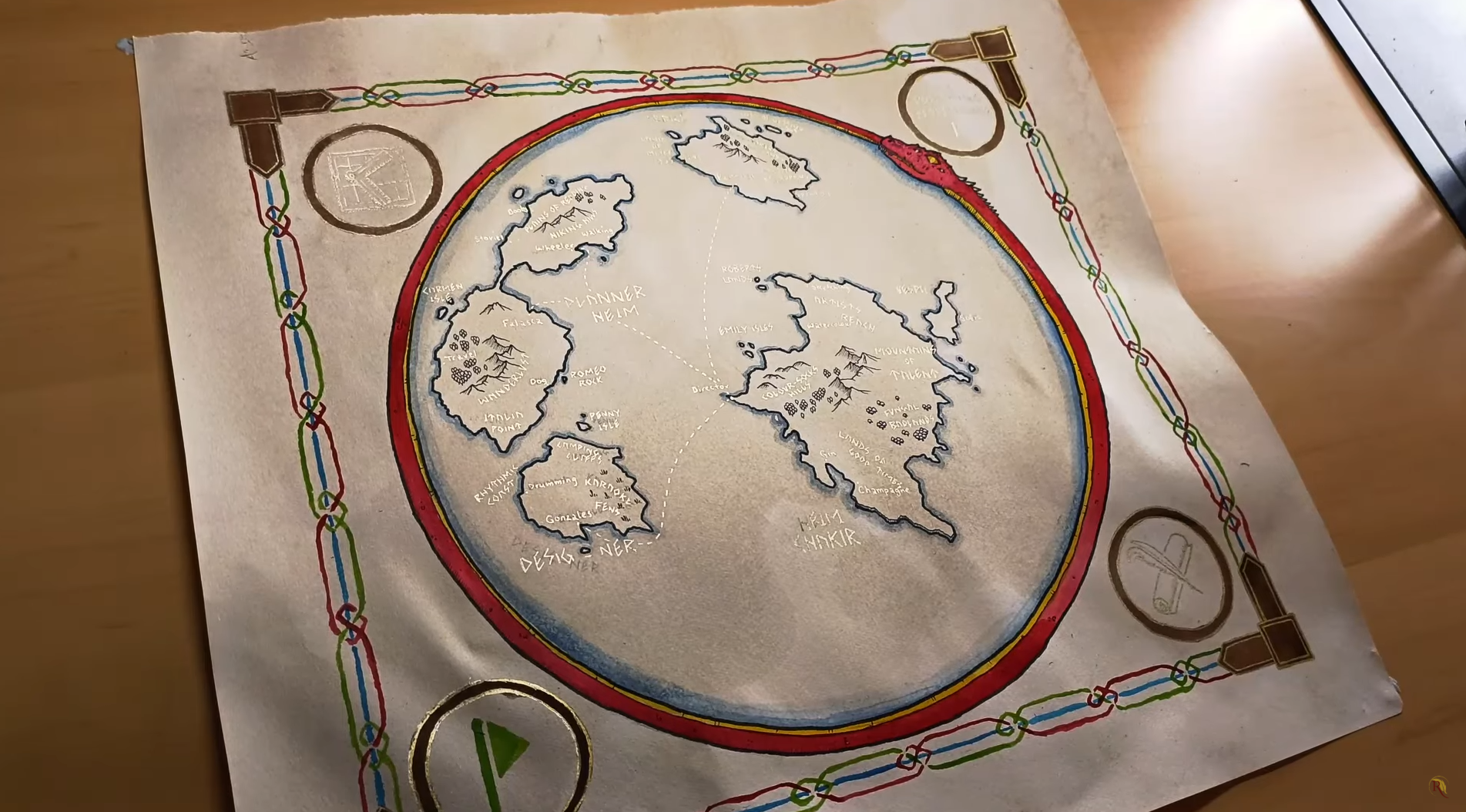
I’m using a sheet of A2 (sorry, Americans) 180gsm watercolour paper to begin with, and I’m going to soak it in some black tea. After leaving it to dry overnight, I’ll tear it down to be roughly square, and sketch out the roughly shape before starting the painting.
As I mentioned earlier in this video, this map is actually a commission for a birthday present for a Viking enthusiast. And while I didn’t have the heart to tell them that Vikings didn’t make maps, I’ll be damned if I don’t make something that looks like it could have been a real Viking map. Because it’s a commission, it won’t be available to download for free on my Patreon, but you can check out the other maps that I’ve made through the link in the description below.
So, what we do have of Vikings is mainly runestones and carvings, as well as some archaeological evidence - also known as graverobbing. But it’s interesting to note that in many ways the concept of the Vikings is more mythology than realism. The image that we conjured up of heavily-armoured, horned-helmeted, intricately ornate warriors isn’t all that close to the truth. And that’s another part of the challenge: we have to make something that fits into the mythology as well.
The Vikings are known for their patterns in their art, so an intricate braided border of three primary colours will do quite well. In the centre, I’ll outline the world as a circle, much like many of the mappa mundi, and surround it with a terrible, snake-like beast - the Jormungandr. This is a reference to the famous Viking mythology. And within it is the world map.
To contrast the map itself with the decoration around it, I’ll use two mediums: the decorations are in watercolours, with their outlines in black fineliner pens. The map itself is done with a blue outline around the coasts, then fineliners for the coastline, the mountains, and the terrain. The map is harsher, easier to read compared to the watercolour.
The last step I’m going to take is to label the map and add some flourishes. To put the reader in mind of some contemporary medieval drawings and tapestries, I’m using a gold pen. The downside to this is that while it looks spectacular in person, it doesn’t show up quite as well on camera. But the shine of the labels, the flourishes to the borders, and the symbols on the outside will draw the eye and hopefully impress the viewer.
So, let’s talk about how we could use this in a game. Normally, the maps that I make are for use in a renaissance-era fantasy world. But this… this is something else. An Indiana Jones-style modern adventure, perhaps?

How would you put this into your world?
The Vikings are long gone now - their songs and sagas the only remnant of their civilisation. Not an organised empire, not a vast network of scholars, but explorers, voyagers. Now reduced to myth and legend. But their stories speak of wonders and miracles as yet undiscovered, even in the days of modern accomplishment.
The sagas of the norsemen chronicle tales of exploration even across the Atlantic. While the archaeologists in North America have yet to find any evidence of their travel, the Saga of Eric the Red is quite specific: he found his way to the continent, some four hundred years before Columbus. And though modern scholars lack any real proof of that, that is only one of the meanest, most mundane claims.
Why bother with claims of landmasses already discovered, when a real explorer follows trails to ends not yet found?
A trail of clues and half-forgotten secrets has led here, to the dusty shelves of a crumbling archive. Its contents are the rare, the old, and the barely credible, but one of the scrolls on the shelf calls out. On it, outlined in gold and painted within the sleek encirclement of Jormungandr, is the map to Kvenland.
Modern scholars have ignored it, attested it as being a misnomer, another name for a stretch of coastline quite near to the Vikings’ territories. But there are other clues, if you know where to look.
The traveller Ohthere made his way to the lands of the Angles in centuries gone by, and gave an account of their location: only stories, to most, but to one particularly excited Christian monk, who made a detailed map to his specifications. The map leads to the mythical, icy lands of Kvenland, and beyond – to the shattered remains of the rainbow bridge.
Finally, a traveller with this map can brave the dangers warned of in the Poetic Edda, and make their way to the spring at the roots of the World Tree, and find the fate of the silent gods.
That’s the kind of storytelling you can weave into a fantasy Viking map. It’s not just about creating something visually striking—it’s about crafting a piece of history, a legend waiting to be uncovered.
So, that’s how I’m approaching this Viking-inspired fantasy map. We’ve looked at how the Norse navigated their world, the kinds of medieval maps that influenced this design, and the process of making it look like a genuine artifact from another time.
As I mentioned, this map is not available for download on my Patreon, as it is a commission, but I did want to give everyone something this week. I’m looking at the interest in a weekly newsletter, which ties together the blog post, the free downloadable map, and adds in a weekly tip or challenge for you to add in to your mapmaking.
To get everyone interested, I’m doing a raffle for it: I have a printed bundle of three full-scale maps from the world of Arreia, from this series and the past, that can be used with the Atlas of Endon and for your own world. I’ll be drawing a name randomly from the people who sign up for the mailing list, and sending it out for free! So, the link to the mailing list is below, please sign up and comment below if you’re keen!
I’m going to be continuing this series in the coming videos, talking about making more maps of the world, but if you have requests or insights, you can always join the Red Quills Discord to talk to me directly, link below.
If you enjoyed this video, make sure to like and subscribe for more fantasy mapmaking tutorials.
Thanks for watching, and I’ll see you in the next one.