
How to Draw a Star Map
This is the written form of the mapmaking tutorial by Ryan of the Red Quills, Making a Star Map.
For centuries, we’ve looked up at the night sky and tried to make sense of the stars—tracing shapes, telling stories, and mapping the heavens. During the Renaissance, as art, science, and exploration flourished, star charts became more than just practical tools for navigation. They became works of art—filled with intricate illustrations, mythological figures, and elegant calligraphy.
Buried in the archives of an old observatory, hidden beneath stacks of astrological charts and ancient manuscripts, lies a single, forgotten folio. Its pages, darkened by candle smoke and the passage of time, hold the celestial secrets of a bygone era. Carefully, reverently, a hand turns the fragile parchment—and there, glimmering in faded gold leaf, are the constellations of a lost world.
Constellations have always been more than just stars. Since time immemorial, humans have looked up at the night sky and found patterns, myths, and omens. The Renaissance was no exception. This was the era of rediscovery—a time when scholars pored over ancient texts, when explorers charted new worlds, and when artists sought to capture the grandeur of the heavens in ink and pigment. Star maps from this period weren’t merely practical tools; they were masterpieces of art and philosophy, blending science with storytelling in intricate and breathtaking designs.
But how do you make a constellation map in that style? What techniques bring that Renaissance aesthetic to life?
Hello, adventurers, and welcome back to the Red Quills! My name is Ryan, and in this episode, I’ll be creating a Renaissance-inspired constellation map for a fantasy setting. We’ll look at historical star charts, the artistic techniques of the time, and how you can apply them to your own maps. And at the end of this post, I’ll be talking about my ongoing map giveaway, so stick around for that!
If you want to watch the full tutorial, you can find it here: How to Make a Star Map
Or, perhaps you would like to download the digital version of the map for your own use? You can find it here at the Red Quills Patreon
Finally, before we continue, if you're looking for other tutorials on mapmaking and worldbuilding, there are dozens on the Red Quills Journal.
Let’s get started.

What is a Star Map?
The Renaissance was a period of explosive growth in knowledge, art, and science, marking a shift in how people perceived the world—and the heavens above. While earlier medieval star maps were often more symbolic than scientific, Renaissance cartographers sought to merge artistic beauty with empirical observation. This transformation was driven by a revival of classical learning, the expansion of global exploration, and the refinement of astronomical instruments. As scholars rediscovered ancient Greek and Roman texts, they blended this knowledge with their own observations, creating celestial maps that were as much works of art as they were scientific tools.
It was a golden age of discovery for Europe—new lands, new ideas, and new ways of understanding the universe. Astronomy in particular flourished, with figures like Copernicus and Galileo making enormous strides in understanding the function and design of the heavens, and occasionally being punished for it. But with that rise in knowledge came the creation of celestial maps.
Unlike the more functional star charts of today, Renaissance constellation maps were highly decorative. They weren’t just tools for astronomers—they were designed for scholars, artists, and collectors. They depicted constellations as mythological figures, sometimes drawn in elaborate poses, surrounded by swirling clouds and celestial symbols.
For those of us designing fantasy worlds, these historical inspirations offer a wealth of storytelling potential. Imagine an empire that believes its fate is tied to celestial alignments, commissioning vast star maps to chart its rise and fall. Or an ancient civilization whose astronomers recorded constellations that no longer exist, hinting at cosmic shifts or lost knowledge. A single star map could serve as a navigational aid, a religious relic, or a puzzle leading to forgotten secrets.
In this video, we’re going to bring one of these fantastical charts to life. We’ll explore the artistic techniques that made Renaissance star maps so distinctive, and we’ll adapt them to a fantasy setting—where the constellations themselves might hold magic, prophecy, or hidden paths across the stars.
So if we were to design a constellation map in this style, what should it include? Elegant linework, rich colors, gold embellishments, and a sense of wonder—something that feels like it belongs in an old-world observatory or a Renaissance scholar’s study.
Let’s take a look at some historical examples.

History of Star Maps and Astrology
The tradition of mapping the stars goes back thousands of years, but the Renaissance brought a shift in how celestial charts were presented. These maps became expressions of both scientific knowledge and artistic mastery, blending empirical data with intricate, imaginative designs. Astronomers and cartographers of the time sought to redefine humanity’s understanding of the cosmos while still honoring the mythological traditions that had shaped star lore for millennia.
One of the most famous examples of Renaissance celestial maps is the Uranometria, created by Johann Bayer in 1603. It was the first star atlas to use Greek letters to designate star brightness, a system still in use today. Bayer’s charts combined scientific accuracy with artistic grandeur, illustrating constellations in sweeping, dramatic forms.
Earlier, in the 16th century, the Flemish cartographer Gerard Mercator (of map projection fame) also created celestial globes, depicting constellations as luminous figures spread across the celestial sphere. His maps were heavily inspired by the classical works of Claudius Ptolemy, a 2nd-century Greek astronomer whose star catalogue remained influential well into the Renaissance.
Other notable examples include the celestial maps of Andreas Cellarius, whose Harmonia Macrocosmica (1660) remains one of the most visually striking star atlases ever created. His work featured stunningly detailed representations of the Ptolemaic, Copernican, and Tychonic models of the universe, showing how Renaissance astronomy was grappling with new discoveries while still embracing the artistic traditions of the past.
These historical examples highlight the dual nature of Renaissance constellation maps—some endevoured to be as accurate as possible, yes. I will forever love and admire my boy Mercator. But particularly in the early Renaissance, many of the maps were as much about storytelling as they were about accuracy. Each constellation is a myth, and the night’s sky is a vast method for detailing history and culture. And that’s the approach I’ll be taking for this project.

How to Make One
To begin, I’m using a sheet of A2 watercolor paper, and I’m not going to weather it this time. It’s worth noting, if you’re weathering paper of your own, that if you do it will mean that many kinds of paints and inks will spread more haphazardly over the paper than it would do without the weathering. It does give a feeling of age, but also removes a feeling of precision. And because I’m going to make this very artistic, I need that to not happen.
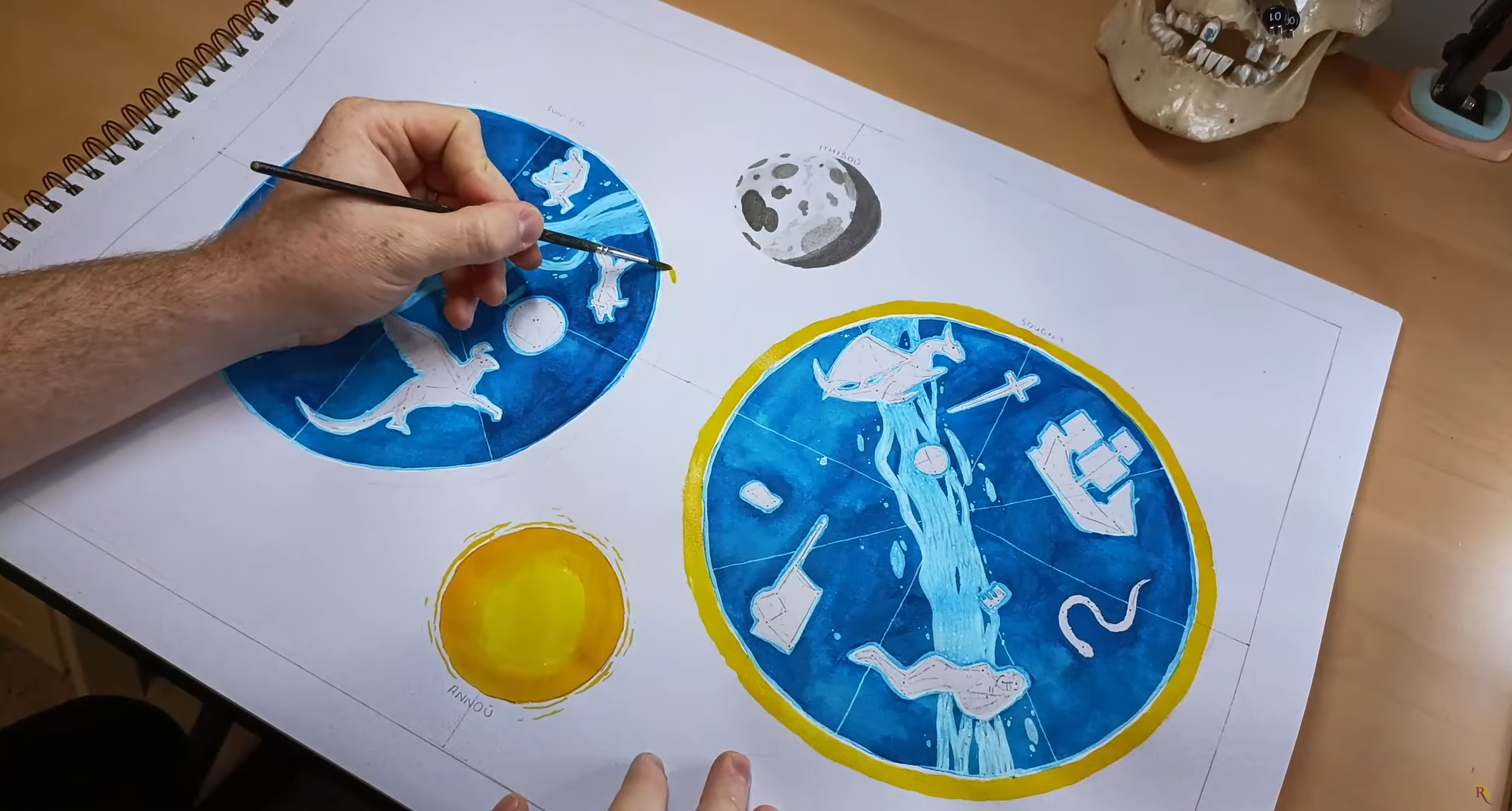
So I’m going to briefly sketch out in pencil the shapes of the constellations in two circular maps. Since no spherical surface can be rendered onto a flat surface without distortion - yes, I mean it, any method will have some distortion, it’s just a question of how much - I’m not going to worry too much about that.
But I want constellations, so I’ll refer back to the map of the World Tree that I did a few episodes ago.
Once they’re pencilled in, I’ll erase them so that they’re mostly gone, and then paint in the layers. I have a particularly good blue here that is very pigmented, so I’ll paint it out in sections, being careful around the outside of the constellations, and then I’ll use water to blend those sections where they join. It doesn’t make a flat colour, but it does give a kind of imperfect feel that looks like the night’s sky.
I’ll paint in the sun and the moon, using yellow and orange on the corona of one and shades of grey on the other, and then white acrylic paint in lines to mark out the milky way. The benefit of this acrylic paint marker is that it will soak up some of the blue, and rather than being a stark white, it will just be lighter. And the lines work out nicely, because I have a piece in my world mythology that the goliaths think that the Milky Way (or that particular band of stars) is the threads of fate seen in the sky at night, so the linework adds to that.
Then, using various thicknesses of black fineliner pen, I add in the shapes and details of the constellations, and label. Trust the process! I also use a gold pen to mark in the constellations themselves.
And finally, I’ll add in some notations in pen in the same handwriting I used for the map of the Tor Network last year, because they are both maps of goliath and giant mythology, and I want them to be reminiscent.
Since this is an artistic map rather than a practical navigation tool, I’ll be taking some liberties with scale and placement, favoring composition over strict accuracy. The goal is to create something that feels like a relic from another world—a document that could be discovered in a dusty archive or passed down through generations of scholars and stargazers.
With all of that in place, we’ll have a map that looks like it was plucked from the pages of a 16th-century astronomer’s journal.

Bringing it into your World
The goliaths are wanderers, travellers, nomads. They camp in the snows of the mountaintops, venturing to the places that the lowlanders fear to go, and stay in contact with their giantish kin. They alone know the safe paths that lead to the Tors, to the Agdu, and though they refuse the written word, they keep their history safe with an oral tradition dating back millennia.
Their stories are their history, told and retold night after night around their fires, and rigorous training keeps their wording the same as it was when they were first told. According to their own stories, they were begun by their creator-gods, the Elder Giants of the dawn of time.
But times are changing. The goliaths and the giants are dwindling, and their dominion over the world has long since passed. Their stories are being forgotten, one by one. And so they accept the offer for one scholar to sit and record the stories of their constellations.
It was just a simple task: use a reference of modern stellar cartography to map out the constellations that the goliaths use to tell their stories. Record their culture, as much as one can, and store it away for posterity. An act of mildly patronising charity, it could be said.
But their stories are not like the stories of the rest of the world. They have some similarities, it’s true: hero-kings thrown up into the starry sky, beast beasts from hunts of long ages past, and other such legends. But a great many - in a band of stars cast across the night - are a story yet to come.
Most prophecies are vague things, half-remembered dreams couched in riddles, but this…
The giants and the goliaths have been telling the story of the end of the world since its very beginning, and their story hasn’t changed. Of the dragon Ahzuraband, who made a weapon to destroy the mortal world. Of the Vessel Astral, set to voyage out with champions to defend against the weapon. Of the Dreamer in the Dust, who will witness a cataclysmic challenge between those who fight to defend mortal life, and those who seek to end it. And of Ahzuraband’s son, Ancalagon. The black wings.
And that is how you could theoretically bring such a map into your world. We’ve already discussed how you can use a star map as a navigation tool in the Astral Realms, but this is another kind of use for them.
So, that’s how I’m creating a Renaissance-style constellation map. We’ve explored historical influences, artistic techniques, and the storytelling potential of these celestial charts. Whether you’re designing for a fantasy setting or simply want to experiment with a new artistic style, these maps offer a rich intersection of science and mythology.
The beauty of Renaissance star maps lies in their ability to tell a story—not just about the stars, but about the cultures that created them. Each constellation is a legend waiting to be unraveled, each curve of the ink a thread in the fabric of history. And for those of us who love fantasy and worldbuilding, they offer an unparalleled opportunity to weave lore directly into the heavens.
I hope this journey has given you a new appreciation for these incredible maps and how they can be adapted for fantasy settings. Whether you’re a worldbuilder, a storyteller, or simply someone who loves the art of old maps, I encourage you to try making one yourself.
This map is available on the Red Quills Patreon - the link is in the description below - but I have another project for the next few weeks: I’m looking at the interest in a weekly newsletter, which ties together the blog post, the free downloadable map, and adds in a weekly tip or challenge for you to add in to your mapmaking.
To get everyone interested, I’m doing a raffle for it: I have a printed bundle of three full-scale maps from the world of Arreia, from this series and the past, that can be used with the Atlas of Endon and for your own world. I’ll be drawing a name randomly from the people who sign up for the mailing list, and sending it out for free! So, the link to the mailing list is below, please sign up and comment below if you’re keen!
If you enjoyed this video, don’t forget to like and subscribe for more fantasy mapmaking content. And if you’d like to download a high-resolution version of this map, you’ll find it over on my Patreon.
And if you want to see more projects like this, be sure to like, subscribe, and stay tuned for my upcoming videos! Until next time, happy mapping!