
How to Make your Fantasy Globe (Part I)
This is PART I of the tutorial on How to Make a Fantasy Globe, by Ryan of the Red Quills.
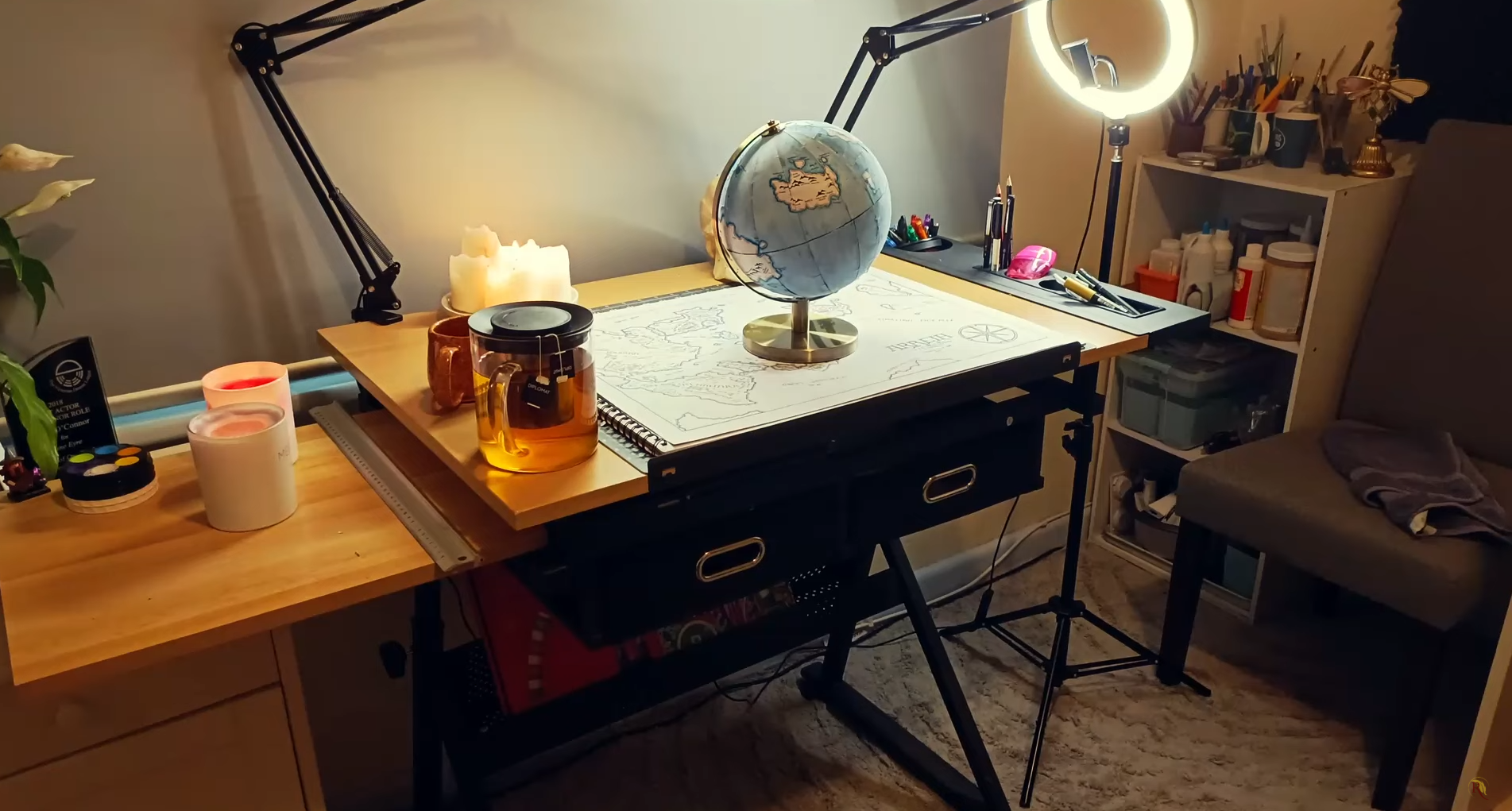
An explorer’s desk is always cluttered. It’s one of those universal constants, like destiny or taxes: those who push back the edges of the map tend never to find enough room in their own worlds for everything they want to do, everything they need to do. And so their workspace, lined with shelves of dark wood and smelling strongly of old books and ink, is always cluttered.
Here you’ll find pens and paper, books of every sort, a fair collection of glues and knives and paints, and all the references that they can gather and call their own. A map is never just ink on a page: it is the vast accumulation of perspective, of experience. Each book is filled with words about those experiences, each map exquisitely rendered with the smell of cool earth and morning wind.
But none of those books or maps, none of the various collections of paper bundles and paints, none of the sketches or the collections of flora, will even come close to actually showing the world as it is. Something complete, but small enough to hold. A whole world, sitting on the desk.
Hello, adventurers, and welcome back to the Red Quills! My name is Ryan, and over the course of this series, we’ve ventured across the surface of the world and out into the far cosmos beyond. We’ve talked about maps and atlases throughout history, plotted the courses and legends of the stars, and even marked the secrets of the planes and leylines in an attempt to give some few ideas in how you can map the world and the universe of your fantasy world.
And now we come to the crown of this series.
Today, I’ve got a special treat for everyone. Not only will I be referencing the maps that I’ve made up until this point, not only will this episode deal with the practicality and the worldbuilding of making a globe of your fantasy world, but this is actually a two-part post, because there’s just so much to talk about. We’ll see how that works out.
In this post, I’ll talk about the practicalities of building a globe of your fantasy world, the history of globe renders in our own world, and give examples of how you can pull them into your own world. In the next, I’ll show you how I finalised putting it all together, and talk about the worldbuilding that you can do, in an updated summary of the world map tutorials I have been doing since the start of last year.
If you want to watch the accompanying video, you can catch it here: How to Make a Fantasy Globe (Part I)
And if you want to get ahead of the curve and watch the next episode now, it's available to my paid Red Quills Patrons from this week, releasing to everyone else next week!
Or, for other worldbuilding and mapmaking tutorials, you can check out the rest of the Red Quills Journal for more!
I’ve also got some updates on my Fantasy Atlas project, along with a map bundle giveaway—so stick around to hear more about that at the end of the episode!
Let’s get started.

Why a Globe?
Maps are incredible tools for worldbuilding. They let us chart new lands, define cultures, and they shape the stories that we tell. But no matter how much detail we put into them, they all have one fundamental limitation—they exist on a flat surface.
The world, however, isn’t flat. It’s a sphere.
For centuries, cartographers have struggled with the challenge of turning a three-dimensional world into a two-dimensional map. That’s where projections come in. The Mercator projection—which is by far the most well-known, and popularised because of international trade and particularly shipping—distorts the size of landmasses near the poles, and stretches them far beyond their actual proportions.
But when you build a globe, you sidestep those distortions entirely. A globe preserves the real relationships between continents, oceans, and trade routes, and it gives you the worldbuilder a much clearer sense of scale and geography.
So in this episode, I’ll be creating a fantasy globe. It’s just a test, at this point, to determine my own world’s size and shape, how the continents fit together, and give me a perspective on it that a flat map will never be able to show. As time goes on, I will probably make more - updated, increasingly detailed and smoother renditions of this globe so that I can use it properly.
But today, we’ll look at how globes have been made throughout history, explore some techniques for turning a flat map into a sphere, and I’ll talk about how this process helps with your worldbuilding. And in the next episode - part 2, which will be available right now for my Patrons - we’ll dive deeper into how a globe changes the way we think about fantasy worlds - their geography, trade, politics, and cultures.
But first, let’s talk about globes and maps in real-world history, so that we can figure out how to make one fit into your fantasy world.

Are Globes Really That Important?
For as long as people have made maps, they’ve also tried to represent the world as a sphere. And some of the earliest globes date back over 2,000 years—ancient Greek scholars like Crates of Mallus built models of the Earth as a perfect sphere, divided into quadrants. But these were more philosophical than practical. At the time, most maps were flat, stylized, and based on limited exploration.
Alas, none of these early globes have survived, and we only know about them based on second-hand stories. But this only goes to show how significant a globe is in understanding the world around you! Even when you don’t know anything about the world, even when one of the only things you know is that it is a globe, someone will make one. You feel it too, don’t you? The urge to globe.
Despite the fact that none of them have survived, there’s no real doubt that they were very inaccurate. Maps were, back then. They were based on hearsay and speculation.
That changed during the Age of Exploration. As sailors charted new coastlines, the need for accurate navigation grew. In the early 1500s, cartographers like Martin Behaim created some of the first modern globes, painted by hand onto delicate paper gores—flattened segments designed to wrap around a sphere. These globes were incredibly detailed for their time, but they still weren’t perfect. They were often filled with, shall we say, ‘speculative geography’, blank spaces labeled “Here Be Dragons” and coastlines that shifted with each passing year.
Then came Gerard Mercator. In 1569, he introduced the Mercator projection, a way of flattening the world while keeping navigation easy. His map preserved angles and directions, making it useful for sailors, but it stretched landmasses near the poles. Greenland, for example, appears much larger than it really is. It was a tradeoff—accuracy in shape and direction at the cost of scale. That tradeoff still affects how we see the world today.
But a globe doesn’t have that problem.
Unlike a projection, it represents distances and shapes correctly, making it the most accurate way to visualize a world. And for worldbuilding, that’s incredibly useful. It forces us to think about things like how continents connect, where trade routes naturally form, and how cultures develop based on geography.
In this episode, I’ll be making my own fantasy globe, following some of these historical techniques. But first, let’s talk about how to actually turn a flat map into a sphere.

How to Make One
Turning a flat map into a globe isn’t as simple as just wrapping paper around a sphere. A map projection distorts the surface, so to make a proper globe, we need to break it into segments. Historically, cartographers used gores—long, curved strips that, when arranged correctly, fit together without overlapping or stretching too much.
For this globe, I’ll be using a printed map that I’ve divided into twelve gores. Each one tapers toward the poles and widens at the equator, keeping distortion to a minimum. If you’re making a physical globe, you can either print gores directly onto paper or draw them by hand. The key is keeping them evenly spaced around your sphere.
Now, I want to call myself out here. I handpainted and handcut these gores, and measured them based on some rudimentary mathematics. But I made some errors, which I will tell you about so that you don’t make them yourself.
One of the decisions that I made was to cut the gores before drawing out the map, and drew the map before placing it onto the globe. Now, I did this for specific reasons: the first because the gores would help me to combat the distortion of the map when drawing it out, and the second because the curved surface of the globe would be difficult to draw on, and would lower the quality of the illustration.
I would still do both, and there will always be distortions issues. I will warn you about that now. If you’re making your own, don’t aim for a method which will eliminate error, because the exactitude that you will need for a project like this relies both on your measurements and on your execution, and there’s too much that can go wrong when doing things by hand.
Which means that you want a method which will not eliminate errors, but allow you to address them. The one that I saw after the fact is of deliberately leaving 1mm gaps between the gores on the sphere as a stylistic choice, because it will control for errors of up to 1mm, which is all you really need.
If you don’t want to do that, make sure that you keep the join flat on the equator, and then if there are any gaps between gores, have specific thin strips ready to glue between them. I will probably go for the stylised look for the next one, myself.
The base itself can be anything—a foam ball, a wooden sphere, or even a 3D-printed shell. Historically, globes were made with papier-mâché over a wooden core, then covered with gores. I’ll be using a modern approach, but the principles remain the same. The gores will need to be carefully cut out, lined up, and adhered without too many wrinkles or gaps.
If you want to make them digitally, you can! But this is a tutorial for doing it practically.

When you make a globe, you shift your perspective, you make your world more real.
When we rely on flat maps, we unconsciously accept distortions. Borders stretch, continents warp, and distances get skewed. But when you hold a globe in your hands, you see the world as it truly is—continuous, interconnected, and without edges.
This process isn’t just useful for mapmakers. If you’re a worldbuilder, a globe forces you to think about how your world fits together. How do trade routes really function when you account for curvature? What happens to climates when you stop thinking in rectangles? Where do your explorers go when there is no true ‘edge of the map’?
Now that I have the globe assembled, it’s time to explore what it means for worldbuilding. So in the next episode, I’ll take this sphere and examine how it changes the way we think about geography, politics, and storytelling. I’ll also revisit some of my previous worldbuilding videos—on trade, cultural icons, ley lines, and vanishing continents—to see how they apply when viewed on a globe.
The beauty of globes is how they challenge our assumptions. A world that seemed balanced on paper might be wildly different when wrapped around a sphere. Continents shift. Oceans stretch. And places that once felt distant might suddenly be closer than you thought. It’s an invitation to rethink your world—not just its physical form, but how people navigate it, trade across it, and tell stories within it.
If this has sparked new ideas for your own maps, I’ve got more coming soon. In the next episode, I’ll take this globe and explore what it means for worldbuilding—how it affects trade, culture, and climate, and how it can reshape the stories you tell. Plus, I’m preparing some big updates for the Fantasy Atlas project, and the map bundle giveaway is coming up! If you want to be in the draw for a free collection of high-resolution fantasy maps, make sure you’re signed up for the mailing list.
You can also find digital downloads of my maps on Patreon, along with extra resources and behind-the-scenes content. And if you enjoyed this episode, don’t forget to like and subscribe for more fantasy mapmaking content.
See you in the next one—until then, happy mapping!