

How to Worldbuild with a Fantasy Globe (Part II)
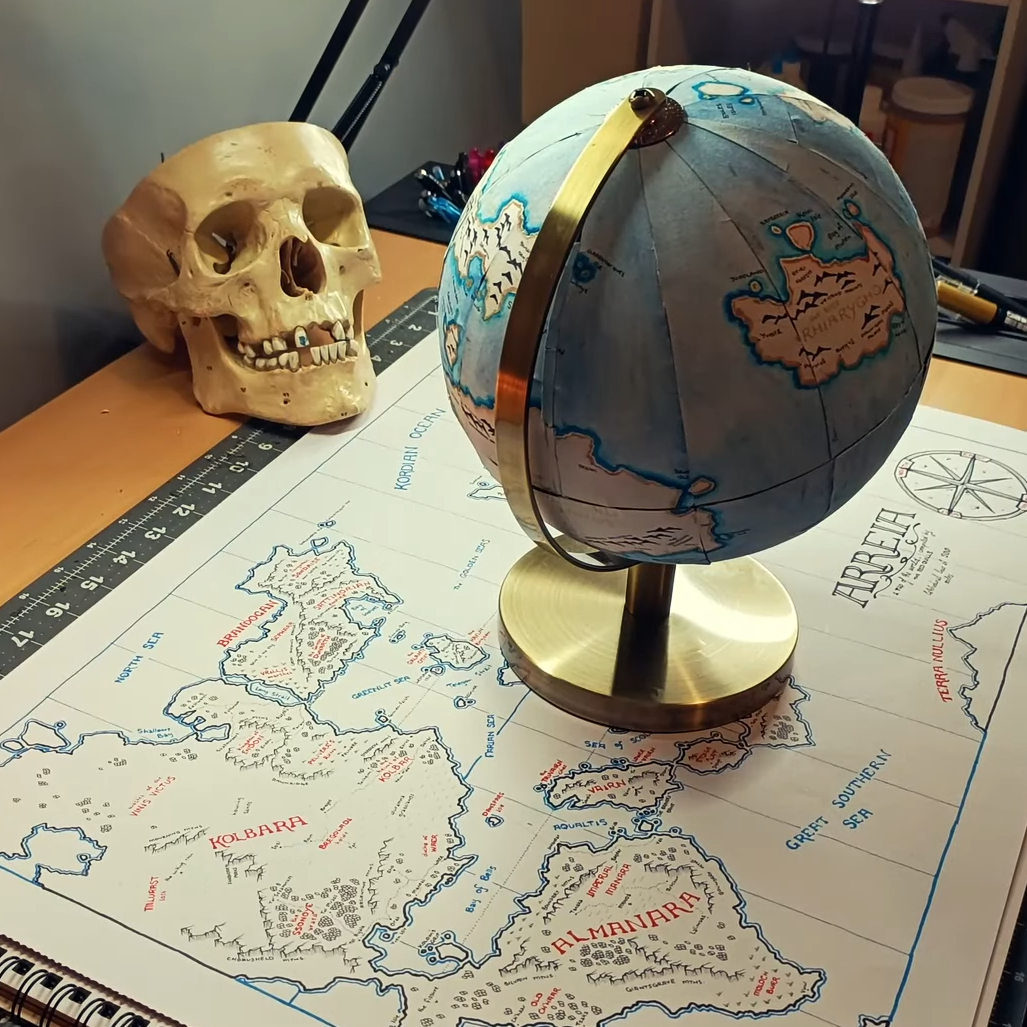
This is Part II of How to Make a Fantasy Globe, an ongoing tutorial by Ryan of the Red Quills.
So it’s taken a great deal longer than seven days to make our fantasy worlds, but hey – we’re only mortal.
All of the peaks of mountain ranges, dressed in snowy splendour. All of the deep recesses of the ocean floor, dark as night. All of the forests, smelling of leaf-litten and damp. The many caves, ruins, and forgotten corners. All of the bustling cities and peaceful villages. All of them laid out as so much ink and paint.
Over the course of this series - and this channel as a whole - we’ve gone through and drawn out many of the details that you can put into your fantasy worlds. From kingdoms to worlds, to globes within vast cosmoi. We have built a monument of paper to a world as thin as a thought.
Hello, adventurers, and welcome back to the Red Quills! My name is Ryan, and this week we are continuing the topic from the week previous, and continuing to follow along on my project to create a globe of my fantasy world, Arreia. This is a part of the special treat I made as thanks to my Patrons, who got access to this video as soon as the first part came out. Everyone else had to wait a week, which is torture in this economy of modern immediacy.
Last week’s post had me talking about the processes that I used to make the globe, the history of globe-making in our own world, and the practicalities of putting it together in a way which would be useful. As I go along today, I’ll talk about what was useful about that, and what would change, but our focus is moving on from just the map on the surface of the globe.
We have so far mapped this world in parts, in whole, and in its place in the vast starry sky, and this week, as I put the globe together, I’ll talk about the processes most useful in worldbuilding for you, touching on the posts previous that I have made.
If you want to check out the video tutorial, you can find it here: How to Worldbuild with a Fantasy Globe (Part II)
Or you might want to check out the Red Quills Patreon for more downloadables and community features.
Lastly, if you want to find other blog posts on worldbuilding and mapmaking, look no further! The Red Quills Journal is here for you.
But we’ll mainly be talking about how you can use a globe, and what you should use it for. So, let’s get started.

From Flat to Curved
Flat maps make worldbuilding easy. They give us clear edges, structured layouts, and convenient grids for measuring distance. But when you take that world and turn it into a sphere, everything changes. Trade routes shift. Climates realign. Distances that seemed vast suddenly shrink, while others stretch further than you expected. And that’s before you start thinking about the people living in this world—how their stories change when their world has no edges.
In the last episode, I built a globe from a flat fantasy map, uncovering the distortions and difficulties that come with transferring a two-dimensional world into three dimensions. Now, I want to take that globe and see what happens when we treat it as a real world. How does it affect storytelling? What does it do to politics, economy, or culture? And what lessons can we take from history to apply to our own worldbuilding?
To answer that, we’ll go through a few major elements—trade, culture, geography, and history—and see what changes when you abandon the convenience of a flat world.

Why Make Globes?
The idea of a spherical Earth dates back to ancient Greece, with philosophers like Pythagoras and Aristotle proposing that the world was round. There is some evidence that the Greeks created early globes for teaching and astronomical purposes, though none have survived.
However, the first known surviving globe was made in 1492 by Martin Behaim, a German mapmaker who attempted to create the most accurate model of the world known to Europeans at the time. Of course, it was missing the Americas entirely, so it wasn’t particularly useful—but the idea of a three-dimensional map was revolutionary. Unlike flat maps, which always had some form of distortion, Behaim’s globe allowed for a continuous view of the world’s surface without stretched continents or misleading distances.
As globes became more common, they changed the way explorers, traders, and rulers thought about geography. When European empires began expanding in the 16th and 17th centuries, they had to reckon with the fact that their maps didn’t always match reality.
Trade routes that seemed straightforward on a Mercator map—like sailing from Portugal to India—became vastly more complicated when factoring in ocean currents, wind patterns, and the true shape of the Earth. The introduction of navigational globes allowed for a better understanding of these routes, influencing everything from colonial expansion to the rise of global trade networks.
So, if globes changed how people saw the real world, how could they change the way you see your fantasy world?

Trade and Travel
Let’s start with the most immediate effect: trade routes.
Long, long, long ago, in the faraway land of 2024, I made a video about trade routes on maps. It was one of my earliest videos, and cries out to this day for a remake. In that video, I talked about fantasy economies, about the costs of trade across the oceans, about how to map toll points, trade goods, and even passage costs for travellers. And that was great – for a flat map.
Because on a flat map, routes often look straightforward—just draw a line between two points. But on a globe, that line isn’t always the shortest path. Because of the distortion that you always get on a flat map from a curved surface, they end up being not-so-straight at all.
Instead, you get want great circle routes—the actual shortest distance between two points on a sphere. This is why flights from Europe to North America curve over Greenland instead of flying straight across the Atlantic.
In a fantasy world, this has massive implications.
You as a worldbuilder are imagining a continent-spanning trade empire that believes its capital is in the perfect central location—until you put it on a globe and realize its “shortest” routes take merchants into dangerous waters, unpredictable storms, or uncharted territories.
You don’t realise that the passage straight across the ocean only looks like the shortest map because you’ve made something like a Mercator map. When you put it on a globe, you see the truth. So maybe an isolated island nation turns out to be far more strategically important than it seemed on a flat map.
You can also use this to rethink how people navigate the world. Many real-world civilizations, from Polynesians to Norse sailors, relied on non-linear navigation methods—using ocean currents, wind patterns, and celestial positioning rather than straight lines on a map.
If your world has magic, how does that influence navigation? Do ley lines follow great circle routes? Are there magical “currents” in the sky or sea that make certain paths more efficient?

Culture and Borders
People on the surface of the world often don’t think of the ground beneath their feet as being curved. As anyone who has explored the internet in the past ten years knows quite well. But when you’re exploring from a given point, the centre of your map - your homeland - will always be the most accurate part. It’s only around the edges that you will get distortion.
And when we think about political borders, we often imagine them as rigid lines dividing territories. But on a globe, borders don’t always behave the way we expect. Take the Arctic Circle: on a Mercator map, it looks like the northernmost reaches of Canada and Russia are worlds apart, but in reality, they’re geographically close. Which is why Russia and Canada both compete for Arctic trade routes and resources today.
In your world, you can play with this concept.
A kingdom that seems distant on a flat map might turn out to be a neighbor when viewed on a globe. A “remote” mountain range could actually be a crucial crossroads between civilizations. Or an empire might discover that its borders are more vulnerable than it thought when it realizes an enemy nation has a direct overland route that was previously hidden by map distortions.
This also applies to cultural diffusion. When you put a globe together, you might find that two distant cultures actually share a natural trade route—meaning language, customs, or technologies could spread between them.
Maybe two civilizations that believed they were entirely separate discover shared myths and traditions because of ancient seafarers who connected them centuries ago.

Geography and Climate
One of the biggest revelations that comes from building a globe is how climate zones actually function. On a flat map, we often divide worlds into convenient categories—deserts in the south, tundras in the north, temperate forests in the middle. But on a sphere, climate is dictated by latitude, ocean currents, and wind patterns.
Take Earth’s Hadley Cells, the atmospheric circulation patterns that dictate tropical and desert climates. These cells create predictable climate bands: equatorial rainforests, mid-latitude deserts, and temperate zones. If you’re making a world, it helps to consider how these bands function. Your equator should be humid and tropical, while your mid-latitudes will likely have deserts. If you place a large ocean in the right place, it could create monsoons or hurricanes.
Globe-building also forces you to think about how mountains influence weather. On a flat map, we often place deserts and forests without much consideration—but on a sphere, rain shadows become a major factor. If one side of a mountain range gets constant rain, the other side is likely to be an arid wasteland.
You can use this to add depth to your world. Maybe a once-thriving civilization collapsed when its climate shifted. Maybe an empire’s expansion is limited by natural wind patterns. Or maybe your world has magical forces that defy these climate rules, leading to supernatural weather phenomena.
Seeing your world as a globe forces you to think differently. No longer are your continents and oceans static—they interact, they flow, they change based on geography and climate. Borders are not fixed; they are influenced by proximity, travel, and history. Even the stories you tell are affected, because the way people experience their world is shaped by the reality of its physical form.
So, if you’re designing a fantasy world, consider making a globe—or at least thinking in three dimensions. It might reveal things about your world that you never noticed before. It might force you to reconsider the placement of cities, trade routes, or even entire civilizations. And it might just make your world feel more alive.
And that’s how I’m using a globe to rethink fantasy worldbuilding. We’ve explored how geography, trade, culture, and climate shift when you move from a flat map to a sphere, and how that impacts storytelling in unexpected ways. Whether you’re designing a world from scratch or revisiting an existing setting, thinking in three dimensions can reveal new details and challenges that make your world feel more alive.
The beauty of globes isn’t just in their accuracy—it’s in how they reshape our perspective. Borders that seemed distant might be neighbors. Trade routes that looked efficient might be anything but. And the cultures in your world, just like in history, are shaped by the unseen forces of climate, distance, and connection.
I hope this deep dive has given you new ideas for your own worldbuilding, and if you’re interested in exploring more, I’ve got some exciting updates on the way. In the next few videos, I’ll be revisiting some of my older topics, expanding the Fantasy Atlas, and taking a fresh look at how maps shape the worlds we create. Plus, the map bundle giveaway is coming up! I’ll be sending out a collection of high-resolution fantasy maps to one lucky subscriber—so if you haven’t already, make sure you’re signed up for the mailing list.
If you’d like to get your hands on digital downloads of the maps I create, you’ll find them over on my Patreon, along with extra resources and behind-the-scenes content. And if you enjoyed this episode, don’t forget to like and subscribe for more fantasy mapmaking content.
Stay tuned for the next episode, and until next time—happy mapping!