

How to Compile your Fantasy Atlas (Part II)
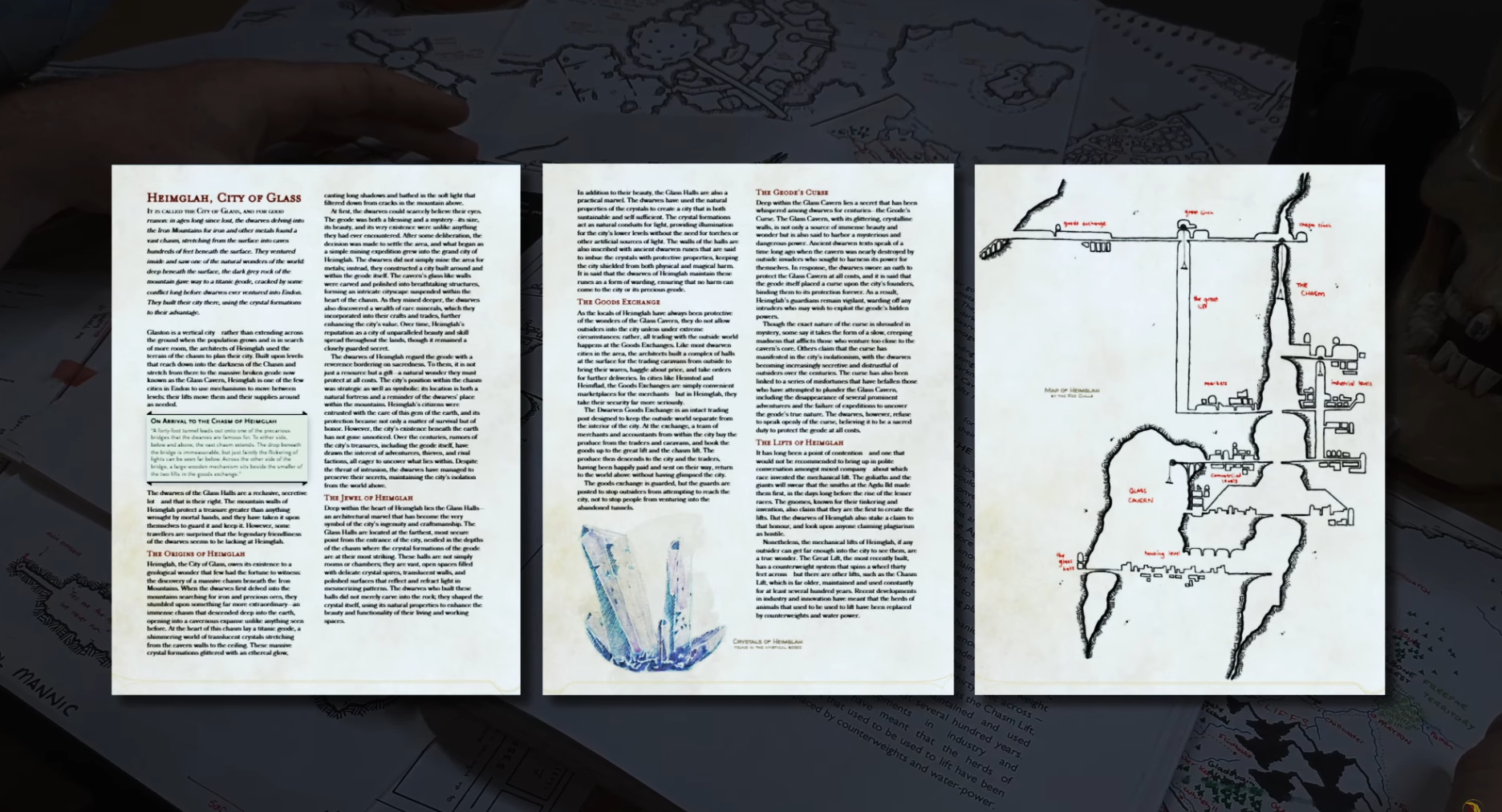
This is How to Compile your Fantasy Atlas, the second part of How to Make your Fantasy Atlas, in which Ryan of the Red Quills focussed on creating content and writing the excerpts themselves.
Beneath the storm-darkened sky, the royal cartographer spreads a massive parchment across the oaken table. Candles flicker, casting pools of light on the intricate lines and sigils. Before him stretches the Kingdom of Endon—not as mountains and rivers alone, but as a living, breathing realm, each duchy a chapter, each town a thread in the great woven tapestry of history.
He dips his quill into ink, sketching the borders anew. Mines are marked with crossed pickaxes, ruins with crumbling towers, roads with careful, meandering lines. The king’s advisor watches with keen interest, his fingers tracing a path from city to city.
A simple mark on the map holds the weight of centuries. As the storm rages outside, within this chamber, order is being forged from chaos. A kingdom made navigable by ink and vellum.
Hello, adventurers, and welcome back to the Red Quills! Last time, we talked about what makes an atlas more than just a stack of maps—how it becomes a structured, useful tool for worldbuilders and game masters alike. But a concept alone won’t make an atlas. Today, we’re diving into the actual process of compiling one.
I’ll be using my own Kingdom of Endon as an example, showing you how I divide territories, mark locations, and create pictorial maps that are both functional and immersive. Whether you’re making an atlas for a tabletop campaign, a novel, or just for fun, these techniques will help you organize your world into something truly usable.
We’ll start with some historical inspiration—because people have been making atlases for centuries. Then, I’ll take you step-by-step through the process of categorizing regions, sorting towns and landmarks, and visually representing them with symbols and colors. Finally, we’ll close with a storybook-style example of how an atlas can change the course of a world. So, grab your quills and parchment—we have a lot to cover!
For those who want to download the current version of the Atlas of Endon, you can check it out on the Red Quills Patreon!
This tutorial is also in video format, on my YouTube channel, and if you're working on your own version of a fantasy atlas, share it at the Red Quills Discord channel.

Atlases have been around for hundreds of years, but their purpose has changed over time. The first atlases weren’t just collections of maps—they were arguments about how the world should be understood. Some were political, showing the dominance of empires. Others were navigational, guiding explorers across vast oceans. Many, however, were made to bring order to a chaotic world.
One of the oldest structured atlases is the Theatrum Orbis Terrarum (1570), created by Abraham Ortelius. This was a major leap in mapmaking, as it gathered maps into a book with consistent styles and explanations. It didn’t just show the world—it categorized it. Similarly, the Atlas Maior (1665) by Joan Blaeu wasn’t just a collection of maps; it was a visual encyclopedia of regions, with notes on their cultures and economies.
Fantasy settings have their own well-structured atlases. The Atlas of Middle-earth (1981) by Karen Wynn Fonstad breaks down Tolkien’s world into travel routes and historical movements. Meanwhile, the Forgotten Realms Campaign Setting divides its vast world into kingdoms and political regions, making it digestible for both Dungeon Masters and players.
The takeaway? A well-structured atlas isn’t just about drawing maps—it’s about dividing a world into usable, understandable parts.

Now that we’ve seen how atlases have been organized historically, let’s get practical. Here’s how you can compile your own fantasy atlas.
Step 1: Define Your Regional Divisions
First, decide how your world is broken up. Are you working with duchies, provinces, city-states, or something else? I divided Endon into duchies, each with its own governing structure and culture. This makes navigation easier and helps players understand political boundaries.
Step 2: Organize Locations Within Each Region
List out towns, villages, ruins, mines, dungeons—whatever your world contains. Each should belong to a region. This prevents your atlas from becoming a disorganized mess where no one can find anything.
Step 3: Use Symbols and Colors for Navigation
A map isn’t useful if you can’t read it. Simple symbols—like a tower for ruins, crossed hammers for a mine—make locations instantly recognizable. Color-coding regions also helps. In my maps, I use subtle color shifts to differentiate duchies.
Step 4: Create Pictorial Maps of Each Region
Instead of just marking a city with a dot, try illustrating major locations. A small sketch of a castle, a winding road leading to a village—these details make an atlas immersive.
Step 5: Cross-Reference Entries
Every map should connect back to the text. If your atlas mentions a legendary ruin, there should be a map showing its location. Keeping these linked ensures that your world feels cohesive and easy to navigate.

A well-organized atlas isn’t just a collection of maps—it’s a tool, a guide, and a living document of your world. By dividing your world into regions, using clear symbols, and linking maps to lore, you create something far more useful than a simple illustration. You create a resource that brings clarity to both worldbuilders and players.
In future episodes, we’ll explore even more advanced techniques—like detailing individual settlements, mapping trade routes, and creating political maps. But for now, I’d love to hear from you. How do you organize your worlds? Do you use pictorial maps or prefer a more traditional approach? Let me know in the comments!
As always, you can download today’s version of the Atlas on the Red Quills Patreon, and join our community on Discord for more worldbuilding discussions. Until next time, adventurers—happy mapping!