
How to Draw a Basic Map
This tutorial is from the voiceover of the video from the Red Quills YouTube channel, How to Draw a Basic Map. For more details, check out the link below.
The wind howls across an open expanse of parchment, curling at the edges where time has worn it thin. Beneath the flickering lantern light, ink glistens, freshly laid upon the stretched vellum. A world unfolds: mountains like the spines of ancient beasts, rivers carving paths like veins of the land itself, forests sprawling in deep, untamed clusters.
The cartographer’s quill does not hesitate. It knows the order of things. The landmass takes shape first, the edges of the continent jagged and raw, kissed by the inked waves of a vast and boundless sea. Then, the ridges and peaks of distant mountains rise from the surface, carefully etched with jagged strokes, casting deep shadows in their folds. Rivers snake between them, drawn ever downward, seeking the embrace of lakes and ocean.
Names appear next—bold, decisive. Cities stand proud upon the plains, fortresses nestled into the cliffsides, realms divided by ink and imagination. This is a world yet to be explored, a map yet to be followed. The quill lingers for only a moment before moving to the final stroke, the final mark upon the paper. It is finished.
Hello, adventurers, and welcome back to the Red Quills! Today, we’re going back to basics. We’re talking about how to draw a simple fantasy map—the kind you’d find in the opening pages of your favorite book or laid out in front of players at the beginning of a tabletop campaign.
This is the first episode in a four-part series on different styles of fantasy maps, and we’re starting with the foundation: a clean, readable, black-ink map, the kind that tells a story before a single step is taken in the world it describes.
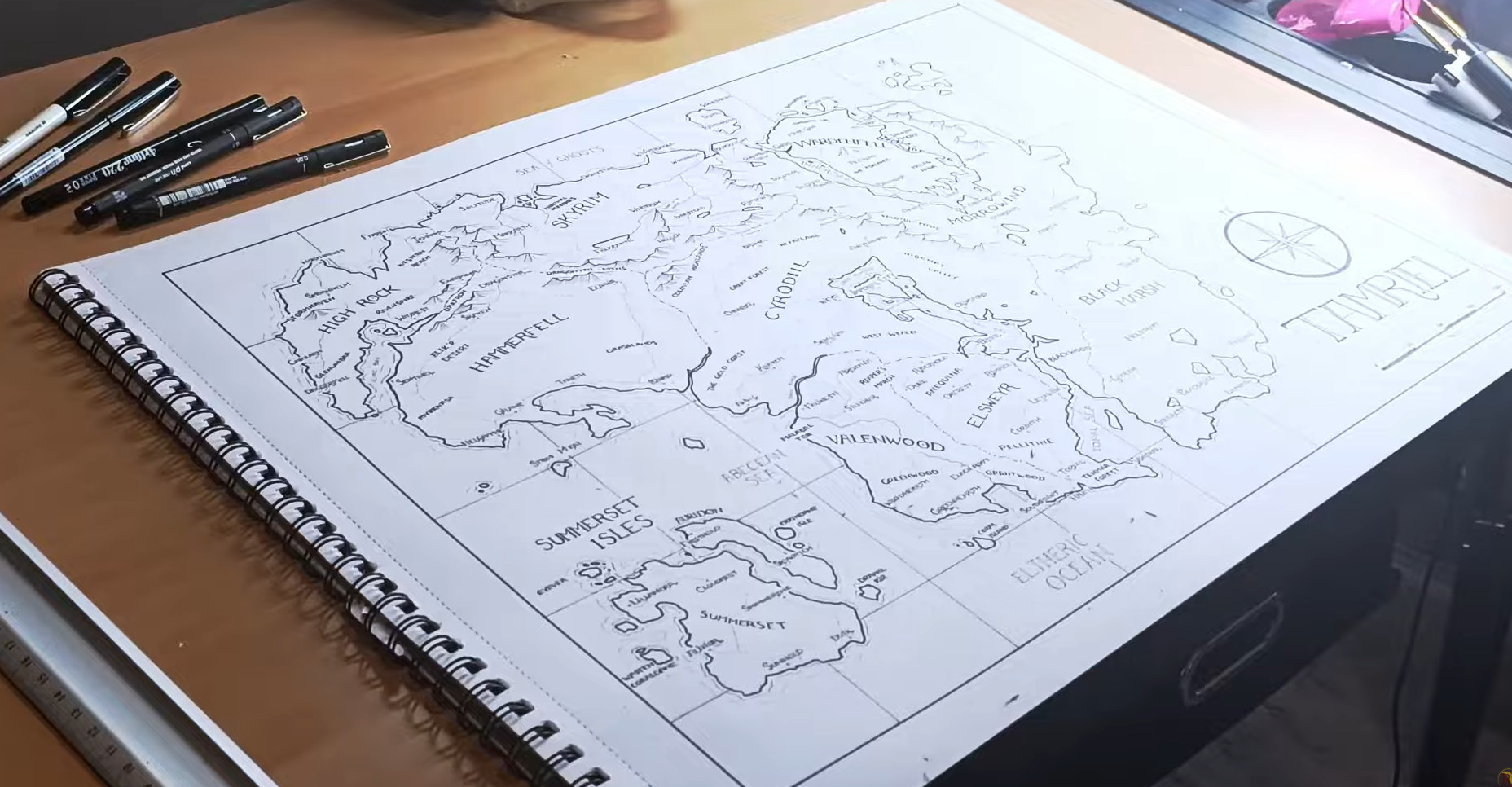
We’ll be using a map of Tamriel—the iconic continent from The Elder Scrolls games—as an example to guide us. I’ll walk you through the proper order for drawing a map, from sketching to labels, coastlines, mountains, rivers, and terrain. We’ll also talk about what makes a good map actually work—because it’s not just about making something pretty. If you’re a Dungeon Master, a writer, or a worldbuilder, a good map is an invitation to adventure. And we want to make sure it’s one worth following.
You can download the full map for free on the Red Quills Patreon.
If you want another tutorial style, we have a library of video tutorials available on the Red Quills YouTube channel: it is the best place to see what else we have on offer, check out the methods in real time, and watch the processes that Ryan of the Red Quills uses.
Otherwise, check out the other posts in the Journal, or join the mapmaking community we're growing on the Red Quills Discord.
So grab your quill—or your stylus—and let’s begin.

Maps have always been a cornerstone of fantasy storytelling, but the way they’re presented has evolved over time. Early fantasy maps were often inspired by medieval and Renaissance cartography—detailed, decorative, and filled with artistic flourishes that sometimes took precedence over accuracy. As role-playing games emerged, these maps took on a new purpose: they needed to be functional, clear, and immersive.
Tolkien’s Middle-earth: The Gold Standard
J.R.R. Tolkien set the stage for fantasy cartography with The Lord of the Rings. His maps, drawn by his son Christopher, balanced artistic flair with geographical logic. The Misty Mountains weren’t just a pretty feature—they dictated the movement of armies and travelers. Rivers, forests, and cities were positioned with the logic of a real-world landscape. This approach heavily influenced the way modern fantasy maps are made, teaching us that a map should serve the story first.
Dungeons & Dragons: Functional Worldbuilding
With the rise of Dungeons & Dragons, maps became more than just illustrations—they became tools for exploration. Maps in RPG modules were designed with usability in mind, often simplified for clarity. Grid-based dungeon maps, hex maps for wilderness travel—these innovations made maps interactive.
Tamriel: A Living World
Tamriel, from The Elder Scrolls, offers a prime example of a functional and immersive fantasy map. Each region has a distinct geography, and the map itself feels like something a traveler in that world might use. The clear labels, well-defined coastlines, and simple mountain stylization make it an excellent case study for today’s tutorial.

Alright, let’s get into the actual process of making your own fantasy map. Here’s the best order to follow to keep your work clean and structured:
1. Sketch the Landmass
Start with a rough pencil sketch. Coastlines should be irregular—no smooth, perfect shapes. Islands and peninsulas add interest. If you’re using digital tools, a textured brush can help simulate a more natural coastline.
2. Add Labels Early
Cities, major landmarks, and regions should be labeled early on. Choose a clear, readable font style and avoid cramming too many names into one area. A map is no good if no one can read it.
3. Define the Coastline
Now, ink in the coastline. Use short, jagged lines to create a sense of natural erosion. A few breaks and indentations can suggest cliffs or coves.
4. Draw the Mountain Ranges
Mountains are drawn using a jagged ridgeline as the backbone. From each peak, use sweeping strokes to suggest slopes. A classic trick is to darken one side of the range with line shading—this gives depth. Alternatively, a watercolor wash can soften the effect.
5. Rivers & Lakes
Rivers always flow from highlands to lowlands and never split as they go. If you have multiple rivers in one area, they should be converging, not branching apart.
6. Hills, Forests, and Terrain
Hills are drawn with small, curved lines. Forests are best represented with clustered tree icons. Marshlands and deserts can be indicated with simple texturing techniques—dots for sand, wavy lines for wetlands.
By following these steps in this order, you’ll ensure your map is both visually appealing and geographically sound.

The parchment is spread across the table, its inked lines illuminated by the flickering glow of candlelight. A robed scholar studies it with careful eyes, tracing the course of rivers, the placement of mountains, the scattered ruins that mark the path ahead.
Beyond the map’s edges, the world waits. The eastern mountains, where legends say a hidden vault lies buried beneath the stone. The great forest to the south, its canopy so dense that even the midday sun struggles to reach the ground. The scholar’s gloved hand pauses over a name—an ancient city, long abandoned. That is where the journey begins.
The map is no mere decoration. It is the first step in an adventure.

And there you have it—your guide to drawing a simple, effective fantasy map! We’ve covered everything from the best order to sketch your landmass to techniques for making mountains, rivers, and coastlines come to life.
If you’d like a free downloadable map to use as a reference, check out the Red Quills Patreon. And if you’re looking for feedback or just want to share your work, our Discord community is always open to fellow adventurers.
Next episode, we’ll be diving into another style of fantasy cartography, so stay tuned. Until then, keep creating, keep exploring, and I’ll see you next time.