

How to Map your Worldbuilding
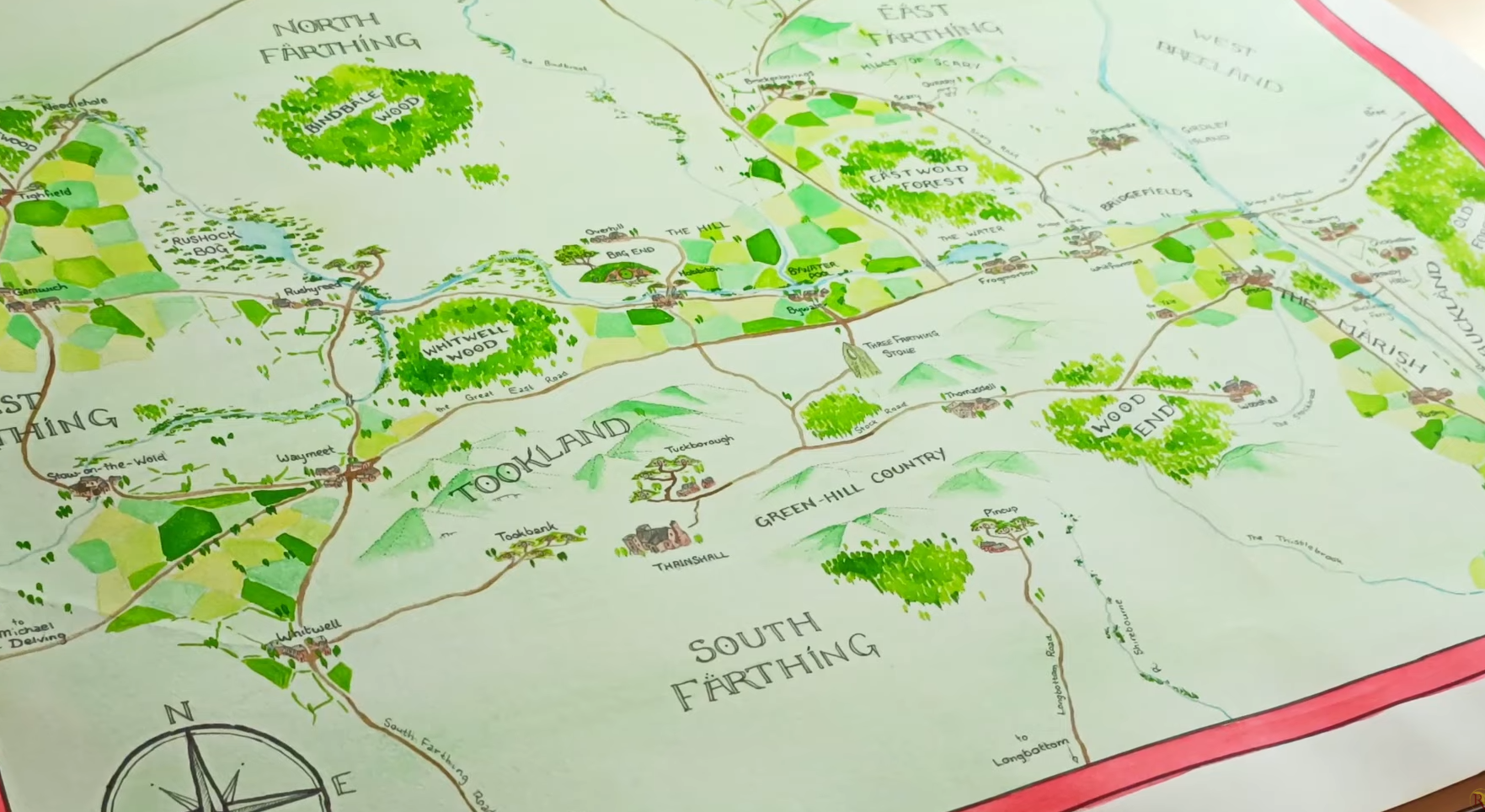
This written tutorial is taken from the voiceover of the Red Quill's video, How to Map your Worldbuilding, from that YouTube channel.
The morning sun spills golden light across rolling green fields, dappling the winding dirt paths with warm hues. Low stone walls crisscross the landscape, marking the boundaries of small, neatly kept farms. Clusters of round doors, set into gentle hillsides, peek out from beneath thick, flowering hedges. Smoke curls lazily from chimneys, mingling with the scent of fresh-baked bread and the earthy fragrance of morning dew.
The Brandywine River flows slow and steady to the east, its banks lined with willows that whisper secrets to the water. Beyond, a great forest looms, its trees ancient and knowing, standing sentinel over the pastoral realm. This is a world shaped by time, by generations of careful tending, by unspoken agreements between land and those who call it home.
Every path here has a purpose. Every landmark has a story. And every settlement, no matter how small, is part of something greater. To understand this world, one need only look to the map—a silent storyteller, holding the history, the culture, and the very heart of this land within its careful lines.
Want to download the map of the Shire? Check it out for free on the Red Quills Patreon.
You can also watch the full video tutorial on our YouTube channel: How to Map your Worldbuilding
Otherwise, you can browse the rest of the Red Quills posts and tutorials right here at our Journal, or send us an email in the contacts below. If you want to get in contact with Ryan directly, another option is to join the Red Quills Discord channel.

Hello, adventurers, and welcome back to the Red Quills! Today, we’re diving into one of the most crucial elements of any fantasy setting: the world map. But not just any map—a worldbuilding map, one that doesn’t merely show mountains and rivers but tells a story.
Maps are more than just navigation tools. They reveal how civilizations develop, where settlements thrive, and how geography influences culture and politics. In this episode, we’ll explore how to craft a worldbuilding map that does more than look good—it enriches your world. We’ll use the Shire from The Lord of the Rings as our guide, dissecting how Tolkien’s careful geographical design helped shape the culture and daily life of his hobbits. We’ll go step by step, from initial sketching to adding watercolors and ink, and discuss how settlements, roads, and landmarks contribute to a believable, immersive world.
By the end of this video, you’ll have a clear roadmap—pun absolutely intended—for how to craft your own world map with deep storytelling potential. Let’s get started!

Throughout history, maps have served as both practical tools and cultural artifacts. Medieval European maps, such as the Hereford Mappa Mundi (c. 1300), weren’t meant for navigation so much as they were for understanding the spiritual and political landscape of the world. The world was drawn in a symbolic fashion, with Jerusalem at the center, emphasizing divine order rather than geographic accuracy.
In contrast, Chinese cartography, such as the Da Ming Hunyi Tu (1389), reflected a meticulous, almost bureaucratic approach to mapping, emphasizing trade routes, governance, and natural resources. The difference in mapping styles reveals the priorities of each society: Europe’s focus on religious authority versus China’s emphasis on administration and logistics.
Tolkien’s own maps followed a different tradition—one inspired by the decorative and detailed maps of early adventure literature. The map of Middle-earth, drawn by Christopher Tolkien, follows in the footsteps of Treasure Island’s map by Robert Louis Stevenson (1883) and The Map of Narnia by Pauline Baynes (1950). These maps were not just background details but integral to the storytelling itself. The reader could trace Bilbo’s journey across the Misty Mountains, or imagine setting out from Cair Paravel on an adventure of their own.
This tradition of worldbuilding maps continues today in role-playing games. Think of the Forgotten Realms map from Dungeons & Dragons, or Tamriel from The Elder Scrolls. These maps serve as both narrative and functional tools, grounding players in the world while giving them the freedom to explore.

So, how do we make a world map that tells a story? Let’s break it down into clear, actionable steps. We’ll be working over-the-shoulder with a detailed Shire-style map, layering watercolor and ink for a warm, storybook feel.
- Start with a Rough Sketch
- Begin by blocking out major landforms—rivers, forests, hills.
- Don’t worry about perfection yet. The goal is to get a sense of the land’s shape and flow.
- Think about how geography shapes settlements. A village by a river? A fortress in the mountains? Every placement should make sense.
- Define Your Settlements & Roads
- Consider why a town exists where it does. Trade routes? Natural resources? Safe defensible positions?
- Draw roads that connect settlements logically—shortest paths between cities often follow rivers or valleys.
- Think of natural barriers. A mountain range dividing two cultures will create distinct societies.
- Refine with Watercolor Layers
- Lay down light washes of green for fields, blue for water, brown for mountains.
- Keep colors muted; this isn’t a topographical map but a storytelling one.
- Add Details with Fine Brushes
- Paint in little hedgerows, waterwheels, and tiny farmsteads.
- Highlight key locations: Bag End, the Green Dragon Inn, Bucklebury Ferry.
- Ink the Final Details
- Use fine liners to bring out details and add shading to give depth.
- Hand-letter the labels, keeping them clear and legible.

The ancient map lies unrolled on the oak table, its inked lines tracing the familiar lands of home. The Brandywine River glistens in the lamplight, its winding course guiding the eye toward the tall trees of the Old Forest. Tiny thatched-roof cottages dot the green fields, each with a name passed down through generations. A well-worn road leads eastward, toward the misty silhouette of the Bree-lands—an invitation to adventure, to something beyond the quiet comfort of familiar hills.
A traveler studies the map, fingers tracing the border of the Tooklands. The markings show an old, forgotten road—a mere dotted line veering off from the Great East Road. It winds between two ridges before disappearing into the dense woodland. Why was it abandoned? And what, if anything, remains along its path?
On the well-loved walls of Bag End, Bilbo Baggins has hung his favourite map: a large piece of parchment on which all of the best walking routes have been outlined in red. He looks at it often, an anchor to this most comfortable and beloved land.
The map is not just a chart of land; it is a promise. A mystery waiting to be solved, a memory on the page, an untold story written in ink and parchment.

And there you have it! A worldbuilding map isn’t just a tool—it’s an artifact of your setting, a window into its history, culture, and daily life. From medieval mappa mundi to Tolkien’s hand-drawn landscapes, maps have always shaped our understanding of the worlds they depict.
By starting with a rough sketch, thinking about settlements logically, and layering watercolor and ink for warmth, you can create a map that doesn’t just guide characters but immerses them in your world. Whether for your tabletop game, your novel, or just for fun, worldbuilding maps add depth and richness to any fantasy setting.
If you want to download a high-resolution version of today’s Shire-inspired map, you can find it on the Red Quills Patreon. And if you need help or feedback on your own maps, come join our Discord community—we’d love to see what you create!
Until next time, keep your quills sharp and your maps even sharper. Happy worldbuilding!