
How to Map Fantasy Cultures and Politics
This tutorial is taken from the voiceover for the Red Quills YouTube video, How to Map Fantasy Cultures and Politics, by Ryan of the Red Quills.
The banners flutter in the wind, their sigils catching the last golden light of the sun as it sinks below the horizon. From the towering spires of the capital to the distant edges of the realm, where the riverlands give way to icy tundras, the land is a patchwork of borders, each traced by years of conquest, treaties, and bloodlines long remembered. Merchants cross through mountain passes, their routes carved by generations of trade, while warlords gaze at aged maps, tracing the fault lines of old rivalries, searching for the next opening to expand their dominion. No map here is static—each line, each crest, each name is a whisper of history, a testament to shifting allegiances and the ever-turning wheel of power.
Hello, adventurers, and welcome back to the Red Quills! Today, we're tackling one of the most important aspects of worldbuilding: how to map fantasy cultures and politics. Geography isn’t just about coastlines and mountain ranges—it’s about the people who live there, the borders they fight for, and the history they leave behind.
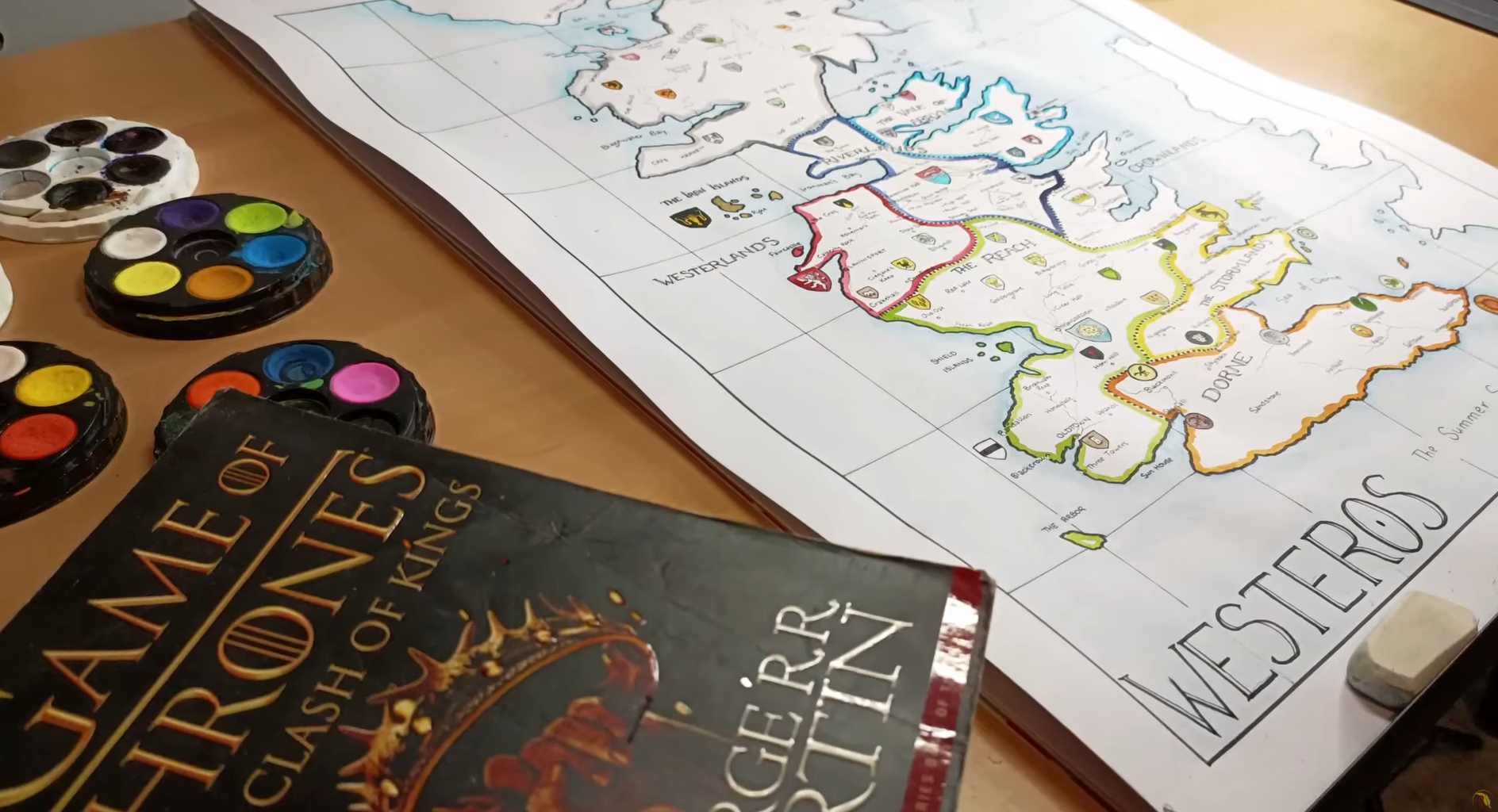
In this episode, we’re looking at how maps serve as living documents that shape and reflect the cultures they depict. Our case study? Westeros from A Song of Ice and Fire, a land shaped by geography, noble houses, and endless political maneuvering. We'll break down how different terrains define cultural identities, how trade routes influence economic power, and why political maps are some of the most useful tools in a fantasy writer’s arsenal. And while we talk, we’ll be illustrating a detailed, weathered political map of Westeros using fineliner pens, watercolor, and ink—complete with house crests, colored borders, and carefully aged textures.
Want to watch this episode, rather than simply reading it? Check out the full video: How to Map Cultures and Politics
You can also download the map of Westeros for free on the Red Quills Patreon, or join the Red Quills Discord channel to talk about your own projects. For more mapmaking tutorials, our Journal is chock-full!
By the end of this episode, you’ll have a solid grasp of how to create maps that tell a deeper story—not just about where things are, but why they matter.

Political maps have been an essential part of human civilization for centuries, from medieval Europe to the sprawling empires of Asia. These maps weren’t just navigational tools—they were records of power, history, and identity.
One of the most famous medieval maps is the Mappa Mundi (circa 1300), housed in Hereford Cathedral. Unlike modern political maps, it blended geography with theology, emphasizing sacred sites and dominions rather than strict territorial borders. Its structure reflected the medieval worldview, where divine order took precedence over precise geography.
Jumping forward, we have the Carta Marina (1539) by Olaus Magnus, one of the earliest detailed maps of Scandinavia. Unlike earlier maps that focused purely on political boundaries, the Carta Marina included cultural details—depictions of trade, sea monsters, and settlements—that showcased how people interacted with their environment.
For something closer to Westeros, we can look at 17th-century European maps, like Joan Blaeu’s Atlas Maior (1665), which detailed the noble houses and territories of Europe with elaborate coats of arms and intricate border designs. These maps weren’t just for navigation; they were statements of power, displaying alliances and rivalries in ink and parchment.
As we build our own fantasy political map, we’ll take inspiration from these historical examples—using color, heraldry, and topography to craft something that looks like it belongs in the grand halls of a medieval war council.

Now, let’s break down the process of drawing a political map that breathes life into your fantasy world.
Step 1: Sketching the Borders Start with rough territorial divisions. These should follow natural landmarks—rivers make great borders, as do mountain ranges and coastlines. But don’t make them too clean; history is messy, and so are borders. Keep an eye on choke points, trade routes, and contested regions.
Step 2: Adding Heraldry and Cultural Icons Medieval political maps often featured noble crests, city seals, and even illustrations of landmarks. In our map of Westeros, we’ll include house sigils—direwolves for the North, lions for the Westerlands, and dragons for King’s Landing. This gives each region a distinct identity, reinforcing its political and cultural history.
Step 3: Labeling with Purpose Not all names are equal. A fortified city might have an elaborate, flourishing script, while a smaller village has something simpler. Use different styles for different types of settlements. If a region has changed hands often, consider a mix of languages or old, faded names in the margins.
Step 4: Coloring the Map Medieval maps often used color to differentiate political zones. You’ll want distinct hues for each major kingdom or territory. But avoid making it too modern—stick to earthy tones, using washes of ink or watercolor to give a hand-painted feel.
Step 5: Aging the Map For that authentic, weathered look, we’ll stain the edges with tea or ink washes. Small imperfections—like faded areas or ink smudges—make the map feel like an artifact with a history of its own.

The chamber is dimly lit, the flickering candlelight playing off the golden ink of the map spread across the war table. Lords and commanders lean over the parchment, eyes tracing the jagged lines of borders, each line a reflection of treaties forged and oaths broken. The North, vast and cold, holds the wild and unpredictable, while the Reach, fertile and green, hums with the promise of supplies and reinforcements. The Westerlands, rich with gold, are both a prize and a curse—stronghold of power but a beacon for the greedy.
The ruler’s hand hovers over the Riverlands. This territory, carved by the rivers that give it its name, has changed allegiances more than any other, a reminder that maps are not only a guide to the present but a record of history’s shifting tides. They will make their move soon—but first, they must read between the lines inked onto the page.

And that, adventurers, is how you create a political map that does more than just show borders—it tells a story. We’ve looked at historical examples, broken down the process step by step, and explored how maps serve as a crucial tool in worldbuilding. Whether you’re creating maps for a novel, a campaign, or just for fun, remember: every line you draw is a piece of history waiting to unfold.
If you enjoyed this video, don’t forget to check out the rest of this series, where we tackle different styles of fantasy maps, from regional landscapes to intricate dungeon layouts. And if you want to download today’s map or get involved in our growing community, head over to the Red Quills Patreon or join us on Discord.
Until next time—keep exploring, keep creating, and may your maps always lead to adventure!