
I Used 13th Century Tech To Forge A Fantasy Map
What if the secret to making a fantasy map that feels real - a map that feels like it has a pulse, that breathes history - was hiding in a largely forgotten 13th-century technology? This was a tech used by actual sailors, merchants, and yeah, probably pirates, to get around the sketchy waters of the medieval world. It’s a technique that’s been almost completely sidelined, an art of mapmaking that feels a lot more like alchemy than science.
Want to download this sick piece of mappery? Of course you can. It's available for free on the Red Quills Patreon.
Or just watch the full video tutorial on our YouTube channel.
Hello, adventurers, and welcome back to the Red Quills.
This series, we’re making maps for different genres of TTRPG, and today, I’m going back to a pirate map.
Now, I say “going back”, because this isn’t the first time that I’ve done a pirate map. I made a video on what I would keep in mind about making a pirate map, on the history of pirate maps, and how they didn’t really exist, at about six months into starting this channel. And that video… kinda flopped, honestly. And that’s fair - no one really wants to be told that pirate maps don’t really exist.
But it’s a pretty significant part of the genre of maps, so I wanted to revisit it, particularly with what I’ve learned about not just the making of maps, but the history of maps.
I got obsessed with the idea that old-school methods were the key to making my own worlds feel more grounded. So, I decided to try and bring them back. I went down a deep rabbit hole of historical cartography to forge a map for my Dungeons & Dragons campaign, the Goldhunter Seas. And I did it using only the techniques a mapmaker in the 1300s would have had: hand-drawn compass roses, a spiderweb of rhumb lines, and specially prepared, vellum-style parchment. This isn't just about drawing a map. It's about reviving an old-world technology to bring a fantasy world to life.

The Problem & The Quest
Let’s be real. Most fantasy maps, as cool as they can be, feel a little… generic. We've all seen them: the jagged, fractal coastlines that look like they were spit out by a computer, the perfectly cone-shaped volcanoes, the copy-pasted tree symbols for a forest. They look awesome, but they don’t feel functional. Those maps don't feel like they were made by someone living in that world for an actual reason. They feel like they were made for us, the reader, looking down from on high.
This became a huge problem for me when I was prepping my new D&D campaign, the Goldhunter Seas. As you can guess from the name, it’s a world of high-seas adventure, swashbuckling pirates, and salty merchants sailing to faraway lands. In a world like that, a map isn't just pretty art. It’s a tool. It's a vital piece of gear, as important as a compass or a good sword. A ship’s captain would literally live or die by how good their charts were. My players needed a map that felt like it had been clutched in a pirate's fist, stained with sea salt, and studied by candlelight in a rocking ship's cabin.
I wanted to give them more than just a printout.
I wanted to give them an artifact. A prop that felt like it was pulled right out of the world we were about to explore. And that's what kicked this whole project off. I didn’t just want to draw a map of the Goldhunter Seas; I wanted to forge one. And so I had to find a historical method that would force me to think like an in-world mapmaker. I had to get away from the usual fantasy tropes and find a process that had weight, history, and a real logic behind it. My quest was to create a map that didn't just show a world, but proved it existed.

The Research - Unearthing an Old Art
My journey didn't start with a pen, but with a search. I was hunting for how real sailors found their way around before GPS, before satellites, and even before the map projections we all take for granted today. And that’s when I found them: Portolan Charts.I’ve actually talked about them before.
These charts are a bit of a historical mystery. They just sort of showed up in the Mediterranean around the late 13th century and were, for their time, shockingly accurate. If you compare them to the more religious, abstract maps of the era, which often had Jerusalem at the center of the world and were more about theology than geography, portolan charts were pure function. They were so good, in fact, that some historians think their construction was way ahead of its time, which has led to some cool theories that they were actually copies of much older maps that are now lost.
So what makes a portolan chart so special?
It really comes down to a few things. First, and most importantly, they have incredibly realistic coastlines. That was their entire job. They were for navigating, so the shape of the coast, the bays, the harbors - all of it was drawn with incredible care. This focus was so intense that the inside of the continents was often just left blank. To a sailor, what was happening a mile inland didn't matter; the coast was everything.
The second, and most striking feature, is the web of lines that covers the whole map.
These aren't latitude and longitude. They’re called rhumb lines, and they shoot out from different compass roses hidden on the chart. A compass rose would have 16 or 32 points, and a line was drawn from each point, stretching across the entire map. A sailor could use these lines to set a course. To get from one port to another, they’d find the rhumb line that was the closest match, point their compass that way, and just keep sailing. It was a brilliant, elegant system for crossing big bodies of water like the Mediterranean.
These charts were drawn on vellum, a high-quality parchment made from animal skin that was tough enough for life at sea. They used colored inks, often marking major ports in red and minor ones in black - a rule I knew I had to follow. They would also mark hazards like reefs with little clusters of dots.
Looking at these historical artifacts, from the famous Catalan Atlas to maps made in Genoa and Venice, I felt like I was learning this incredible, old-school system. This wasn't just a style; it was a complete technology for seeing the world. It was logical, beautiful, and soaked in the history of exploration. This was it. This was the tech I was going to use to forge the Goldhunter Seas. My quest finally had a path. Now I just had to do it.

The Process
With all that research done, it was time to stop reading and start making. This wasn't just a quick sketch. It was a whole construction project, carefully layering different techniques to build not just a picture, but an object that felt like it had a past.
Stage 1: Preparing the Parchment
First things first, I couldn't use bright, clean printer paper. The map needed to feel old, like a survivor. I crumpled it and roughed it up a little before staining it, so that the varying density of the paper would take the stain differently.
So, to get a convincing stand-in for vellum, I took a big sheet of heavy artist’s paper and took a cue from one of the comments on my more recent videos. Usually I use black tea (or earl grey, for preference), but this comment claimed that soy sauce worked wonders. So I gave it a go. I painted the paper in soy sauce and, because I have limited time to make maps, baked it at 100*C for five minutes.
Soy sauce worked pretty well, but it did have a little bit of a funky smell. That could be because I dried it with heat rather than time, but still. Earl grey does smell nicer. But it worked.
Before I'd even drawn a single line, the canvas for my world already had a story.
Stage 2: Sketching the World
With my "parchment" ready, I started with a super light pencil sketch. This was where I got to just build the world. I mapped out the major landmasses of the Goldhunter Seas: the big continental coasts, the islands of Fir-na-Bolg, the teeth of Illig’s Trap. I wasn't stressing about tiny details yet. This was about getting the big shapes right and making sure the geography made sense for a world of sailors. I thought about things like prevailing winds, natural harbors, and where to stick islands to serve as pirate lookouts or naval chokepoints.
Stage 3: Defining the Coastlines
To really capture that portolan style, I had to obsess over the coasts. I mixed up some brown and sepia watercolors for an earthy, organic look. Using a fine brush, I painted the coastlines right over my pencil sketches. This part is key. The watercolor naturally bleeds into the textured paper, creating a soft, slightly fuzzy edge that looks way more natural than a hard ink line. The little variations in color gave the coasts a sense of depth, like they'd been shaped by wind and water for thousands of years.
Stage 4: The Heart of the Chart
This was the scariest, but most important, part of the whole thing. The rhumb line network is what makes a portolan chart a portolan chart. I started by designing a few compass roses, placing one in the middle of the biggest open sea and a couple more in other key spots.
Then, the really careful work began. From the center of my main compass rose, I used a long ruler and a fine-tipped pen to draw 32 straight lines radiating out to the edges of the map. This is the main grid. Then I did the same thing for the other compass roses. The result was this dense, spiderweb-like network covering everything. It took forever and required a ton of focus to keep the lines straight. But as the web took shape, the map transformed. It stopped looking like a drawing and started looking like a scientific instrument. It looked functional.
Stage 5: Inking the Details
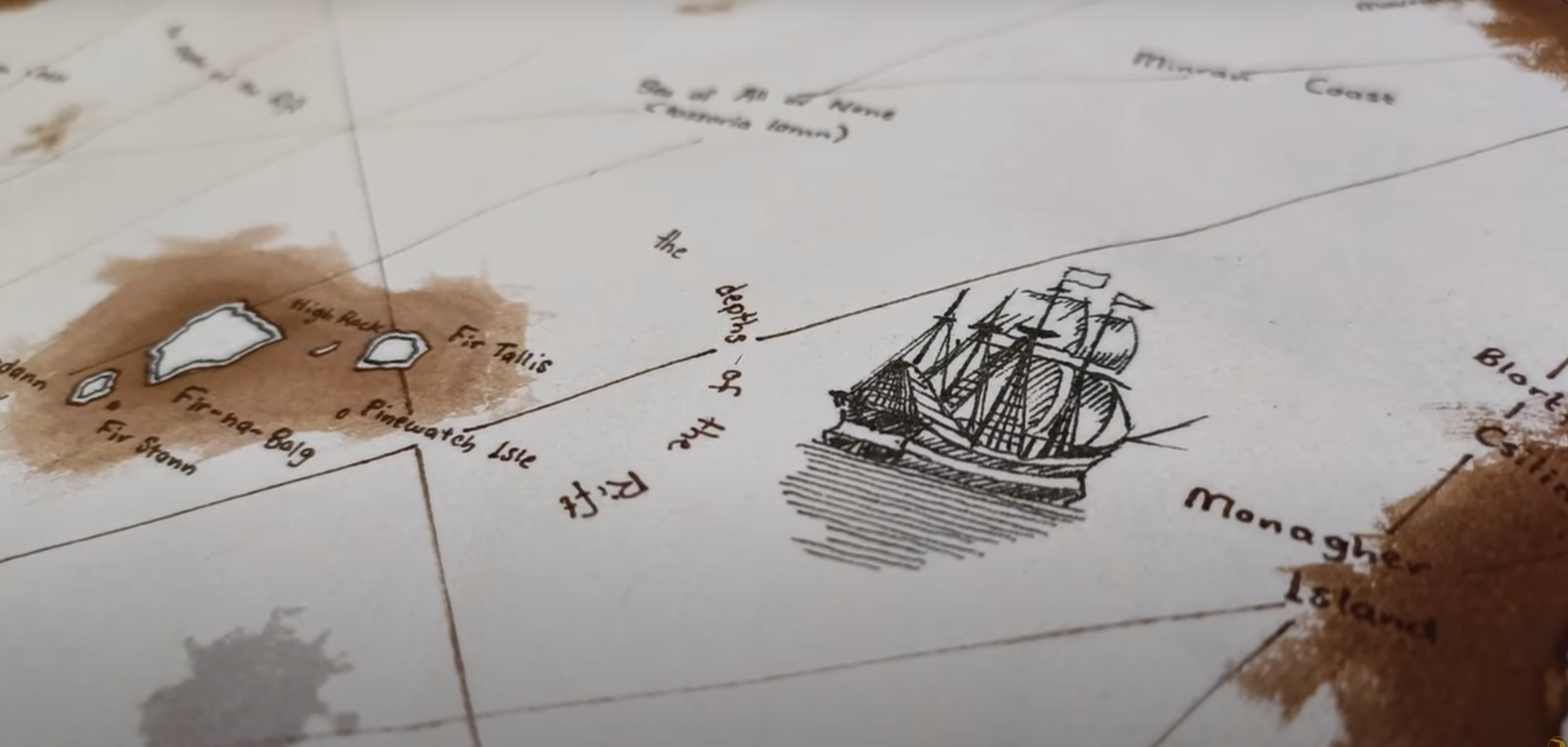
With the skeleton in place, it was time to add the life. I stuck to the historical color rules I'd learned about. With black ink and a dipping pen, I started labeling hundreds of smaller features: minor ports, settlements, and kingdom labels. With brown ink, I labelled the coasts, the bays and coves, the islands and coral reefs. The nautical labels branch perpendicular to the coast out to sea, and the land-based labels head inland. It's a weird little detail that makes the map feel crowded and alive, like every inch of coast has been claimed and named by sailors.
Stage 6: Adding the Illustrations
This is where I started to blend history with fantasy. In the big empty parts of the ocean, I added little illustrations in a medieval style. Ships and symbols on the compass rose, to make it feel alive. It’s a simple addition, but boy does it work.
Stage 7: The Final Touches
The map was drawn, but it wasn't done. It needed to feel like it had survived a tough life. A simple crumple and a few drops of red wine, as well as a pretty committed stain from a wine goblet make it feel as though it had been used. I deliberately stopped myself from finding a knife and a chopping board and stabbing the significant places with a blade for emphasis.

__________________________________________________________________________
And so, after countless hours of research, staining, crumpling, drawing, inking, and a decent amount of swearing... it was finally done. Holding it in my hands, it felt less like something I had made and more like something I had found. It felt heavy, with a history that was both real and made-up.
This is the Chart of the Goldhunter Seas.

Let's take a closer look. You can see how that web of rhumb lines gives the whole thing this incredible structure. They aren't just for decoration; they give the map a sense of mathematical seriousness, like it's a real tool for navigation. And here, the great port city of Rudha, in bold black ink, just like Venice or Genoa would've been on a 14th-century chart. Every single one of these names, written perpendicular to the coast, was done by hand, each one a tiny piece of the world being willed into existence.
This thing is more than just a guide to a fantasy world.
It’s a key. The process of making it, of sticking to these ancient rules, forced me to think about my world differently. I had to consider how a sailor would see it, what they would care about, what they would fear, and what they would look for. Bringing this 13th-century tech back to life didn't just help me draw a map; it helped me build the world itself.

___________________________________________________________________________
So, that’s the journey.
That’s how you can take a set of techniques, mostly ignored for over 500 years, and use them to breathe an incredible amount of life and history into a fantasy world. The process taught me that "realism" isn't about making things look like a photograph. It’s about logic, purpose, and story. A map feels real when it looks like it was made by someone in that world, for a reason. Portolan charts were the peak of navigational tech for centuries, and that built-in purpose is a powerful tool for any worldbuilder.
If you’ve ever felt like your fantasy maps were missing that spark, that sense of history, I seriously challenge you to give this a try. You don’t have to be a professional artist. You just need patience and a willingness to play with the past. I would love to hear about what you make. Let me know in the comments what you think. What other old-school techniques, from mapmaking or anywhere else, do you think we could bring back to make cool stuff for our fantasy worlds?
And of course, this map isn't destined to just hang on a wall. It’s about to be put into the hands of my players. If you want to see their reactions when they unroll this thing for the first time, and if you want to follow their adventures as they sail into the Goldhunter Seas, make sure to subscribe and hit that notification bell. You won’t want to miss what happens next. Thanks for joining me on this adventure into the past. Now, let’s see where it takes us.