
Why Your Map is Boring (And How to Fix It!)
This post is the written version of the video tutorial available to watch now on the Red Quills YouTube channel.
Let me guess. You’ve drawn your map. It has mountains. It has rivers. Maybe a kingdom with a name like Faldermere or Thayrethorne or something else vaguely Tolkien-y. You unroll it for your players. They look at it. They nod. Maybe they say something polite like, "Cool." And then, five minutes later, they forget it exists.
Oof.
Look, I’ve been there. You’ve put in the effort. The contour lines are smooth. The forests are shaded. The kingdom borders are logical. Technically, you’ve done everything right. But here’s the honest truth: Most D&D maps are fine. They’re functional. Clean. Playable.
But they’re also completely forgettable. They’re boring.
And it’s not your fault. Because if you’re anything like I was when I started, you’ve been told to focus on geography, not storytelling. To learn elevation lines, not narrative lines. To make your world feel real, not feel alive.
So today, I want to walk you through why that happens - and exactly how to fix it. We’re going to talk about emotional weight, narrative design, and even do a side-by-side of two maps: one boring, one better.
You can watch the full video tutorial here: Why Your Map is Boring (And How to Fix It!)
Or read more on the Red Quills Journal.
Let’s begin where most of us do: with a map that looks like a map, and nothing else.
What Makes a Map Boring?
Here’s the first myth I want to bust: Boring doesn’t mean ugly. It means empty. You can make a gorgeous, hyper-detailed, color-coded masterpiece that still feels like a setting generated by a fantasy name generator. So what actually makes a map boring?
Let me put it plainly. Boring maps are:
- Geographically correct - but emotionally flat
- Full of names - but lacking reasons to care
- Generic - the kind of world you’ve seen a dozen times on a thousand tables
That might sound harsh, but hear me out.
A boring map has regions. Names. Borders. Maybe even weather patterns. But when your players look at it, there’s no spark. No curiosity. No dread. No wonder. They see geography, but not story.
And that’s the real issue. Because your map shouldn’t just show terrain. It should be a portal into your world. Most D&D maps? They’re not portals. They’re signposts. Labels on land.

Why It Happens
Okay, so why do we end up making these lifeless little landscapes? Why do smart, creative DMs like you and me fall into the trap of building worlds no one wants to explore?
Three big reasons:
- We Think Like Cartographers, Not Storytellers. We sit down to “build a world.” So we start with the landmass. Add rivers. Plot cities near water. It’s all very logical. It’s what real cartographers do.
But you’re not running a campaign in the real world. You’re telling a story. A weird story. A dramatic story. A story full of magic and secrets and betrayal and ancient horrors.
Your map should reflect that. But most of us get stuck drawing like we’re designing a textbook, not an adventure.
- We Build the World First, and Add the Adventure Later. You know the advice: "Build your world from the top down."
Wrong. Or at least, incomplete.
Because if you build your map in a vacuum - before you know who your players are or what they care about - you’re designing for no one. You’re creating set dressing instead of stagecraft.
That doesn’t mean don’t have fun making continents. But don’t stop there. Think about the conflicts, not just the coastlines.
- We Copy Real-World Geography Too Literally. You’ve probably read about tectonic plates. Maybe studied river delta patterns or trade winds.
All good stuff. But real-world geography works because it’s full of story. Every bend of a river affected a war. Every mountain pass became a battleground. Real maps have history baked in. If you copy the realism - but none of the conflict - you get a map that looks right and feels wrong. And here’s the kicker:
Fantasy maps shouldn’t follow the rules of realism. They should follow the rules of play.

How to Fix It
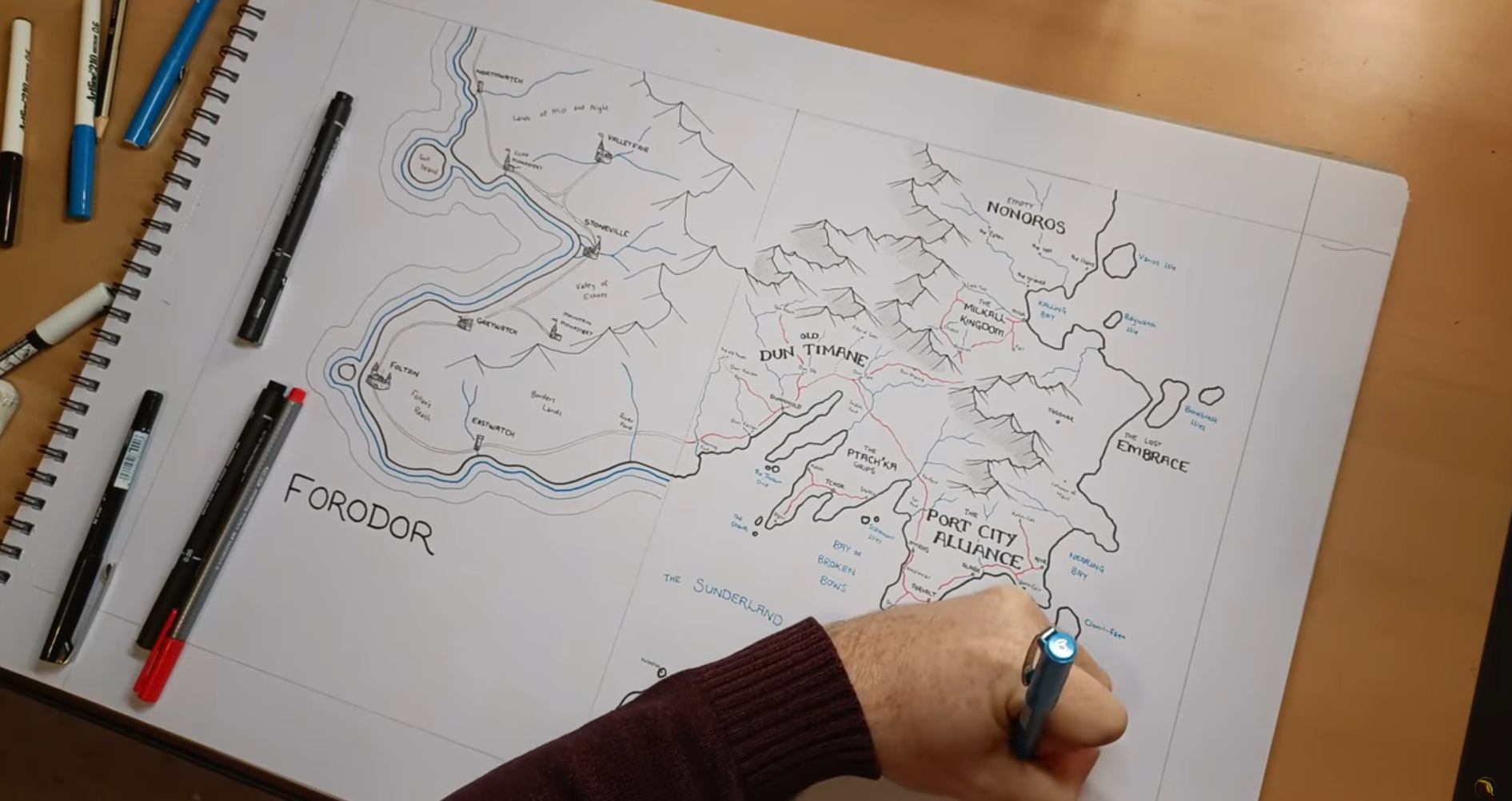
Let me show you how to turn your map from functional to fascinating. We’ll do this step-by-step. In fact, I’m going to draw two maps as we go: the boring version we’ve already seen, and a new one that applies each of these fixes.
By the end, you’ll see the transformation. But more importantly, you’ll know how to apply this to your own maps - starting today.
Here are five ways to fix your map:
Fix 1: Add Story Hooks to the Terrain
This is the biggest change you can make for the least effort.
Stop labeling your map like a textbook. Start labeling it like a legend.
Instead of: "Ruins" Try: "The Singing Stones – Haunted by the Last Queen"
That second one isn’t a quest. It’s a question. Who was the Last Queen? Why does she haunt the stones? What song do they sing?
You’ve just given your players a mystery without a monologue. A reason to point to the map and say, “What’s that place?”
Fix 2: Break the Symmetry
Real-world continents are messy. Your fantasy map can be even messier. But so many D&D maps are symmetrical. Balanced. Predictable. One ocean on each side. A mountain range down the middle. It looks like a 3rd grade diorama of Pangaea. No wonder your players’ eyes glaze over.
So break it.
- Add a massive inland sea.
- Split the continent into shards.
- Float a mountain range in the air.
- Put a crater where the gods fell.
Give your world one impossible, unforgettable feature.
Fix 3: Focus on Conflict Zones
This one’s easy: players are drawn to drama.
So show it on the map.
- A cursed forest pressing into farmland
- A city split by a river - and a civil war
- A no-man’s-land between rival empires
Mark the tension. Draw the frontlines. Sketch the scars.
Conflict zones are where quests happen, stories start, and player interest spikes.
Fix 4: Highlight Player-Relevant Details
This is where your map stops being generic and starts being theirs.
If your players are monster hunters, mark the monster nests. If they’re smugglers, chart the secret routes. If they’re knights of a fallen order, show the shattered keeps.
Add:
- Hidden caves
- Sacred groves
- Ley lines
- Forgotten bridges
- Floating isles
Make the map about them.
Don’t just draw the world. Draw the adventure.
Fix 5: Use Map Design to Reinforce Tone
A horror map should feel cursed. A divine realm should feel surreal. A feywild region should be downright uncanny.
Use every visual tool you have:
- Symbols
- Lettering styles
- Border designs
- Color palettes
- Negative space
A city of angels might be drawn in golden ink with perfect circles. A demonic wasteland might crack and sprawl across the page. Let your map sing the same note as your campaign.

Before & After
Let’s take a step back:
On the left, we have our original map. Logical. Symmetrical. Safe.
On the right, the new version - where every choice hints at story.
You can see the difference. Instead of “Ancient Forest,” we have: "The Everwound – Where the Trees Still Bleed." Instead of “Volcano,” we have: "Glassfire Crater – Birthplace of the Last Flame." Instead of “Capital City,” we have: "The City with No Doors." That last one isn’t just cool - it invites questions. And questions are what get your players invested.
This second map isn’t just a piece of paper. It’s a promise. It’s a map that says, “There’s something here worth discovering.” And that, more than artistic skill or geographical realism, is what makes a D&D map great.
If your map feels a little empty - don’t redraw the rivers. Redraw the story.
Here’s your checklist:
- Add story hooks to your labels
- Break the symmetry and add one impossible feature
- Show conflict zones and shifting power
- Add player-relevant locations and secrets
- Use your visual design to set the tone
Remember: your map is your first piece of worldbuilding art. Let it do more than tell players where to go.
Let it make them want to go there.

Your Creative Prompt
Take your current campaign map. Pick one region. Rename three locations using story hooks. Then draw (or imagine) one feature that shouldn’t exist.
Try it. Just one region. Just a few labels. And see how much more alive your world feels.
If you’re feeling brave, share what you come up with. I’d love to see what strange and wonderful names you invent.