
Making a Modular Gridmap
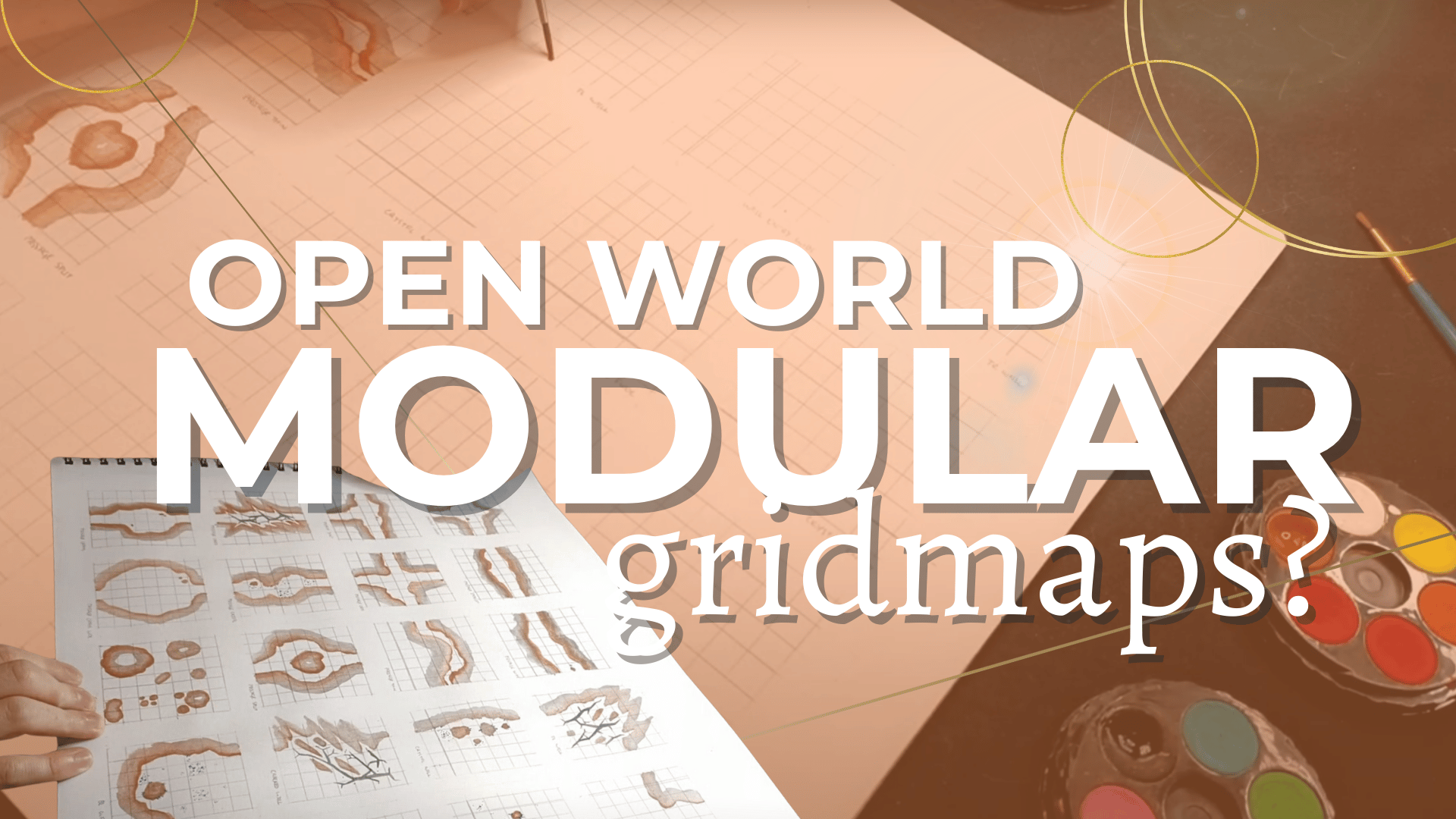
Our journey begins in a vast and rugged landscape—a war-torn expanse on the Elemental Plane of Earth, where ancient battles between Earth Elementals and Fire Elementals have left the terrain scarred and volatile. Imagine your players stepping into this environment, the air heavy with the remnants of elemental magic, and the ground beneath their feet shifting and cracking with each step. This is the kind of open-world map that demands attention to detail and careful design to ensure it feels alive, interconnected, and, most importantly, full of possibilities.
________________________________________________________________________
If you want to watch the full YouTube tutorial for this topic, you can find it here: Making a Modular Gridmap
All of the downloadables for this series are available on the Red Quills Patreon.
And if you want to read the other entries on this topic, you can find them here: The Red Quills Journal
_______________________________________________________________________
In this episode, we’ll venture into the expansive and intricate world of open-world gridmaps. We’ll examine the unique challenges that come with designing such maps, particularly when it comes to balancing player freedom with guided narrative progression. This episode will focus on the Elemental Plane of Earth, using an old war zone between the Earth Elementals and Fire Elementals as our canvas. We’ll delve into how to generate dynamic encounters, integrate worldbuilding clues, and maintain a balance between smaller skirmishes and larger, more climactic battles. Whether your players are seasoned adventurers or new to the game, the techniques discussed here will help you craft an open-world experience that is both immersive and engaging.
In this episode, we’ll discuss the intricacies of open-world map design. Open-world maps provide a unique opportunity to create a sandbox environment where players can explore at their own pace, uncover hidden secrets, and face a variety of challenges. However, the freedom that open-world maps offer can also present challenges to the DM. How do you maintain narrative momentum without restricting player freedom? How can you ensure the world feels consistent and alive, rather than just a collection of random encounters? And how do you create a map that balances exploration with the need for dynamic and engaging combat scenarios?
We’ll explore these questions and more as we delve into the theoretical and practical aspects of open-world gridmap design. By the end of this episode, you’ll have a comprehensive toolkit for creating an open-world environment that is both expansive and richly detailed, capable of supporting an entire campaign or a single memorable session.

Designing an Open World
Designing an open-world map is like walking a tightrope—you need to strike a balance between giving players the freedom to explore and ensuring there’s enough structure to guide them through the narrative. Let’s start by discussing some key principles that can help you achieve this balance.
1. Freedom vs. Structure: The beauty of an open-world map lies in its sense of freedom. Players can go where they want, when they want, and discover the world at their own pace. However, too much freedom can lead to a lack of direction, causing players to feel lost or overwhelmed. To prevent this, it’s essential to create a framework within your open-world map that subtly guides players without them feeling railroaded. This can be achieved by using natural barriers, such as mountains or rivers, or by placing key landmarks that draw players’ attention and subtly steer them toward important locations.
2. Consistent Worldbuilding: An open-world map needs to feel cohesive. This means that the rules governing the world—whether they relate to the laws of physics, magic, or social dynamics—must be consistent throughout. For example, in the Elemental Plane of Earth, you might establish that certain areas are prone to sudden earthquakes or that certain types of magic are more potent in this environment. By maintaining consistency in how these rules apply across the map, you ensure that the world feels believable and immersive.
3. Environmental Storytelling: Environmental storytelling is a powerful tool in open-world design. It allows you to convey the history, culture, and current state of the world without needing to rely solely on exposition. In the Cursed Battlefield, for instance, you might scatter the remains of ancient weapons, charred earth where firestorms once raged, or the petrified remains of Earth Elementals. These visual cues not only add depth to the world but also give players clues about what to expect as they explore further. This method of storytelling invites players to piece together the history of the battlefield on their own, making their discoveries feel more personal and impactful.
By keeping these principles in mind, you can create an open-world map that feels expansive yet cohesive, full of opportunities for exploration while still guiding players through a meaningful narrative journey.

Creating the Open-World Map
Now that we’ve covered the theoretical aspects, let’s get into the nuts and bolts of creating an open-world gridmap. We’ll start with the basic layout and then move on to populating the map with points of interest, clues, and encounters that will keep your players engaged.
1. Varied Terrain and Points of Interest: A well-designed open-world map should feature a variety of terrains and landmarks that make each area feel distinct. In the Cursed Battlefield, for example, you might include jagged rock formations, expansive chasms, and the remnants of elemental fortresses. These features not only add visual interest but also serve as natural waypoints that help players navigate the map. To begin, sketch out the overall layout of your map, ensuring that there’s a good mix of open spaces, dense areas, and natural barriers. Then, start adding points of interest—these could be anything from ancient ruins to mysterious caves, each offering potential for exploration and discovery.
2. Placing Clues and Landmarks: To guide player exploration without overtly directing them, use landmarks and environmental clues. For instance, you could place a series of broken statues leading toward a hidden temple or create a path of scorched earth that hints at a recent battle between the Elementals. These visual clues should be subtle enough that players feel they’re discovering the world on their own but clear enough to provide direction. Additionally, consider placing smaller encounters near these landmarks—such as a group of scavenging creatures or a collapsed tunnel that must be navigated—so that players feel rewarded for their curiosity.
3. Scaling Encounters: One of the challenges in designing an open-world map is ensuring that encounters feel appropriately challenging, regardless of where the players choose to go. To achieve this, design encounters that can scale in difficulty based on the players’ level and actions. For example, in the Elemental Plane of Earth, you might create a group of Earth Elementals that can either be encountered individually or as a larger, more formidable unit. Additionally, consider using environmental factors—such as unstable ground or erupting geysers—to add an extra layer of challenge to these encounters. By varying the difficulty and nature of encounters, you can keep the gameplay fresh and unpredictable, encouraging players to think strategically about how they approach each situation.
With these practical tips in hand, you’re well on your way to creating an open-world map that is both visually compelling and rich in gameplay possibilities.

Denizens of the Elemental Plane of Earth
A crucial aspect of any open-world map is the creatures and NPCs that inhabit it. In the Elemental Plane of Earth, the denizens are as varied and dangerous as the terrain itself. Let’s explore how to design these encounters in a way that ties into the larger narrative and keeps players on their toes.
1. Earth Elementals and Their Variants: Earth Elementals are a natural fit for the Elemental Plane of Earth, but to keep encounters interesting, it’s important to introduce variations. For instance, you could create smaller, faster Earth Elementals that swarm players in large numbers, or massive, slow-moving behemoths that can cause earthquakes with their steps. Each variant should present a unique challenge, requiring players to adapt their tactics depending on the type of Elemental they encounter.
2. Hit-and-Run Tactics and Ambushes: Given the rugged terrain of the Cursed Battlefield, the denizens of this world are likely to use the environment to their advantage. Consider designing encounters where Earth Elementals use hit-and-run tactics, emerging from the ground to strike before disappearing back into the earth. Alternatively, they could set up ambushes in narrow canyons or under unstable ground, forcing players to stay alert and think on their feet. These tactics not only make the encounters more dynamic but also reinforce the idea that the environment itself is a weapon.
3. Integrating Elementals into the Narrative: While Earth Elementals can certainly serve as formidable foes, they can also play a larger role in the narrative. Perhaps some of the Elementals are guardians of ancient secrets or relics from the war, and defeating them—or gaining their trust—could provide players with valuable information or tools. Alternatively, the Elementals might be remnants of the war itself, cursed to roam the battlefield until the conflict is truly resolved. By giving these creatures a deeper connection to the story, you make them more than just random enemies—they become integral parts of the world and its history.
With these ideas in mind, you can populate your open-world map with encounters that are not only challenging but also rich in narrative significance, adding depth to both the gameplay and the story.

The Cursed Battlefield
To bring everything we’ve discussed into focus, let’s take a closer look at the Cursed Battlefield, the open-world map we’ve been using as our example. This case study will illustrate how to tie all the elements together into a cohesive and engaging experience for your players.
1. Integrating the Battlefield into the Quest: The Cursed Battlefield isn’t just a location—it’s a key part of the players’ quest to uncover the secrets of the ancient war between the Earth and Fire Elementals. Perhaps they’ve been sent here to retrieve a powerful artifact, or to find the last known location of a legendary hero who fought in the war. The battlefield is littered with clues that can help them piece together the history of the conflict and the nature of the artifact they seek. As they explore, they might discover ancient journals, shattered weapons, or even the petrified remains of Elementals, each providing hints that guide them toward their goal.
2. Dynamic Encounters in the Battlefield: One of the standout features of the Cursed Battlefield is the potential for dynamic, evolving encounters. For example, players might initially face a group of Earth Elementals defending a crumbling fortress. As the battle progresses, the ground could begin to shake, causing the fortress walls to collapse and creating new hazards or opportunities for both the players and their enemies. Alternatively, a sudden eruption of magma could force players to rethink their strategy, turning what was a straightforward fight into a desperate scramble for survival. These kinds of encounters keep the gameplay fresh and unpredictable, ensuring that players remain engaged throughout their exploration of the battlefield.
3. Balancing Exploration and Narrative Progression: One of the biggest challenges in an open-world setting is keeping players on track without making them feel railroaded. In the Cursed Battlefield, you can achieve this by designing encounters and clues that naturally lead players from one location to the next. For example, after discovering a set of ancient runes that hint at the location of a hidden vault, the players might encounter a group of Earth Elementals that seem to be guarding the area. Defeating or bypassing these Elementals could reveal a hidden path leading deeper into the battlefield, where the players can uncover the vault and its secrets. By pacing the encounters and clues in this way, you ensure that the narrative progresses smoothly without sacrificing the open-world feel.
Through this case study, you can see how all the elements we’ve discussed come together to create a rich, engaging open-world experience. The Cursed Battlefield serves as both a playground for exploration and a key component of the larger narrative, offering players the freedom to explore while still guiding them toward a satisfying conclusion.

As we conclude this episode, let’s recap the key principles of open-world gridmap design. We’ve explored how to balance freedom with structure, the importance of consistent worldbuilding, and the power of environmental storytelling. We’ve also delved into the practical aspects of map creation, from varied terrain and points of interest to scalable encounters and dynamic enemies. Finally, through our case study of the Cursed Battlefield, we’ve seen how all these elements can come together to create a compelling open-world experience that is both immersive and narratively rich.
Open-world maps offer endless possibilities for creativity and exploration, making them a fantastic tool for any DM looking to create a campaign or a memorable single session. By applying the techniques discussed in this episode, you’ll be well-equipped to design open-world environments that captivate your players and bring your world to life.
And don’t forget—our next episode will focus on crafting the ultimate megacreature encounter, where we’ll discuss how to design and balance truly epic battles that serve as the climax to your players’ adventures. Until then, keep exploring, keep creating, and as always, happy mapping!